Cardoso Sandra M, Empadinhas Nuno
Center for Neuroscience and Cell Biology, University of Coimbra, Coimbra, Portugal.
Institute of Cellular and Molecular Biology, Faculty of Medicine, University of Coimbra, Coimbra, Portugal.
Front Physiol. 2018 May 9;9:471. doi: 10.3389/fphys.2018.00471. eCollection 2018.
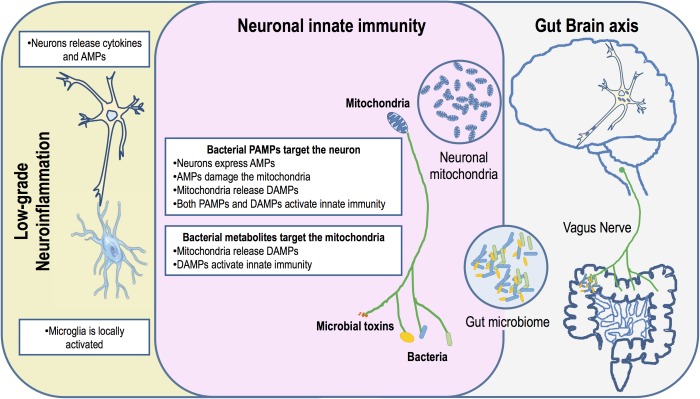
The brain is an immunologically active organ where neurons and glia cells orchestrate complex innate immune responses against infections and injuries. Neuronal responses involve Toll-like or Nod-like receptors and the secretion of antimicrobial peptides and cytokines. The endosymbiotic theory for the evolutionary origin of mitochondria from primitive bacteria, suggests that they may have also retained the capacity to activate neuronal innate immunity. In fact, it was shown that mitochondrial damage-associated molecular patterns could signal and activate innate immunity and inflammation. Moreover, the mitochondrial cascade hypothesis for sporadic Parkinson's disease (PD) argues that altered mitochondrial metabolism and function can drive neurodegeneration. Additionally, a neuroinflammatory signature with increased levels of pro-inflammatory mediators in PD affected brain areas was recently detected. Herein, we propose that a cascade of events initiating in a dysbiotic gut microbiome drive the production of toxins or antibiotics that target and damage mitochondria. This in turn activates neuronal innate immunity and triggers sterile inflammation phenomena that culminate in the neurodegenerative processes observed in the enteric and in the central nervous systems and that ultimately lead to Parkinson's disease.
大脑是一个具有免疫活性的器官,其中神经元和神经胶质细胞协调针对感染和损伤的复杂先天性免疫反应。神经元反应涉及Toll样或Nod样受体以及抗菌肽和细胞因子的分泌。线粒体起源于原始细菌的内共生理论表明,它们可能也保留了激活神经元先天性免疫的能力。事实上,研究表明线粒体损伤相关分子模式可以发出信号并激活先天性免疫和炎症。此外,散发性帕金森病(PD)的线粒体级联假说是指线粒体代谢和功能的改变会驱动神经退行性变。此外,最近在PD受累脑区检测到促炎介质水平升高的神经炎症特征。在此,我们提出,始于肠道微生物群失调的一系列事件会驱动毒素或抗生素的产生,这些毒素或抗生素会靶向并损害线粒体。这反过来又激活神经元先天性免疫并引发无菌性炎症现象,最终导致在肠道和中枢神经系统中观察到的神经退行性过程,并最终导致帕金森病。