Eguiraun Harkaitz, Casquero Oskar, Sørensen Asgeir J, Martinez Iciar
Department of Graphic Design & Engineering Projects, Faculty of Engineering in Bilbao, University of the Basque Country UPV/EHU, Bilbao, Spain.
Research Centre for Experimental Marine Biology and Biotechnology - Plentziako Itsas Estazioa, University of the Basque Country UPV/EHU, Plentzia, Spain.
Front Physiol. 2018 May 8;9:493. doi: 10.3389/fphys.2018.00493. eCollection 2018.
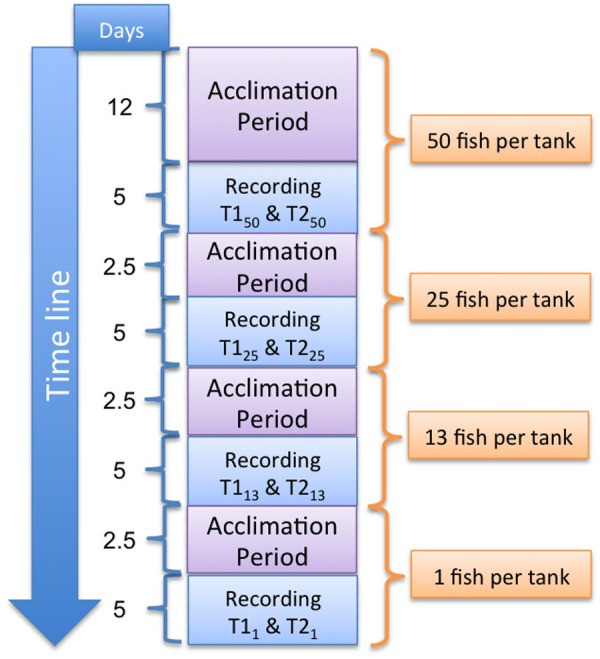
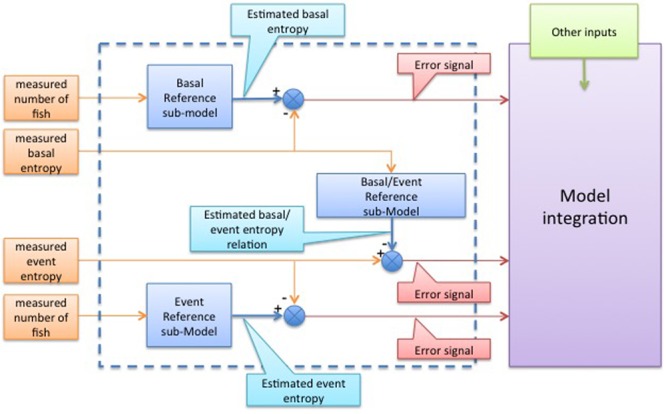
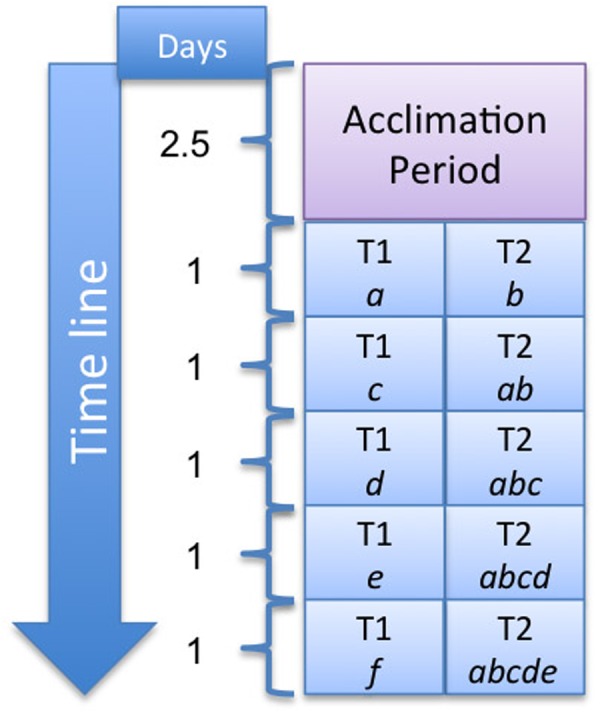
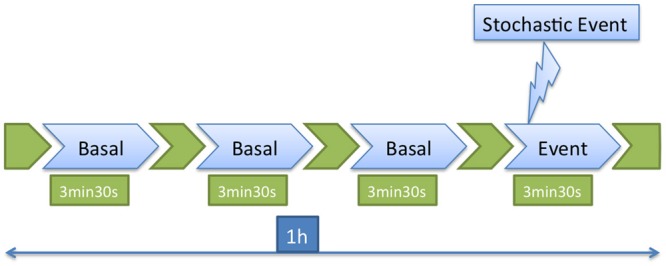
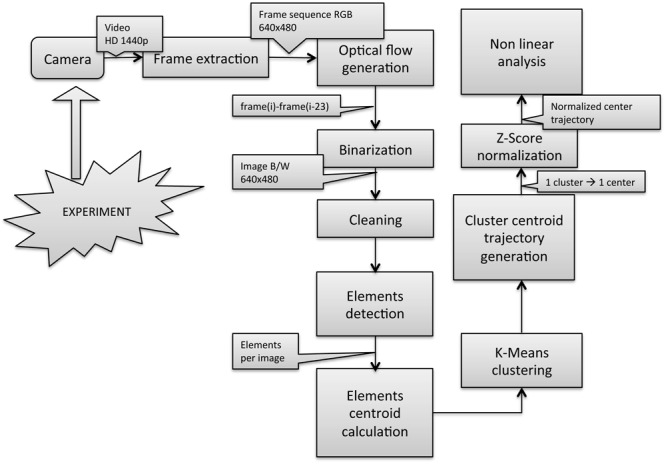
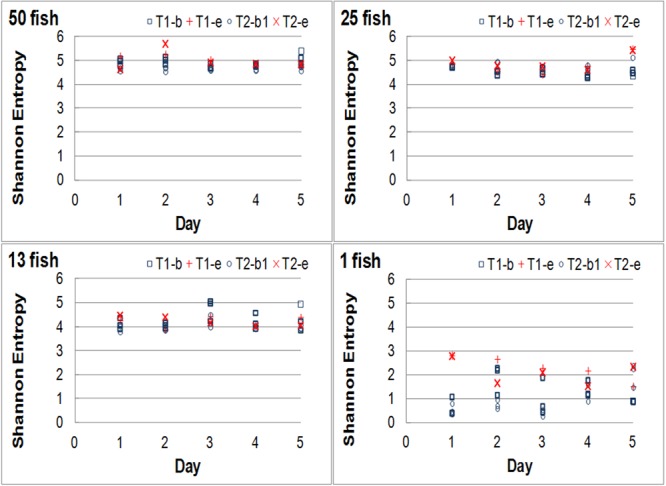
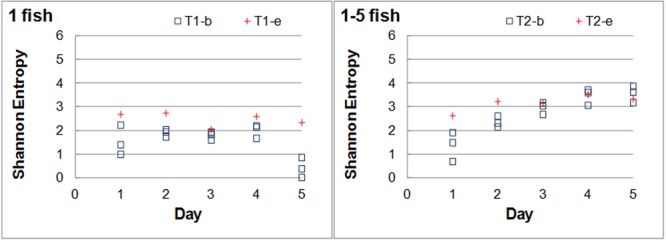
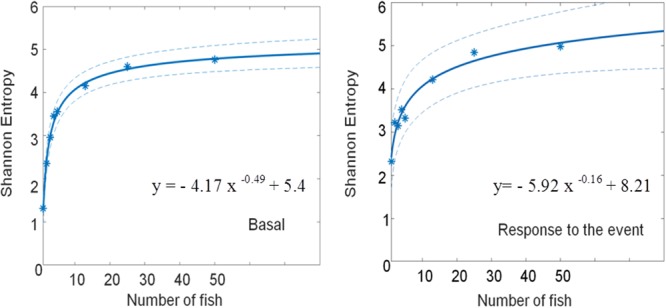
The present study aims at identifying the lowest number of fish (European seabass) that could be used for monitoring and/or experimental purposes in small-scale fish facilities by quantifying the effect that the number of individuals has on the Shannon entropy (SE) of the trajectory followed by the shoal's centroid. Two different experiments were performed: (i) one starting with 50 fish and decreasing to 25, 13, and 1 fish, and (ii) a second experiment starting with one fish, adding one new fish per day during 5 days, ending up with five fish in the tank. The fish were recorded for 1h daily, during which time a stochastic event (a hit in the tank) was introduced. The SE values were calculated from the images corresponding to three arbitrary basal (shoaling) periods of 3.5 min prior to the event, and to the 3.5 min period immediately after the event (schooling response). Taking both experiments together, the coefficient of variation (CV) of the SE among measurements was largest for one fish systems (CV 37.12 and 17.94% for the daily average basal and response SE, respectively) and decreased concomitantly with the number of fish (CV 8.6-10% for the basal SE of 2 to 5 fish systems and 5.86, 2.69, and 2.31% for the basal SE of 13, 25, and 50 fish, respectively). The SE of the systems kept a power relationship with the number of fish (basal: = 0.93 and response: = 0.92). Thus, 5-13 individuals should be the lowest number for a compromise between acceptable variability (<10%) in the data and reduction in the number of fish. We believe this to be the first scientific work made to estimate the minimum number of individuals to be used in subsequent experimental (including behavioral) studies using shoaling fish species that reaches a compromise between the reduction in number demanded by animal welfare guidelines and a low variability in the fish system's response.
本研究旨在通过量化个体数量对鱼群质心所遵循轨迹的香农熵(SE)的影响,确定在小型鱼类养殖设施中可用于监测和/或实验目的的最少鱼类数量(欧洲鲈鱼)。进行了两个不同的实验:(i)一个实验从50条鱼开始,依次减少到25条、13条和1条;(ii)第二个实验从1条鱼开始,在5天内每天添加1条新鱼,最终水箱中有5条鱼。每天对鱼记录1小时,在此期间引入一个随机事件(水箱中的一次撞击)。SE值是根据与事件发生前3.5分钟的三个任意基础(聚群)时间段以及事件发生后紧接着的3.5分钟时间段(鱼群反应)对应的图像计算得出的。综合两个实验来看,测量中SE的变异系数(CV)在单条鱼系统中最大(每日平均基础SE和反应SE的CV分别为37.12%和17.94%),并随着鱼的数量增加而相应降低(2至5条鱼系统的基础SE的CV为8.6 - 10%,13条、25条和50条鱼的基础SE的CV分别为5.86%、2.69%和2.31%)。系统的SE与鱼的数量保持幂律关系(基础:= 0.93,反应:= 0.92)。因此,5 - 13个个体应是在数据可接受的变异性(<10%)和鱼的数量减少之间达成妥协的最低数量。我们认为这是第一项旨在估计在后续使用聚群鱼类物种的实验(包括行为学实验)中使用的最少个体数量的科学研究,该研究在动物福利准则要求的数量减少与鱼类系统反应的低变异性之间达成了妥协。