Gauvrit Nicolas, Zenil Hector, Soler-Toscano Fernando, Delahaye Jean-Paul, Brugger Peter
Algorithmic Nature Group, Laboratoire de Recherche Scientifique LABORES For the Natural and Digital Sciences, Paris, France.
Human and Artificial Cognition Lab, EPHE, Paris, France.
PLoS Comput Biol. 2017 Apr 13;13(4):e1005408. doi: 10.1371/journal.pcbi.1005408. eCollection 2017 Apr.
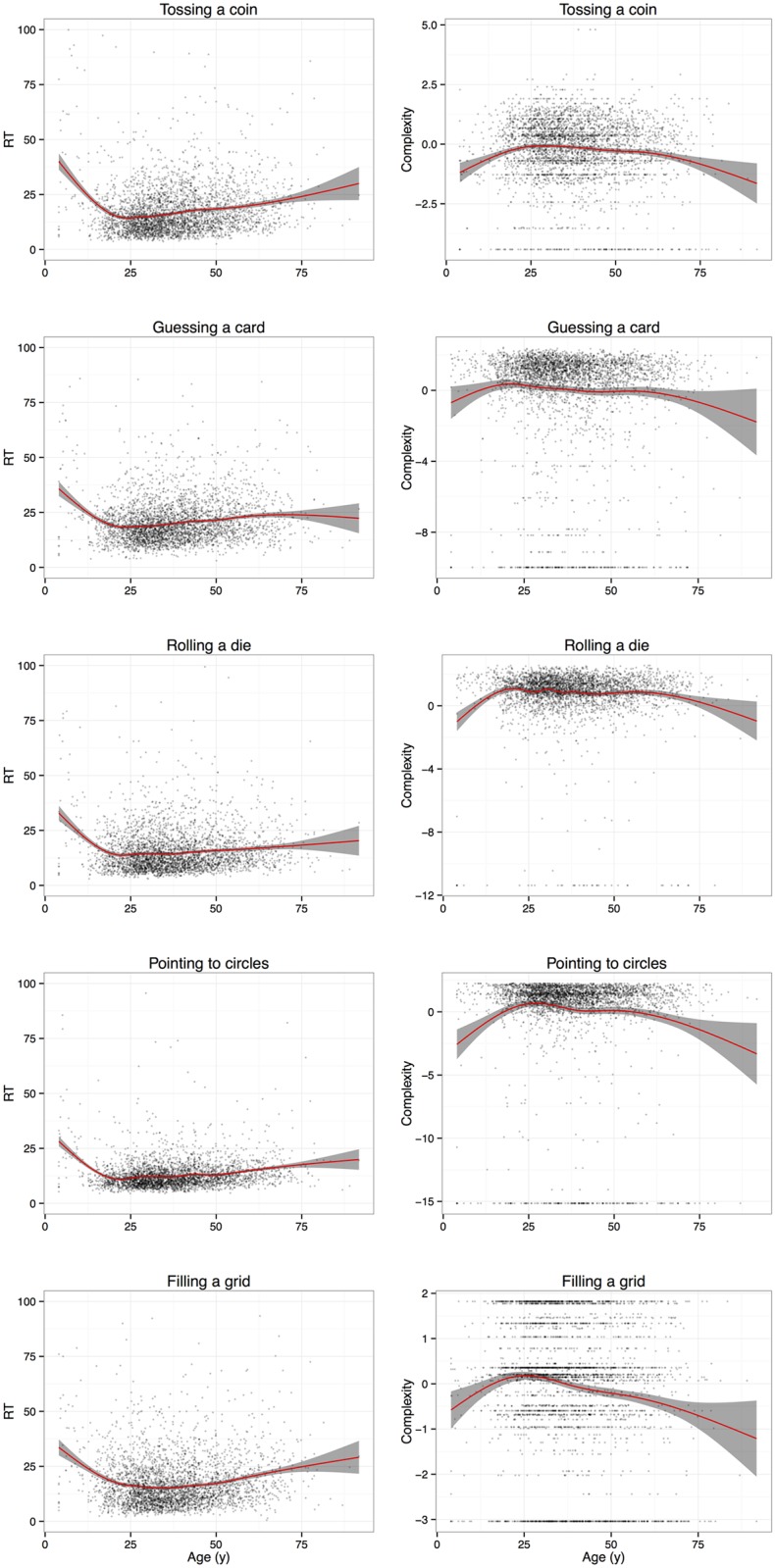
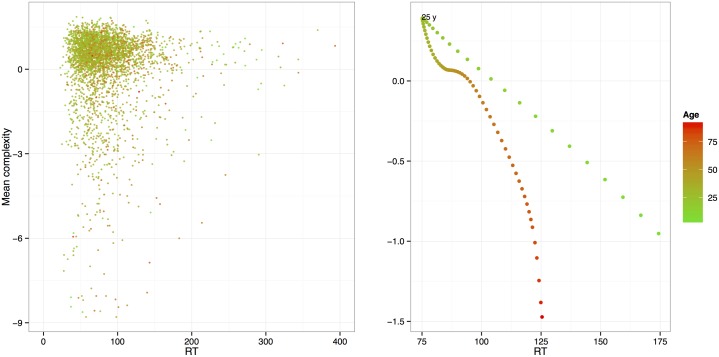
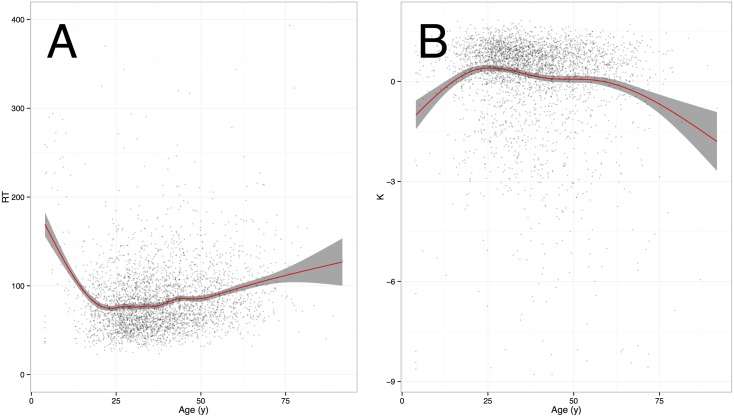
Random Item Generation tasks (RIG) are commonly used to assess high cognitive abilities such as inhibition or sustained attention. They also draw upon our approximate sense of complexity. A detrimental effect of aging on pseudo-random productions has been demonstrated for some tasks, but little is as yet known about the developmental curve of cognitive complexity over the lifespan. We investigate the complexity trajectory across the lifespan of human responses to five common RIG tasks, using a large sample (n = 3429). Our main finding is that the developmental curve of the estimated algorithmic complexity of responses is similar to what may be expected of a measure of higher cognitive abilities, with a performance peak around 25 and a decline starting around 60, suggesting that RIG tasks yield good estimates of such cognitive abilities. Our study illustrates that very short strings of, i.e., 10 items, are sufficient to have their complexity reliably estimated and to allow the documentation of an age-dependent decline in the approximate sense of complexity.
随机项目生成任务(RIG)通常用于评估诸如抑制或持续注意力等较高的认知能力。它们还利用了我们对复杂性的大致感知。对于某些任务,衰老对伪随机生成产生了不利影响,但关于认知复杂性在整个生命周期中的发展曲线,目前所知甚少。我们使用一个大样本(n = 3429),研究了人类对五个常见RIG任务的反应在整个生命周期中的复杂性轨迹。我们的主要发现是,反应的估计算法复杂性的发展曲线与对较高认知能力的测量结果预期相似,在25岁左右达到性能峰值,在60岁左右开始下降,这表明RIG任务能够很好地估计此类认知能力。我们的研究表明,非常短的字符串,即10个项目,就足以可靠地估计其复杂性,并记录在大致的复杂性感知中与年龄相关的下降情况。