Center for Proteomics, Faculty of Medicine, University of Rijeka, Rijeka, Croatia.
Department of Histology and Embryology, Faculty of Medicine, University of Rijeka, Rijeka, Croatia.
Front Immunol. 2018 May 7;9:991. doi: 10.3389/fimmu.2018.00991. eCollection 2018.
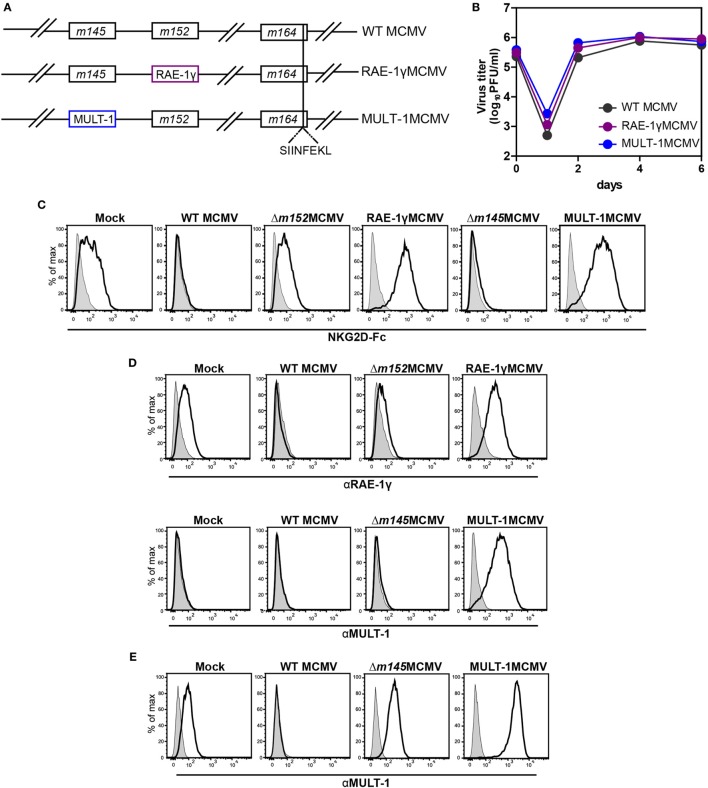
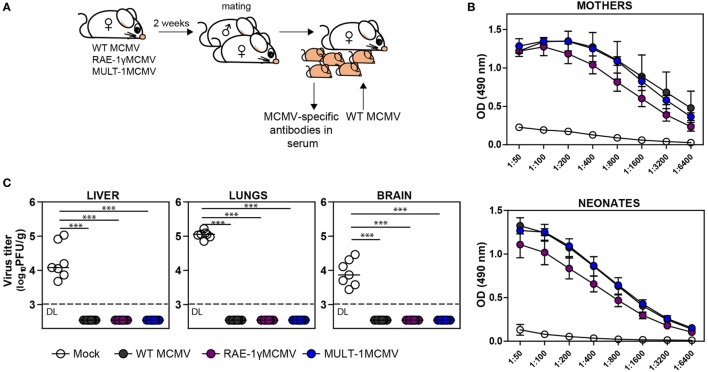
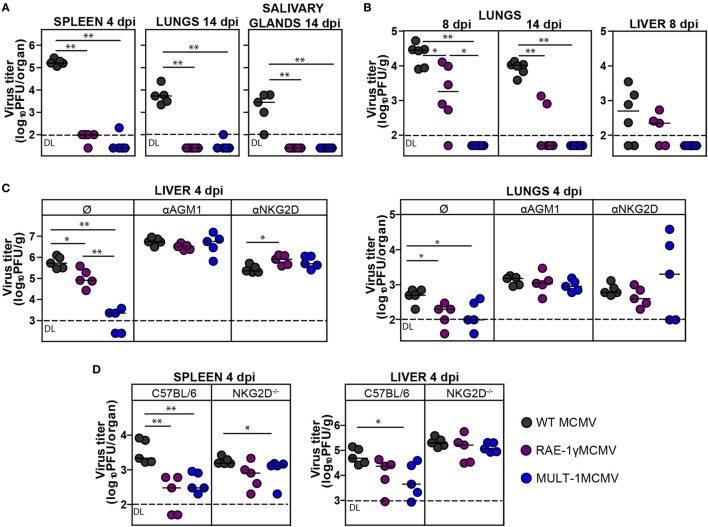
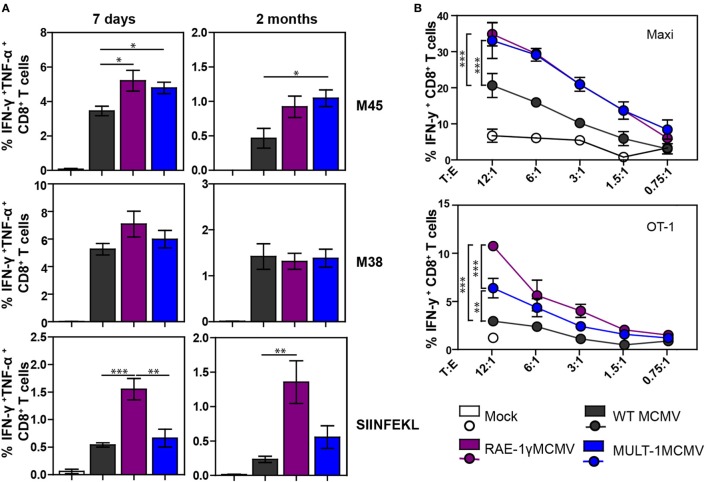
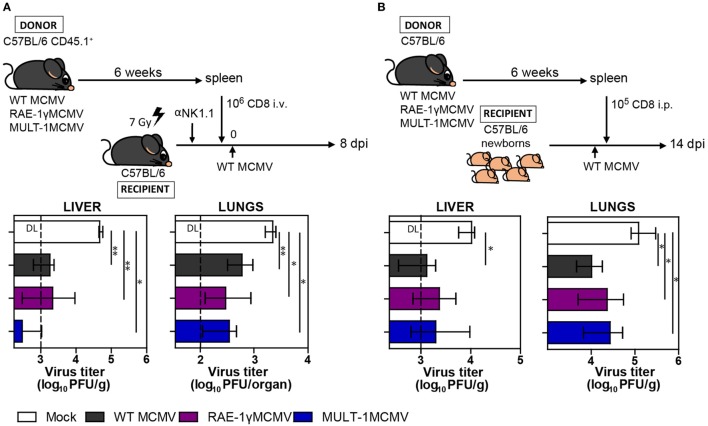
The development of a vaccine against human cytomegalovirus (CMV) has been a subject of long-term medical interest. The research during recent years identified CMV as an attractive vaccine vector against infectious diseases and tumors. The immune response to CMV persists over a lifetime and its unique feature is the inflationary T cell response to certain viral epitopes. CMV encodes numerous genes involved in immunoevasion, which are non-essential for virus growth . The deletion of those genes results in virus attenuation , which enables us to dramatically manipulate its virulence and the immune response. We have previously shown that the murine CMV (MCMV) expressing RAE-1γ, one of the cellular ligands for the NKG2D receptor, is highly attenuated but retains the ability to induce a strong CD8 T cell response. Here, we demonstrate that recombinant MCMV expressing high affinity NKG2D ligand murine UL16 binding protein-like transcript (MULT-1) (MULT-1MCMV) inserted in the place of its viral inhibitor is dramatically attenuated in a NK cell-dependent manner, both in immunocompetent adult mice and in immunologically immature newborns. MULT-1MCMV was more attenuated than the recombinant virus expressing RAE-1γ. Despite the drastic sensitivity to innate immune control, MULT-1MCMV induced an efficient CD8 T cell response to viral and vectored antigens. By using assay, we showed that similar to RAE-1γMCMV, MULT-1 expressing virus provided strong priming of CD8 T cells. Moreover, MULT-1MCMV was able to induce anti-viral antibodies, which after passing the transplacental barrier protect offspring of immunized mothers from challenge infection. Altogether, this study further supports the concept that CMV expressing NKG2D ligand possesses excellent characteristics to serve as a vaccine or vaccine vector.
开发针对人类巨细胞病毒 (CMV) 的疫苗一直是医学研究的长期目标。近年来的研究表明,CMV 是一种有吸引力的针对传染病和肿瘤的疫苗载体。人体对 CMV 的免疫反应会持续一生,其独特之处在于对某些病毒表位的炎症性 T 细胞反应。CMV 编码了许多参与免疫逃逸的基因,这些基因对病毒的生长不是必需的。删除这些基因会导致病毒衰减,这使我们能够显著改变其毒力和免疫反应。我们之前已经表明,表达 NKG2D 受体的细胞配体之一 RAE-1γ的鼠 CMV (MCMV) 高度衰减,但保留诱导强烈 CD8 T 细胞反应的能力。在这里,我们证明表达高亲和力 NKG2D 配体鼠 UL16 结合蛋白样转录本 (MULT-1) 的重组 MCMV (MULT-1MCMV) 插入其病毒抑制剂的位置,以依赖 NK 细胞的方式显著衰减,在免疫功能正常的成年小鼠和免疫不成熟的新生儿中均如此。MULT-1MCMV 比表达 RAE-1γ 的重组病毒衰减得更厉害。尽管对先天免疫控制非常敏感,但 MULT-1MCMV 诱导了针对病毒和载体抗原的有效 CD8 T 细胞反应。通过使用 分析,我们表明,与 RAE-1γMCMV 相似,表达 MULT-1 的病毒提供了对 CD8 T 细胞的强烈启动。此外,MULT-1MCMV 能够诱导抗病毒抗体,这些抗体在穿过胎盘屏障后,可保护免疫母亲的后代免受挑战感染。总之,这项研究进一步支持了这样一种概念,即表达 NKG2D 配体的 CMV 具有作为疫苗或疫苗载体的优异特性。