Department of Evolutionary Studies of Biosystems, SOKENDAI The Graduate University for Advanced Studies, Shonan International Village, Hayama, 240-0115, Kanagawa, Japan.
Department of Artificial Intelligence, University of Groningen, Nijenborgh 9, 9747 AG, Groningen, The Netherlands.
J Comp Physiol A Neuroethol Sens Neural Behav Physiol. 2018 Jul;204(7):639-651. doi: 10.1007/s00359-018-1267-z. Epub 2018 Jun 4.
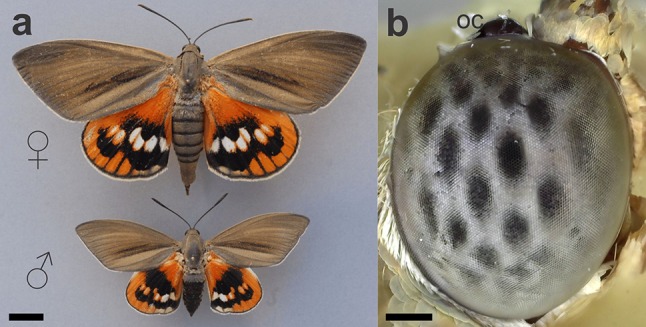
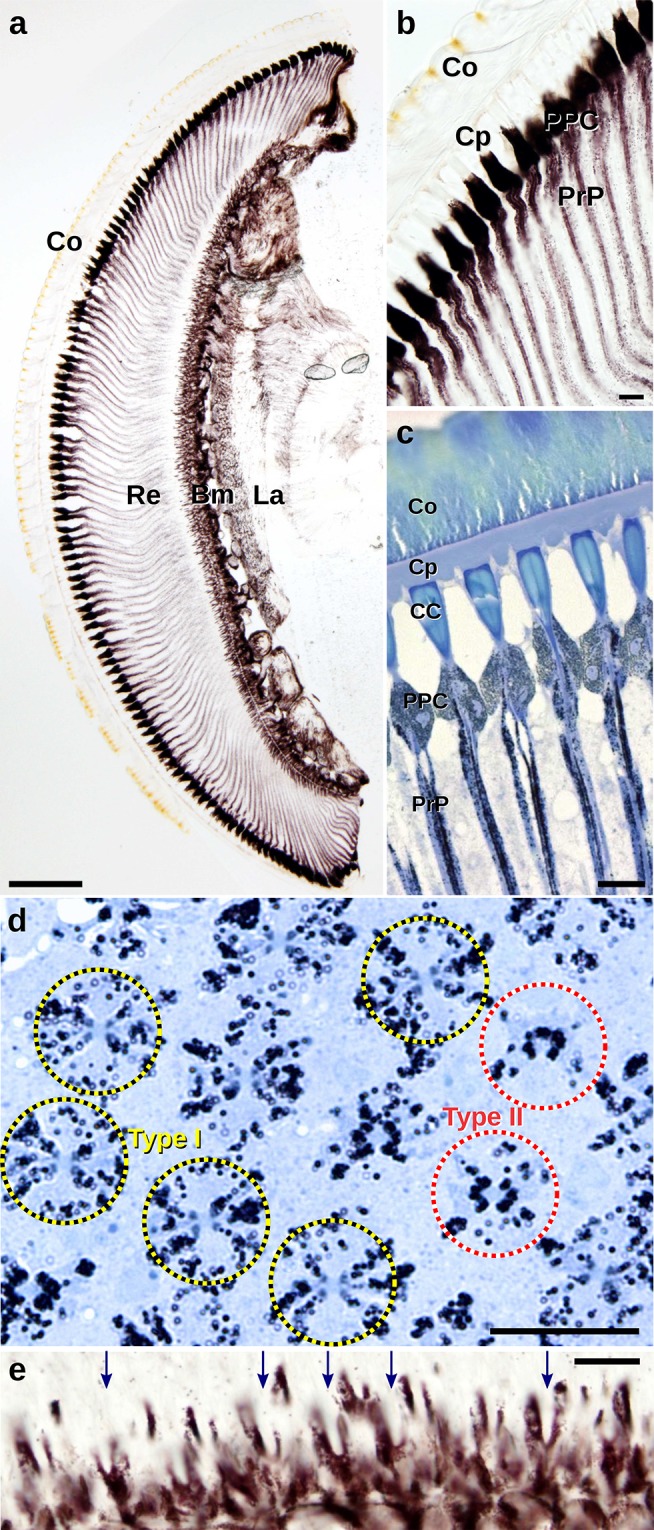
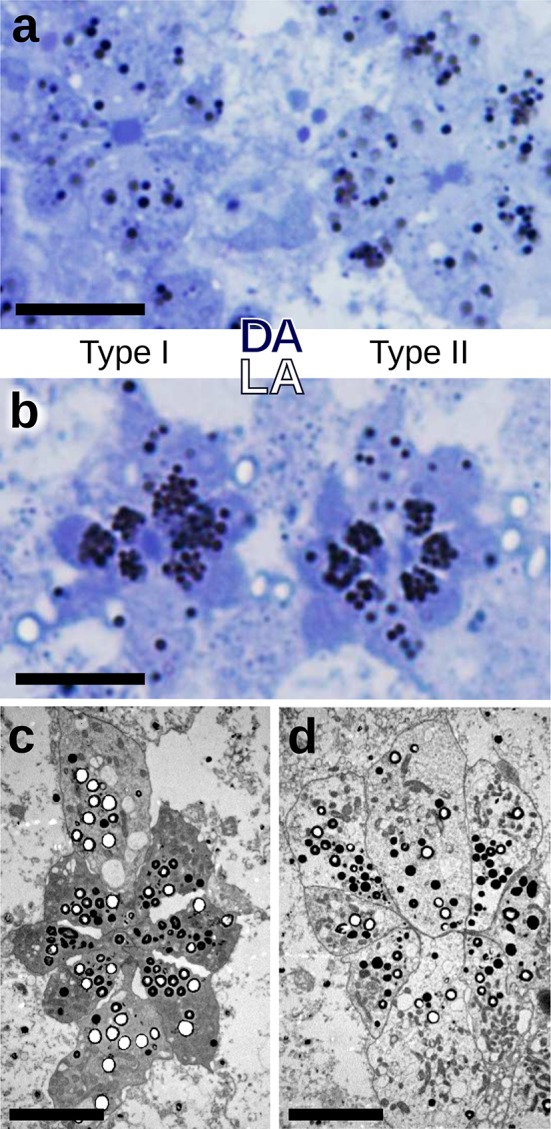
The palm borer moth Paysandisia archon (Burmeister, 1880) (fam. Castniidae) is a large, diurnally active palm pest. Its compound eyes consist of ~ 20,000 ommatidia and have apposition optics with interommatidial angles below 1°. The ommatidia contain nine photoreceptor cells and appear structurally similar to those in nymphalid butterflies. Two morphological ommatidial types were identified. Using the butterfly numbering scheme, in type I ommatidia, the distal rhabdom consists exclusively of the rhabdomeres of photoreceptors R1-2; the medial rhabdom has contributions from R1-8. The rhabdom in type II ommatidia is distally split into two sub-rhabdoms, with contributions from photoreceptors R2, R3, R5, R6 and R1, R4, R7, R8, respectively; medially, only R3-8 and not R1-2 contribute to the fused rhabdom. In both types, the pigmented bilobed photoreceptors R9 contribute to the rhabdom basally. Their nuclei reside in one of the lobes. Upon light adaptation, in both ommatidial types, the rhabdoms secede from the crystalline cones and pigment granules invade the gap. Intracellular recordings identified four photoreceptor classes with peak sensitivities in the ultraviolet, blue, green and orange wavelength regions (at 360, 465, 550, 580 nm, respectively). We discuss the eye morphology and optics, the photoreceptor spectral sensitivities, and the adaptation to daytime activity from a phylogenetic perspective.
手掌蛀蛾 Paysandisia archon (Burmeister, 1880) (鳞翅目 Castniidae) 是一种大型、昼行性的棕榈害虫。它的复眼由约 20000 个小眼组成,具有低于 1°的同位光学特性。小眼包含 9 个光感受器细胞,在结构上与蛱蝶目蝴蝶的光感受器细胞相似。鉴定出两种形态学小眼类型。使用蝴蝶编号方案,在 I 型小眼的远段视杆完全由光感受器 R1-2 的视杆体组成;中段视杆由 R1-8 提供。II 型小眼的视杆在远段分裂成两个亚视杆,分别由光感受器 R2、R3、R5、R6 和 R1、R4、R7、R8 提供;中段,只有 R3-8 而不是 R1-2 对融合的视杆有贡献。在这两种类型中,带色素的双叶光感受器 R9 在基部对视杆有贡献。它们的核位于一个叶瓣中。在光适应后,在两种小眼类型中,视杆与晶体锥分离,色素颗粒侵入间隙。细胞内记录鉴定出四种光感受器类型,其峰值敏感性分别在紫外线、蓝光、绿光和橙光波长区域(分别为 360、465、550、580nm)。我们从系统发育的角度讨论了眼睛形态和光学、光感受器光谱敏感性以及对日间活动的适应。