Heinloth Tanja, Uhlhorn Juliane, Wernet Mathias F
Division of Neurobiology, Institut für Biology, Fachbereich Biologie, Chemie & Pharmazie, Freie Universität Berlin, Berlin, Germany.
Front Cell Neurosci. 2018 Mar 20;12:50. doi: 10.3389/fncel.2018.00050. eCollection 2018.
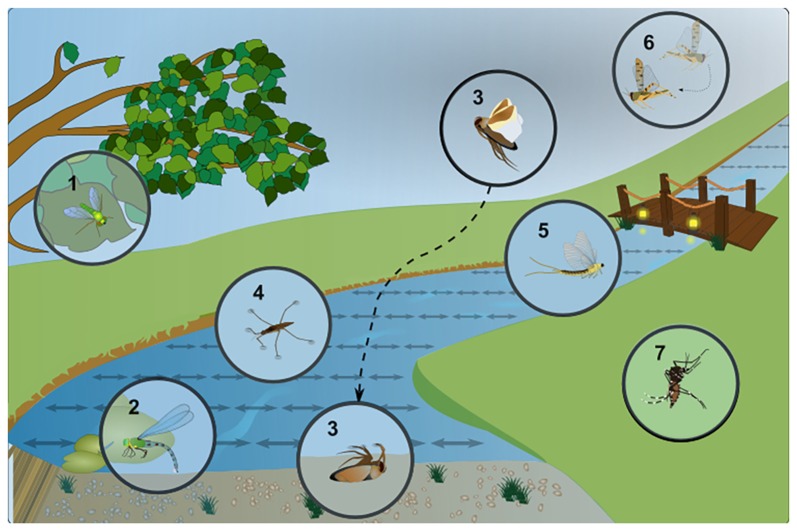
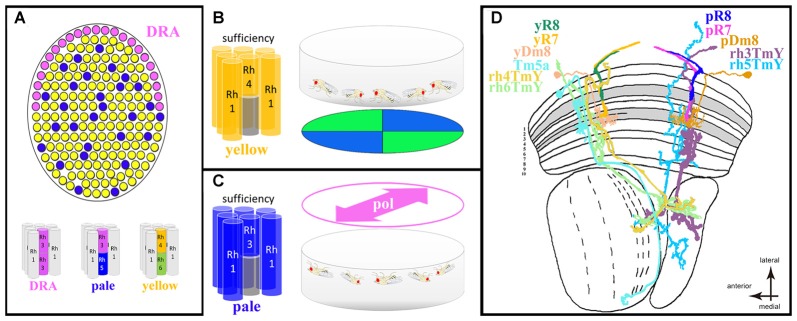
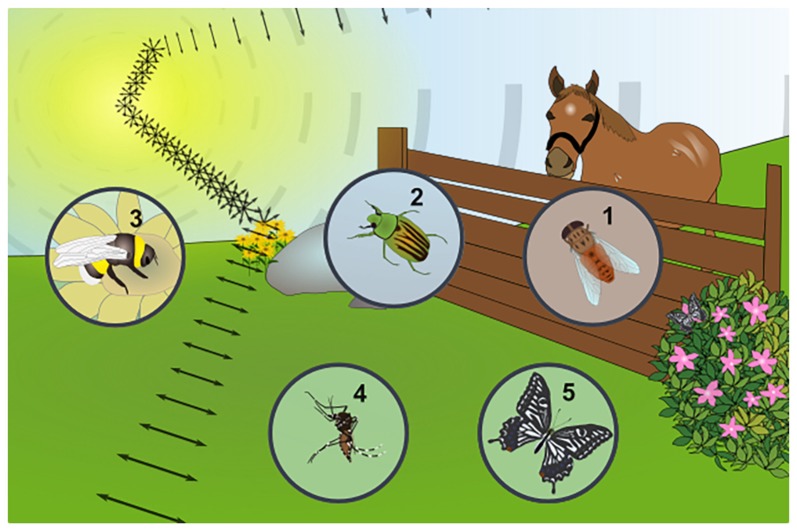
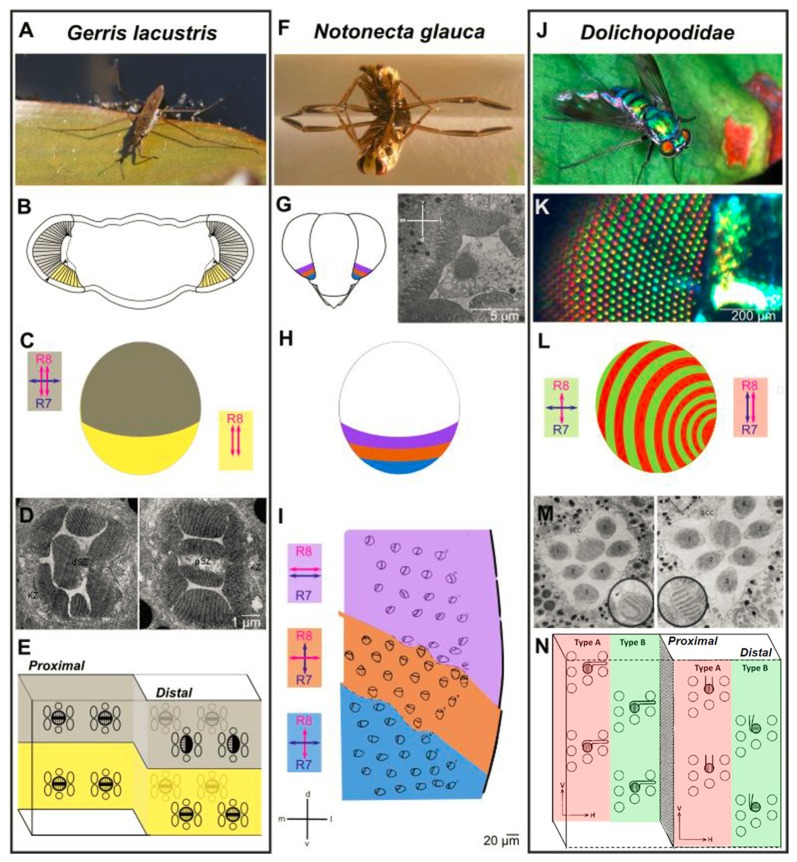
The e-vector orientation of linearly polarized light represents an important visual stimulus for many insects. Especially the detection of polarized skylight by many navigating insect species is known to improve their orientation skills. While great progress has been made towards describing both the anatomy and function of neural circuit elements mediating behaviors related to navigation, relatively little is known about how insects perceive non-celestial polarized light stimuli, like reflections off water, leaves, or shiny body surfaces. Work on different species suggests that these behaviors are not mediated by the "Dorsal Rim Area" (DRA), a specialized region in the dorsal periphery of the adult compound eye, where ommatidia contain highly polarization-sensitive photoreceptor cells whose receptive fields point towards the sky. So far, only few cases of polarization-sensitive photoreceptors have been described in the ventral periphery of the insect retina. Furthermore, both the structure and function of those neural circuits connecting to these photoreceptor inputs remain largely uncharacterized. Here we review the known data on non-celestial polarization vision from different insect species (dragonflies, butterflies, beetles, bugs and flies) and present three well-characterized examples for functionally specialized non-DRA detectors from different insects that seem perfectly suited for mediating such behaviors. Finally, using recent advances from circuit dissection in , we discuss what types of potential candidate neurons could be involved in forming the underlying neural circuitry mediating non-celestial polarization vision.
线偏振光的电矢量方向对许多昆虫来说是一种重要的视觉刺激。尤其是许多进行导航的昆虫种类能够检测偏振 skylight,这已知会提高它们的定向技能。虽然在描述介导与导航相关行为的神经回路元件的解剖结构和功能方面已经取得了很大进展,但对于昆虫如何感知非天体偏振光刺激,比如来自水、树叶或有光泽身体表面的反射,人们了解得相对较少。对不同物种的研究表明,这些行为并非由“背缘区域”(DRA)介导,DRA 是成年复眼背侧周边的一个特殊区域,其中小眼含有对偏振高度敏感的感光细胞,其感受野指向天空。到目前为止,在昆虫视网膜腹侧周边仅描述了少数对偏振敏感的感光细胞的情况。此外,连接到这些感光细胞输入的那些神经回路的结构和功能在很大程度上仍未得到充分描述。在这里,我们回顾了来自不同昆虫物种(蜻蜓、蝴蝶、甲虫、蝽象和苍蝇)的关于非天体偏振视觉的已知数据,并给出了三个来自不同昆虫的功能特化非 DRA 探测器的详细例子,这些探测器似乎非常适合介导此类行为。最后,利用[具体领域]中电路剖析的最新进展,我们讨论了哪些类型的潜在候选神经元可能参与形成介导非天体偏振视觉的潜在神经回路。