Faculty of Health and Sports Science, Doshisha University, Kyotanabe, Japan.
Laboratory of Applied Health Sciences, Kyoto Prefectural University of Medicine, Kyoto, Japan.
Clin Interv Aging. 2018 May 24;13:1019-1033. doi: 10.2147/CIA.S151427. eCollection 2018.
The number of long-term care (LTC) users and the associated expenditures in Japan are increasing dramatically. The national government recommends LTC prevention through activation of communities. However, there is no clear evidence of the effect of population-based comprehensive geriatric intervention program (CGIP) for restraints of LTC users and the associated expenditures in the future. The aims of the current paper are to describe the study protocol and progress of a cluster randomized controlled trial (RCT) with a CGIP in Kameoka City.
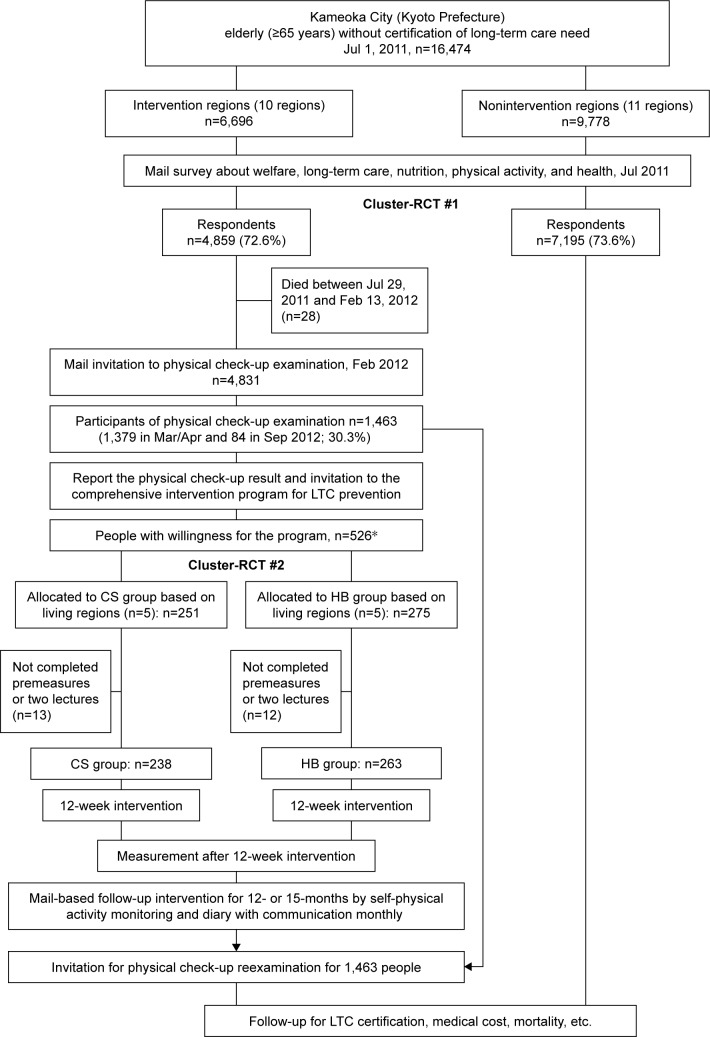
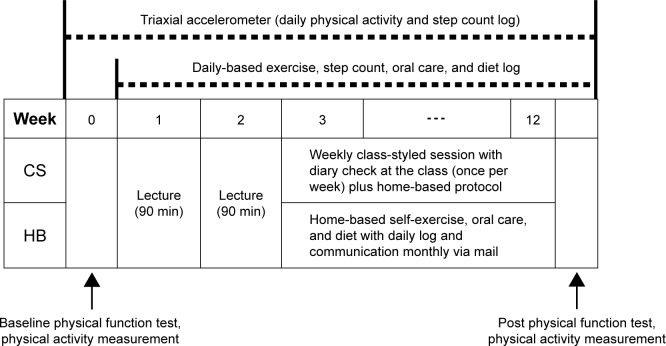
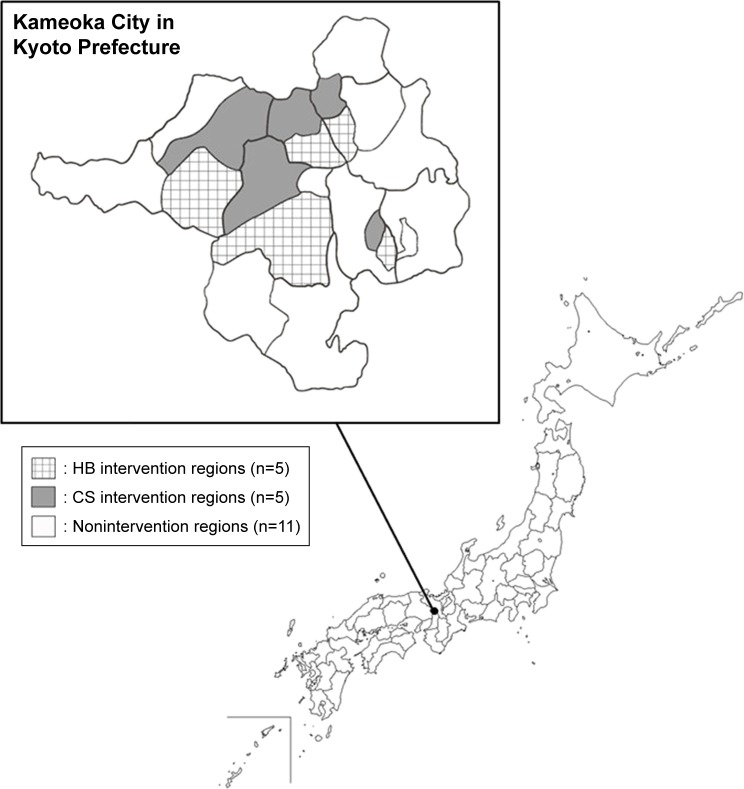
The cluster RCT involved random allocation of regions as intervention (n=4,859) and nonintervention (n=7,195). Participants were elderly persons aged ≥65 years without LTC certification who had responded to a mailing survey. The residents living in intervention regions were invited to a physical check-up, and 1,463 people participated (30.3%). These individuals were invited to the CGIP, and 526 accepted. The CGIP comprised instructions on: 1) low-load resistance training using bodyweight, ankle weights, and elastic bands; 2) increasing daily physical activity; 3) oral motor exercise and care; and 4) a well-balanced diet based on a program from Ministry of Health, Labour and Welfare. We allocated the intervention regions randomly into home-based self-care program alone (HB group, 5 regions, n=275) and home-based program+weekly class-style session (CS group, 5 regions, n=251). We evaluated the effects of the CGIP at 12 weeks and at 12 or 15 months on physical function, and are conducting follow-up data collection for an indefinite period regarding LTC certification, medical costs, and mortality.
The study was launched with good response rates in each phase. Participants of both groups significantly increased their step counts by ~1,000 per day from the baseline during the CGIP. This RCT will provide valuable information and evidence about effectiveness of a community-based CGIP.
日本长期护理(LTC)使用者的数量和相关支出正在急剧增加。国家政府建议通过激活社区来预防 LTC。然而,目前没有明确的证据表明基于人群的综合老年干预计划(CGIP)对未来 LTC 用户的约束和相关支出有影响。本研究的目的是描述在龟冈市进行的一项基于 CGIP 的集群随机对照试验(RCT)的研究方案和进展。
这项集群 RCT 涉及将区域随机分配为干预组(n=4859)和非干预组(n=7195)。参与者是年龄≥65 岁、没有 LTC 认证、回应邮寄调查的老年人。居住在干预区域的居民被邀请进行体检,有 1463 人参加(30.3%)。这些人被邀请参加 CGIP,有 526 人接受了邀请。CGIP 包括以下内容的指导:1)使用体重、脚踝重量和弹性带进行低负荷阻力训练;2)增加日常身体活动;3)口腔运动练习和护理;4)根据厚生劳动省的计划进行均衡饮食。我们将干预区域随机分配到仅家庭自我保健计划(HB 组,5 个区域,n=275)和家庭计划+每周课堂式课程(CS 组,5 个区域,n=251)。我们在 12 周和 12 或 15 个月评估 CGIP 对身体功能的影响,并对 LTC 认证、医疗费用和死亡率进行无限期的随访数据收集。
该研究在每个阶段都获得了良好的回应率。两组参与者在 CGIP 期间每天的步数都增加了约 1000 步。这项 RCT 将提供关于基于社区的 CGIP 有效性的宝贵信息和证据。