Di Stefano Antonino, Coccini Teresa, Roda Elisa, Signorini Cinzia, Balbi Bruno, Brunetti Giuseppe, Ceriana Piero
Pulmonary Rehabilitation Unit and Laboratory of Cytoimmunopathology of the Heart and Lung, Istituti Clinici Scientifici Maugeri SpA Società Benefit, Istituto di Ricovero e Cura a Carattere Scientifico (IRCCS), Veruno, Italy.
Laboratory of Experimental and Clinical Toxicology, Toxicology Unit, ICS Maugeri SpA Società Benefit, Istituto di Ricovero e Cura a Carattere Scientifico, Pavia, Italy.
Int J Chron Obstruct Pulmon Dis. 2018 May 24;13:1691-1700. doi: 10.2147/COPD.S159915. eCollection 2018.
Chronic obstructive pulmonary disease (COPD) is a heterogeneous disease characterized by different phenotypes with either bronchial airways alterations or emphysema prevailing. As blood biomarkers could be clinically useful for COPD stratification, we aimed at investigating the levels of blood biomarkers in COPD patients differentiated by phenotype: prevalent chronic airway disease versus emphysema.
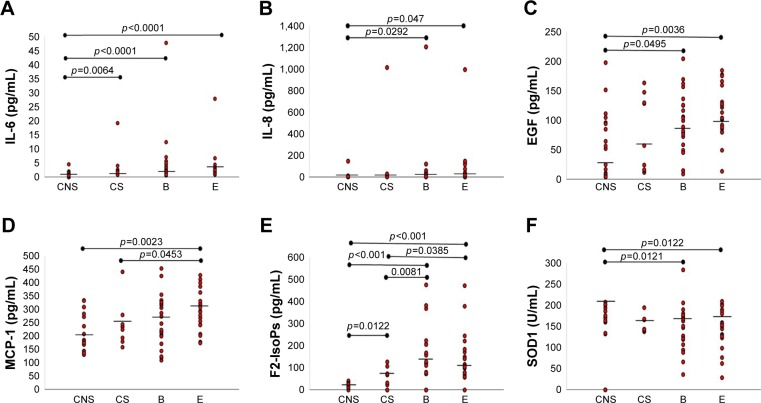
In 23 COPD patients with prevalent airway disease (COPD-B), 22 COPD patients with prevalent emphysema (COPD-E), 9 control smokers (CSs), and 18 control nonsmokers (CNSs), we analyzed the expression levels of interleukin (IL)-1α, IL-1β, IL-2, IL-4, IL-6, IL-8, IL-10, tumor necrosis factor (TNF)-α, interferon (IFN)-γ, epidermal growth factor (EGF), monocyte chemotactic protein (MCP)-1, and vascular endothelial growth factor by enzyme-linked immunosorbent assay in plasma/serum; glutathione peroxidase and superoxide dismutase (SOD)-1 by immunochemical kits in plasma; and free F2-isoprostanes (F2-IsoPs) by gas chromatography in plasma.
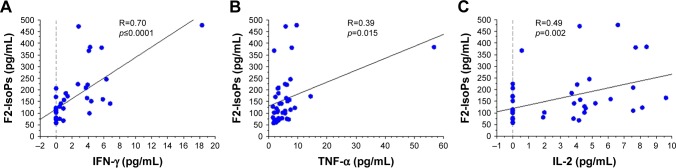
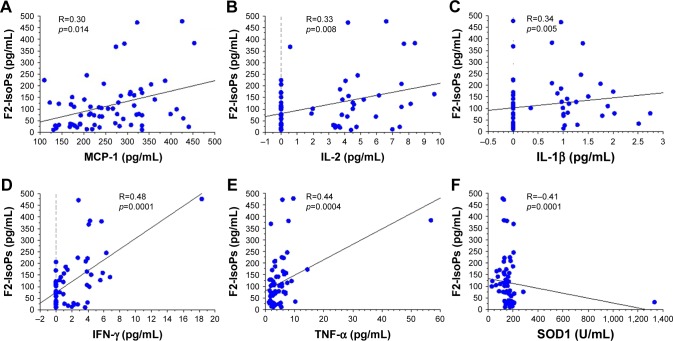
F2-IsoPs level was increased in COPD-B and COPD-E compared with CSs and CNSs; in addition, CS showed higher levels than CNSs; SOD1 level was lower in COPD-B and COPD-E than that in CNSs. Interestingly, MCP-1 level was higher only in COPD-E versus CSs and CNSs; EGF and IL-8 levels were higher in COPD-B and COPD-E versus CNSs; IL-6 level was increased in all three smoking groups (COPD-B, COPD-E, and CSs) versus CNS; IFN-γ and IL-1α levels were higher in CSs than in CNSs; and IL-1α level was also higher in CSs versus COPD-B and COPD-E. In all subjects, F2-IsoPs level correlated positively and significantly with MCP-1, IL-2, IL-1β, IFN-γ, and TNF-α and negatively with SOD1. When correlations were restricted to COPD-E and COPD-B groups, F2-IsoPs maintained the positive associations with IFN-γ, TNF-α, and IL-2.
We did not find any specific blood biomarkers that could differentiate COPD patients with prevalent airway disease from those with prevalent emphysema. The MCP-1 increase in COPD-E, associated with the imbalance of oxidant/antioxidant markers, may play a role in inducing emphysema.
慢性阻塞性肺疾病(COPD)是一种异质性疾病,其特征为不同的表型,以支气管气道改变或肺气肿为主。由于血液生物标志物在COPD分层中可能具有临床应用价值,我们旨在研究按表型区分的COPD患者的血液生物标志物水平:以慢性气道疾病为主型与肺气肿为主型。
我们纳入了23例以气道疾病为主型的COPD患者(COPD-B)、22例以肺气肿为主型的COPD患者(COPD-E)、9例吸烟对照者(CSs)和18例非吸烟对照者(CNSs),通过酶联免疫吸附测定法分析血浆/血清中白细胞介素(IL)-1α、IL-1β、IL-2、IL-4、IL-6、IL-8、IL-10、肿瘤坏死因子(TNF)-α、干扰素(IFN)-γ、表皮生长因子(EGF)、单核细胞趋化蛋白(MCP)-1和血管内皮生长因子的表达水平;通过免疫化学试剂盒分析血浆中谷胱甘肽过氧化物酶和超氧化物歧化酶(SOD)-1;通过气相色谱法分析血浆中游离F2-异前列腺素(F2-IsoPs)。
与CSs和CNSs相比,COPD-B和COPD-E组的F2-IsoPs水平升高;此外,CSs的水平高于CNSs;COPD-B和COPD-E组的SOD1水平低于CNSs。有趣的是,仅COPD-E组的MCP-1水平高于CSs和CNSs;COPD-B和COPD-E组的EGF和IL-8水平高于CNSs;所有三个吸烟组(COPD-B、COPD-E和CSs)的IL-6水平均高于CNSs;CSs的IFN-γ和IL-1α水平高于CNSs;CSs的IL-1α水平也高于COPD-B和COPD-E组。在所有受试者中,F2-IsoPs水平与MCP-1、IL-2、IL-1β、IFN-γ和TNF-α呈显著正相关,与SOD1呈负相关。当相关性仅限于COPD-E和COPD-B组时,F2-IsoPs与IFN-γ、TNF-α和IL-2保持正相关。
我们未发现任何能够区分以气道疾病为主型的COPD患者和以肺气肿为主型的COPD患者的特异性血液生物标志物。COPD-E组中MCP-1升高,与氧化/抗氧化标志物失衡相关,可能在诱导肺气肿中起作用。