Wu Tzu-Yi, Chung Chia-Hua, Lin Chia-Ni, Hwang Jing-Shiang, Wang Jung-Der
Institute of Economics, Academia Sinica, Taipei, Taiwan.
Institute of Statistical Science, Academia Sinica, Taipei, Taiwan.
Clin Epidemiol. 2018 May 25;10:581-591. doi: 10.2147/CLEP.S155601. eCollection 2018.
The mortality rates for different cancers are no longer an efficient tool for making national policy. The purpose of this study were to quantify the lifetime risks, life expectancies (LEs) after diagnosis, expected years of life lost (EYLL), and lifetime health care expenditures for 19 major cancers in Taiwan.
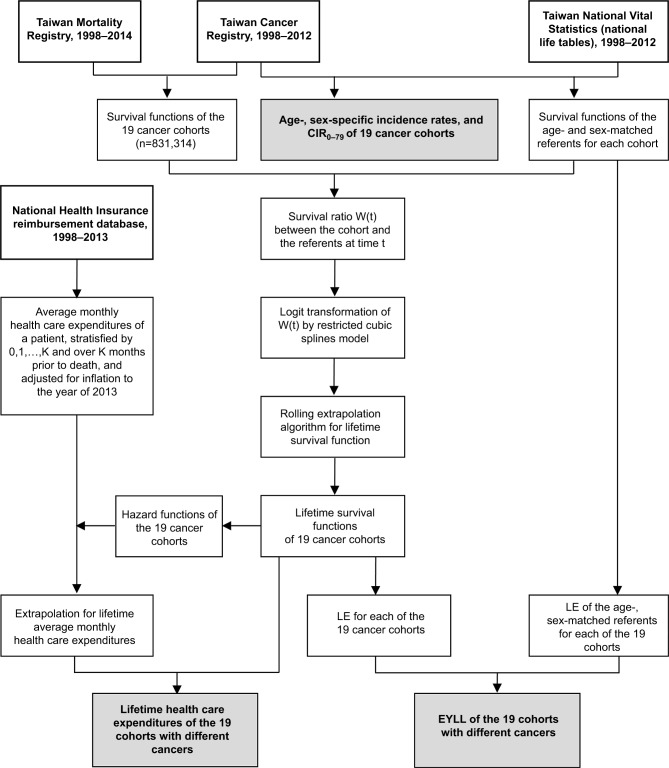
A total of 831,314 patients with 19 pathologically proven cancers were abstracted from the Taiwan Cancer Registry from 1998 to 2012. They were linked to the National Mortality Registry (1998-2014) and National Health Insurance reimbursement database (1998-2013) for survival and health care costs. We estimated the cumulative incidence rate for ages 0-79 years and the lifetime survival function for patients with different cancer sites. The EYLL was calculated by subtracting the LE of each cancer cohort from that of the age- and sex-matched referents simulated from national life tables. The estimated lifetime cost was calculated by adding up the product of survival probability and mean cost at the corresponding duration-to-date after adjustment for the inflation to the year of 2013.
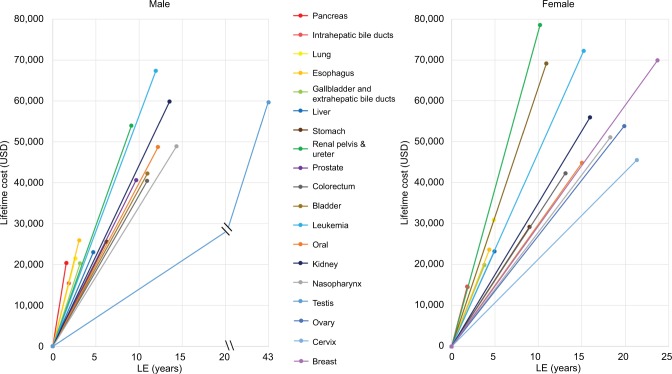
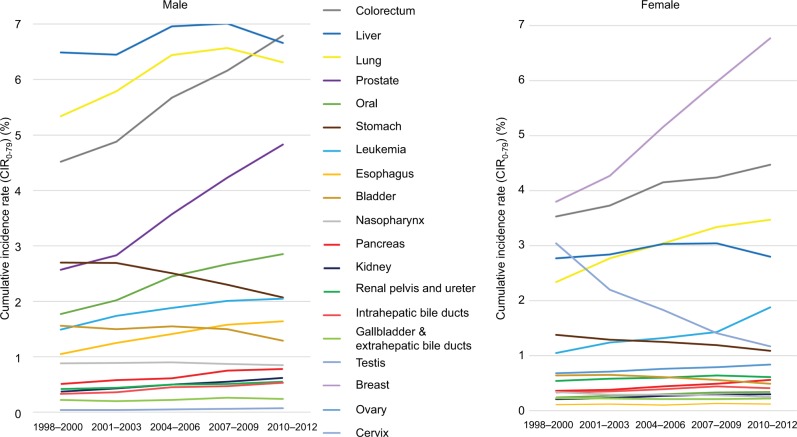
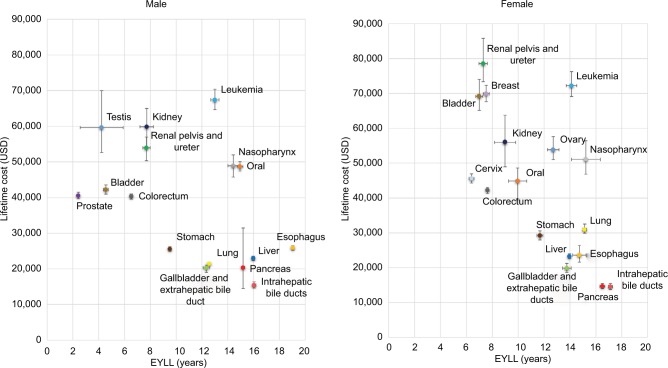
There were 5 cancers with a lifetime risk exceeding 4%: colorectal, liver, lung, and prostate in males, and breast and colorectal in females. Cancers with EYLL of >10 years were: esophageal, intrahepatic bile ducts, liver, pancreas, oral, nasopharyngeal, leukemia, lung, and gallbladder, extrahepatic bile ducts and biliary tract in males, and intrahepatic bile ducts, pancreas, nasopharyngeal, lung, esophageal, leukemia, liver, gallbladder, extrahepatic bile ducts and biliary tract, ovary, and stomach in females. Cancers with lifetime health care expenditures exceeding US$50,000 to the National Health Insurance were as follows: leukemia, kidney, testis, renal pelvis and ureter in males, and renal pelvis and ureter, leukemia, breast, urinary bladder, kidney, ovary, and nasopharyngeal in females. All these impacts should be considered in health policy decisions.
The impacts of cancer in Taiwan are very large. Future studies must consider both quality of life and the entire impact from societal perspectives.
不同癌症的死亡率已不再是制定国家政策的有效工具。本研究的目的是量化台湾19种主要癌症的终生风险、确诊后的预期寿命(LE)、预期寿命损失年数(EYLL)以及终生医疗保健支出。
从1998年至2012年的台湾癌症登记处提取了总共831314例经病理证实患有19种癌症的患者。将他们与国家死亡率登记处(1998 - 2014年)和国民健康保险报销数据库(1998 - 2013年)相链接,以获取生存情况和医疗费用信息。我们估计了0至79岁的累积发病率以及不同癌症部位患者的终生生存函数。EYLL通过从根据国民生命表模拟的年龄和性别匹配的对照人群的预期寿命中减去每个癌症队列的预期寿命来计算。估计的终生成本通过将生存概率与相应时间点的平均成本之积相加得到,成本已根据通货膨胀调整至2013年。
有5种癌症的终生风险超过4%:男性的结直肠癌、肝癌、肺癌和前列腺癌,以及女性的乳腺癌和结直肠癌。EYLL超过10年的癌症有:男性的食管癌、肝内胆管癌(intrahepatic bile ducts)、肝癌、胰腺癌、口腔癌、鼻咽癌、白血病、肺癌、胆囊癌、肝外胆管癌和胆道癌,以及女性的肝内胆管癌、胰腺癌、鼻咽癌、肺癌、食管癌、白血病、肝癌、胆囊癌、肝外胆管癌和胆道癌、卵巢癌和胃癌。向国民健康保险报销的终生医疗保健支出超过50000美元的癌症如下:男性的白血病、肾癌、睾丸癌、肾盂和输尿管癌,以及女性的肾盂和输尿管癌、白血病、乳腺癌、膀胱癌、肾癌、卵巢癌和鼻咽癌。在卫生政策决策中应考虑所有这些影响。
癌症对台湾的影响非常大。未来的研究必须从社会角度同时考虑生活质量和整体影响。