Fujikake Nobuhiro, Shin Minkyoung, Shimizu Shigeomi
Department of Pathological Cell Biology, Medical Research Institute, Tokyo Medical and Dental University, Tokyo, Japan.
Front Neurosci. 2018 May 22;12:255. doi: 10.3389/fnins.2018.00255. eCollection 2018.
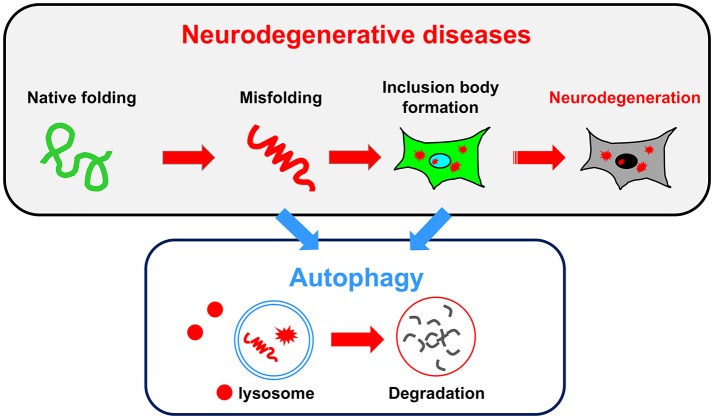
Autophagy is a phylogenetically conserved mechanism that controls the degradation of subcellular constituents, including misfolded proteins, and damaged organelles. The progression of many neurodegenerative diseases is thought to be driven by the aggregation of misfolded proteins; therefore, autophagic activity is thought to affect disease severity to some extent. In some neurodegenerative diseases, the suppression of autophagic activity accelerates disease progression. Given that the induction of autophagy can potentially mitigate disease severity, various autophagy-inducing compounds have been developed and their efficacy has been evaluated in several rodent models of neurodegenerative diseases.
自噬是一种在系统发育上保守的机制,它控制亚细胞成分的降解,包括错误折叠的蛋白质和受损的细胞器。许多神经退行性疾病的进展被认为是由错误折叠蛋白质的聚集驱动的;因此,自噬活性被认为在一定程度上会影响疾病的严重程度。在一些神经退行性疾病中,自噬活性的抑制会加速疾病进展。鉴于自噬的诱导可能会减轻疾病的严重程度,人们已经开发了各种自噬诱导化合物,并在几种神经退行性疾病的啮齿动物模型中评估了它们的疗效。