Yamasaki Tomoko, Ogawa Akitoshi, Osada Takahiro, Jimura Koji, Konishi Seiki
Department of Neurophysiology, Juntendo University School of Medicine, Tokyo, Japan.
Department of Biosciences and Informatics, Keio University School of Science and Technology, Yokohama, Japan.
Front Hum Neurosci. 2018 May 22;12:208. doi: 10.3389/fnhum.2018.00208. eCollection 2018.
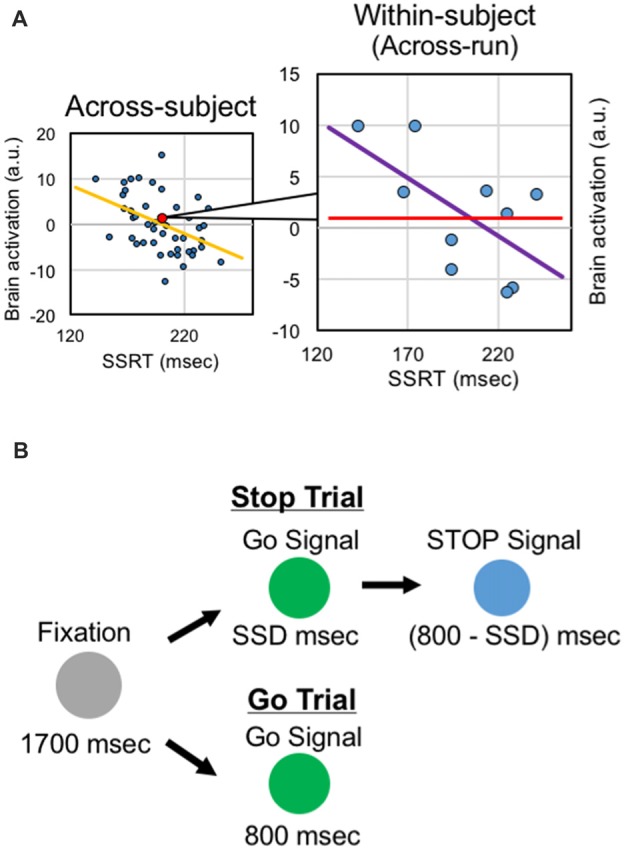
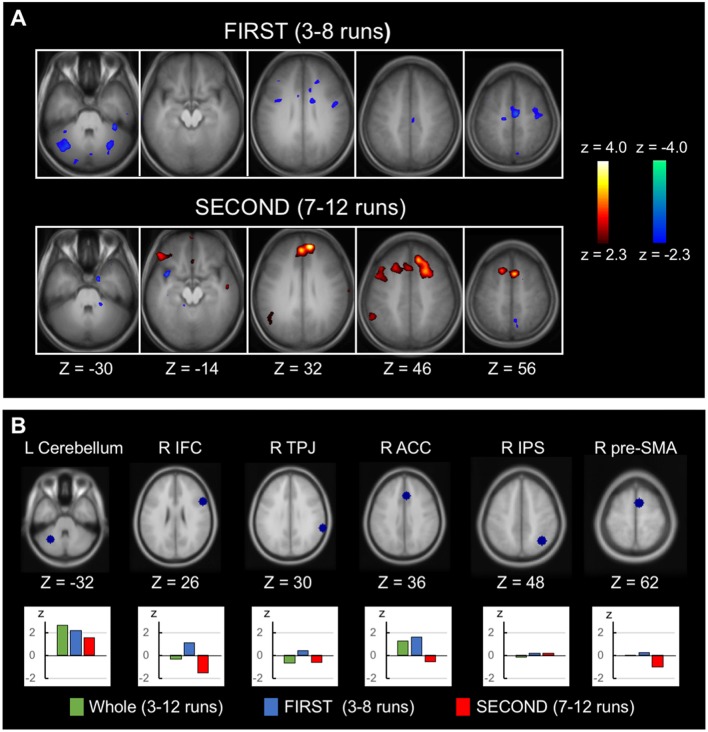
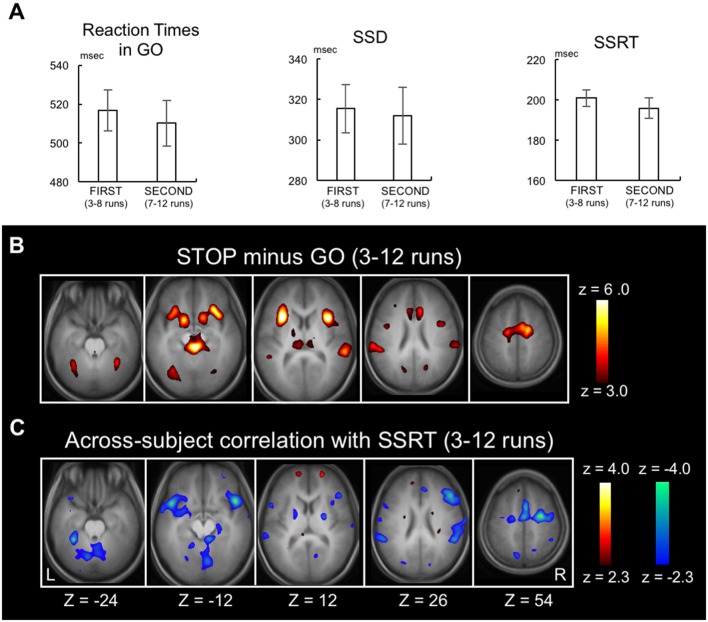
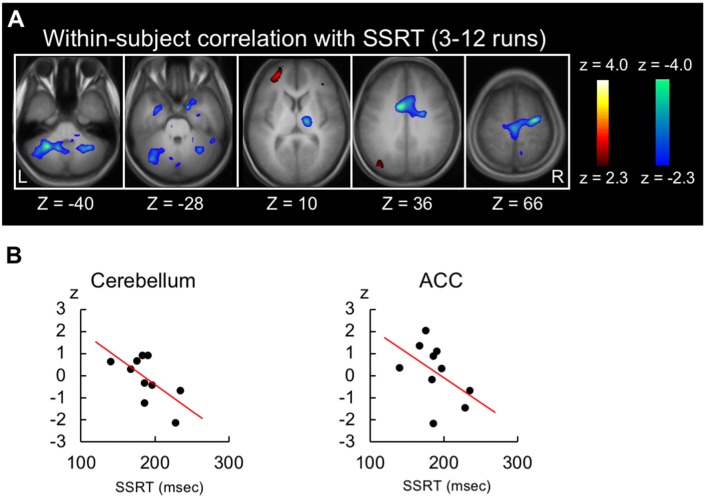
Functional areas in fMRI studies are often detected by brain-behavior correlation, calculating across-subject correlation between the behavioral index and the brain activity related to a function of interest. Within-subject correlation analysis is also employed in a single subject level, which utilizes cognitive fluctuations in a shorter time period by correlating the behavioral index with the brain activity across trials. In the present study, the within-subject analysis was applied to the stop-signal task, a standard task to probe response inhibition, where efficiency of response inhibition can be evaluated by the stop-signal reaction time (SSRT). Since the SSRT is estimated, by definition, not in a trial basis but from pooled trials, the correlation across runs was calculated between the SSRT and the brain activity related to response inhibition. The within-subject correlation revealed negative correlations in the anterior cingulate cortex and the cerebellum. Moreover, the dissociation pattern was observed in the within-subject analysis when earlier vs. later parts of the runs were analyzed: negative correlation was dominant in earlier runs, whereas positive correlation was dominant in later runs. Regions of interest analyses revealed that the negative correlation in the anterior cingulate cortex, but not in the cerebellum, was dominant in earlier runs, suggesting multiple mechanisms associated with inhibitory processes that fluctuate on a run-by-run basis. These results indicate that the within-subject analysis compliments the across-subject analysis by highlighting different aspects of cognitive/affective processes related to response inhibition.
功能磁共振成像(fMRI)研究中的功能区域通常通过脑-行为相关性来检测,即计算行为指标与与感兴趣功能相关的脑活动之间的受试者间相关性。受试者内相关性分析也应用于单受试者水平,它通过在不同试验中将行为指标与脑活动相关联,利用较短时间内的认知波动。在本研究中,受试者内分析应用于停止信号任务,这是一种用于探究反应抑制的标准任务,其中反应抑制效率可通过停止信号反应时间(SSRT)来评估。由于SSRT根据定义不是在单个试验基础上估计的,而是从汇总试验中估计的,因此计算了SSRT与与反应抑制相关的脑活动之间的不同扫描间的相关性。受试者内相关性在前扣带回皮质和小脑中显示出负相关。此外,在分析扫描的早期部分与后期部分时,在受试者内分析中观察到了分离模式:早期扫描中负相关占主导,而后期扫描中正相关占主导。感兴趣区域分析表明,前扣带回皮质中的负相关在早期扫描中占主导,而小脑则不然,这表明与抑制过程相关的多种机制在每次扫描中都会波动。这些结果表明,受试者内分析通过突出与反应抑制相关的认知/情感过程的不同方面,对受试者间分析起到了补充作用。