Moreira Luciana N, Silva Josiane F, Silva Grazielle C, Lemos Virgínia S, Cortes Steyner F
Department of Pharmacology, Institute of Biological Sciences, Universidade Federal de Minas Gerais, Belo Horizonte, Brazil.
Department of Physiology and Biophysics, Universidade Federal de Minas Gerais, Belo Horizonte, Brazil.
Front Pharmacol. 2018 May 22;9:528. doi: 10.3389/fphar.2018.00528. eCollection 2018.
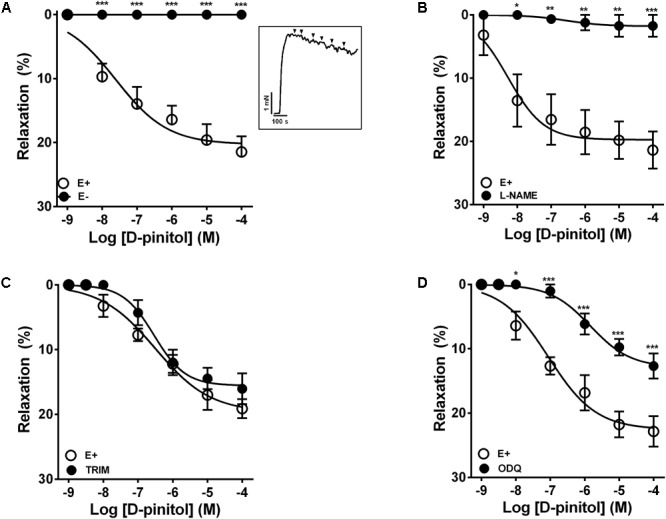
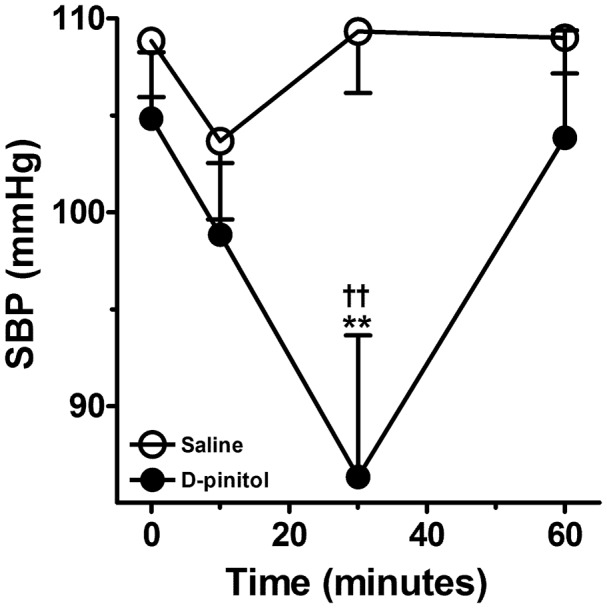
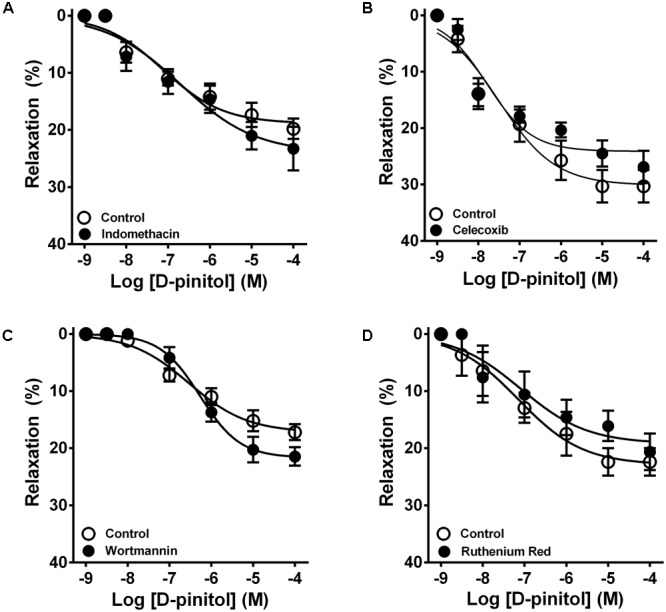
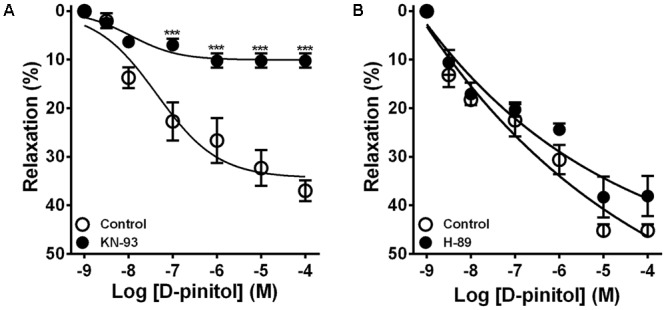
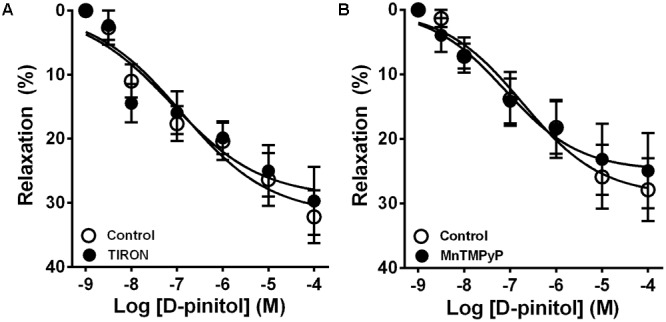
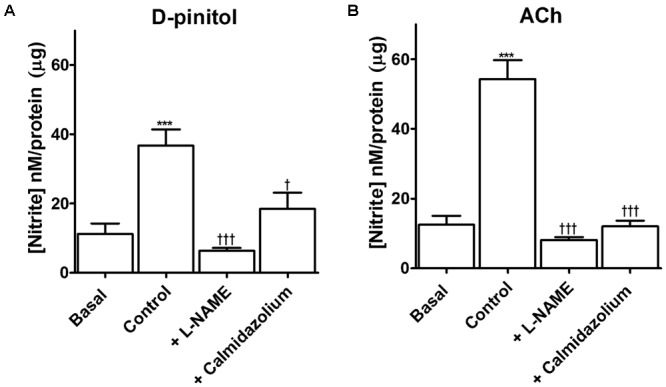
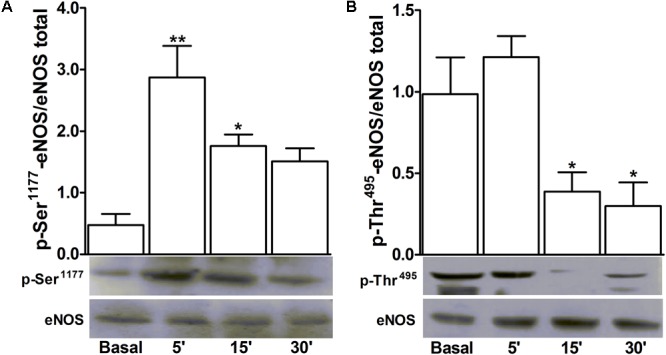
D-pinitol is a cyclitol present in several edible plant species and extensively investigated for the treatment of metabolic diseases in humans, as food supplement, and demonstrated protective effects in the cardiovascular system. For these reasons, the present work aimed at investigating the mechanisms involved in the vascular effects of D-pinitol in mouse mesenteric artery. Mesenteric arteries from male C57BL/6 mice were mounted in a wire myograph. Nitrite was measured by the 2,3-diaminonaphthalene (DAN) method. Protein expression and phosphorylation were measured by Western blot. The systolic blood pressure (SBP) was measured by tail-cuff plethysmography. D-pinitol induced a concentration-dependent vasodilatation in endothelium-intact, but not in endothelium-denuded arteries. Nω-Nitro-L-arginine methyl ester (300 μM) abolished the effect of D-pinitol, while 1H-[1,2,4]oxadiazolo[4,3-a]quinoxalin-1-one (ODQ; 10 μM) shifted the concentration-response curve to the right. KN-93 (1 μM) blunted the vasodilator effect of D-pinitol, but H-89 (0.1 μM) did not change it. 1-[2-(Trifluoromethyl) phenyl]imidazole (300 μM), indomethacin (10 μM), celecoxib (5 μM), wortmannin (1 μM), ruthenium red (10 μM), tiron (10 μM), MnTMPyP (30 μM), MPP (0.1 μM), PHTPP (0.1 μM), and atropine (1 μM) did not change the effect of D-pinitol. D-pinitol increased the concentration of nitrite, which was inhibited by L-NAME and calmidazolium (10 μM). D-pinitol increased the phosphorylation level of eNOS activation site at Ser and reduced the phosphorylation level of its inactivation site at Thr. In normotensive mice, the intraperitoneal administration of D-pinitol (10 mg/kg) induced a significant reduction of the SBP after 30 min. The present results led us to conclude that D-pinitol has an endothelium- and NO-dependent vasodilator effect in mouse mesenteric artery through a mechanism dependent on the activation of eNOS by the calcium-calmodulin complex, which can explain its hypotensive effect in mice.
D-松醇是一种环糖醇,存在于多种可食用植物物种中,作为食品补充剂,已被广泛研究用于治疗人类代谢疾病,并在心血管系统中显示出保护作用。基于这些原因,本研究旨在探究D-松醇对小鼠肠系膜动脉血管作用的机制。将雄性C57BL/6小鼠的肠系膜动脉安装在血管张力测定仪上。采用2,3-二氨基萘(DAN)法测定亚硝酸盐含量。通过蛋白质印迹法测定蛋白质表达和磷酸化水平。采用尾袖体积描记法测量收缩压(SBP)。D-松醇在完整内皮的动脉中诱导浓度依赖性血管舒张,但在内皮剥脱的动脉中无此作用。Nω-硝基-L-精氨酸甲酯(300 μM)消除了D-松醇的作用,而1H-[1,2,4]恶二唑并[4,3-a]喹喔啉-1-酮(ODQ;10 μM)使浓度-反应曲线右移。KN-93(1 μM)减弱了D-松醇的血管舒张作用,但H-89(0.1 μM)对其无影响。1-[2-(三氟甲基)苯基]咪唑(300 μM)、吲哚美辛(10 μM)、塞来昔布(5 μM)、渥曼青霉素(1 μM)、钌红(10 μM)、替诺(10 μM)、锰(III)四吡啶基卟啉(MnTMPyP,30 μM)、甲基哌嗪(MPP,0.1 μM)、孕烷X受体拮抗剂(PHTPP,0.1 μM)和阿托品(1 μM)均未改变D-松醇的作用。D-松醇增加了亚硝酸盐浓度,L-硝基精氨酸甲酯(L-NAME)和氯米帕明(10 μM)可抑制此作用。D-松醇增加了eNOS激活位点丝氨酸的磷酸化水平,并降低了其失活位点苏氨酸的磷酸化水平。在正常血压小鼠中,腹腔注射D-松醇(10 mg/kg)30分钟后,SBP显著降低。目前的研究结果使我们得出结论,D-松醇在小鼠肠系膜动脉中具有内皮和一氧化氮依赖性血管舒张作用,其机制依赖于钙-钙调蛋白复合物对eNOS的激活,这可以解释其对小鼠的降压作用。