Rahimzadeh Poupak, Faiz Seyed Hamid Reza, Imani Farnad, Derakhshan Pooya, Amniati Saeed
Pain Research Center, Iran University of Medical Sciences, Tehran, Iran.
Rasoul-e-Akram Clinical Research Development Center, Iran University of Medical Sciences, Tehran, Iran.
BMC Anesthesiol. 2018 Jun 6;18(1):62. doi: 10.1186/s12871-018-0531-7.
Spinal block is a common procedure for lower limbs surgery. Fentanyl, a synthetic opioid and dexmedetomidine, a selective α2 agonist have been used as adjuvants in spinal anesthesia to prolong intraoperative and postoperative analgesia. The aim of current study is to compare the efficacy of dexmedetomidine and fentanyl added to intrathecal bupivacaine in orthopedic procedures in lower limbs.
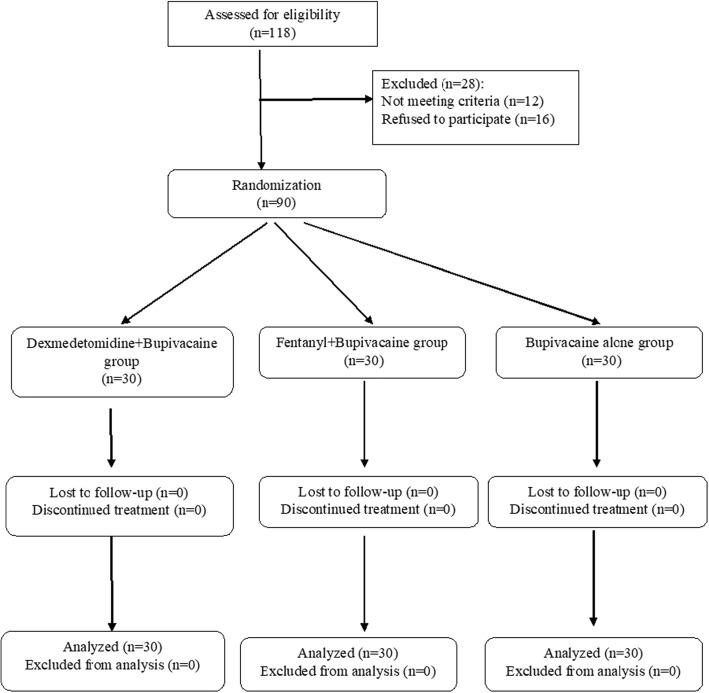
In this randomized clinical trial, 90 patients undergoing elective lower limb surgeries were randomly allocated to three groups. Via intrathecal approach, the patients received 2.5 ml hyperbaric bupivacaine 0.5% plus 5 micrograms dexmedetomidine (BD group), 25 micrograms fentanyl (BF group) or 0.5 ml normal saline (BN group), respectively. Time to reach the complete motor block, the highest sensory level, regression from block, analgesic request and duration of the drug effect, hemodynamic changes and side effects were compared between the groups.
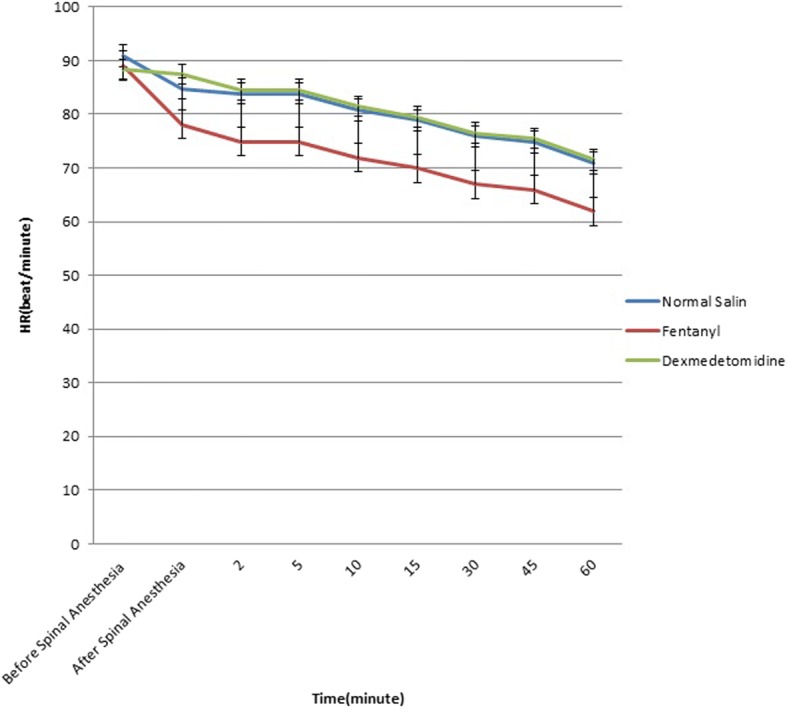
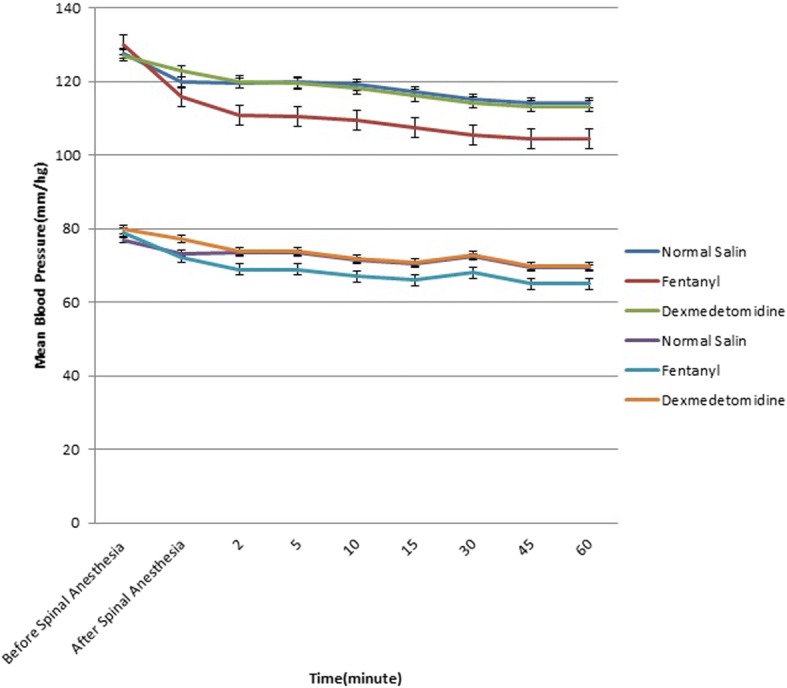
There was no significant difference between the groups regrading time to reach complete motor block, but time to reach the highest sensory level was shorter in group BD than group BF (6.28 ± 1.75 vs. 7.17 ± 1.45, p = 0.03). Group BD had significantly lower mean of NRS 6 h after operation (1.90 ± 0.84 vs. 6.16 ± 1.44 vs. 6.30 ± 1.17, p < 0.001) and longer duration to regress to Bromage 0 (331.60 ± 73.96 vs. 185.56 ± 35.87 vs. 147.03 ± 33.05 min, p < 0.001), to analgesic request (496.63 ± 70.19 vs. 296.33 ± 44.83 vs. 221.83 ± 22.26 min, p < 0.001), to regress two sensory levels (149.00 ± 23.17 vs. 88.90 ± 12.85 vs. 69.33 ± 6.67 min, p < 0.001) and to regress to S1 (560.53 ± 81.86 vs. 329.83 ± 44.10 vs. 241.83 ± 22.26 min, p < 0.001). Serial changes in SBP (p = 0.006), DBP (p = 0.03) and HR (p = 0.002) in group BF were significantly higher than the other two groups. The three groups had comparable side effects.
Using dexmedetomidine as an adjuvant to bupivacaine for spinal anesthesia in lower limb surgeries has longer duration of sensory and motor block and longer postoperative analgesia.
IRCT registration number: IRCT2017041010599N15 , 24 May 2017.
脊髓阻滞是下肢手术的常见操作。芬太尼(一种合成阿片类药物)和右美托咪定(一种选择性α2激动剂)已被用作脊髓麻醉的辅助药物,以延长术中和术后镇痛时间。本研究的目的是比较右美托咪定和芬太尼添加到鞘内布比卡因用于下肢骨科手术的疗效。
在这项随机临床试验中,90例行择期下肢手术的患者被随机分为三组。通过鞘内途径,患者分别接受2.5毫升0.5%的重比重布比卡因加5微克右美托咪定(BD组)、25微克芬太尼(BF组)或0.5毫升生理盐水(BN组)。比较三组患者达到完全运动阻滞的时间、最高感觉平面、阻滞消退时间、镇痛需求及药物作用持续时间、血流动力学变化和副作用。
三组患者达到完全运动阻滞的时间无显著差异,但BD组达到最高感觉平面的时间比BF组短(6.28±1.75 vs. 7.17±1.45,p = 0.03)。BD组术后6小时的NRS平均值显著更低(1.90±0.84 vs. 6.16±1.44 vs. 6.30±1.17,p < 0.001),恢复到布罗麻0级的时间更长(331.60±73.96 vs. 185.56±35.87 vs. 147.03±33.05分钟,p < 0.001),镇痛需求时间更长(496.63±70.19 vs. 296.33±44.83 vs. 221.83±22.26分钟,p < 0.001),恢复两个感觉平面的时间更长(149.00±23.17 vs. 88.90±12.85 vs. 69.33±6.67分钟,p < 0.001),恢复到S1的时间更长(560.53±81.86 vs. 329.83±44.10 vs. 241.83±22.26分钟,p < 0.001)。BF组的收缩压(p = 0.006)、舒张压(p = 0.03)和心率(p = 0.002)的系列变化显著高于其他两组。三组的副作用相当。
在下肢手术的脊髓麻醉中,使用右美托咪定作为布比卡因的辅助药物,感觉和运动阻滞持续时间更长,术后镇痛时间更长。
IRCT注册号:IRCT2017041010599N15,2017年5月24日。