MRC-University of Glasgow Centre for Virus Research, Glasgow, United Kingdom.
Field Museum of Natural History, Department of Science and Education, Chicago, Illinois, USA.
J Virol. 2018 Jul 31;92(16). doi: 10.1128/JVI.00145-18. Print 2018 Aug 15.
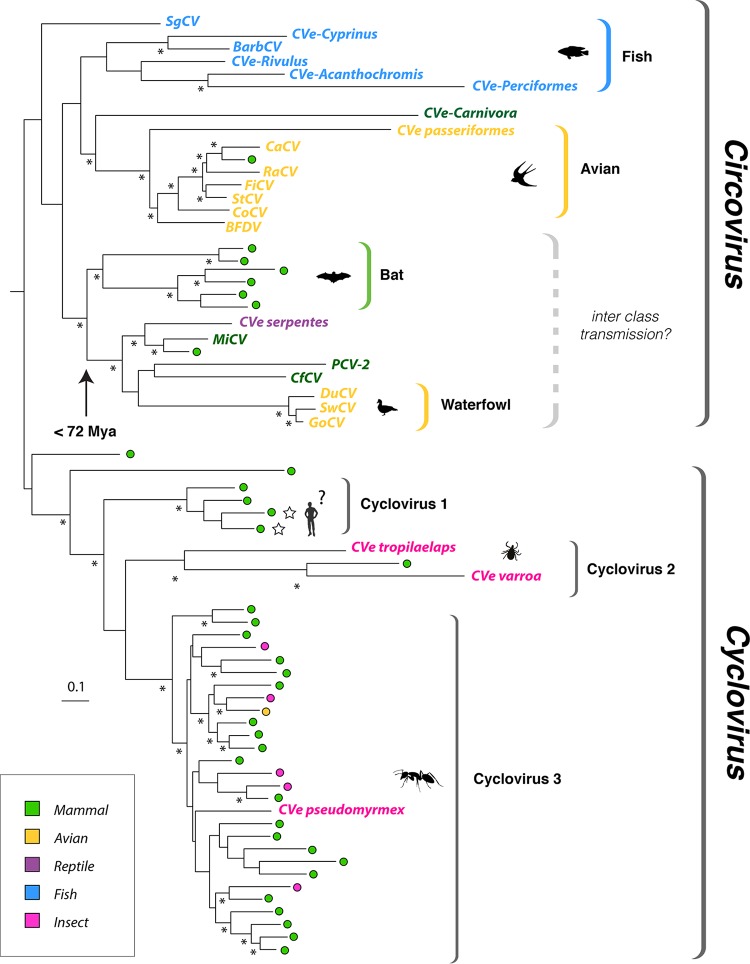
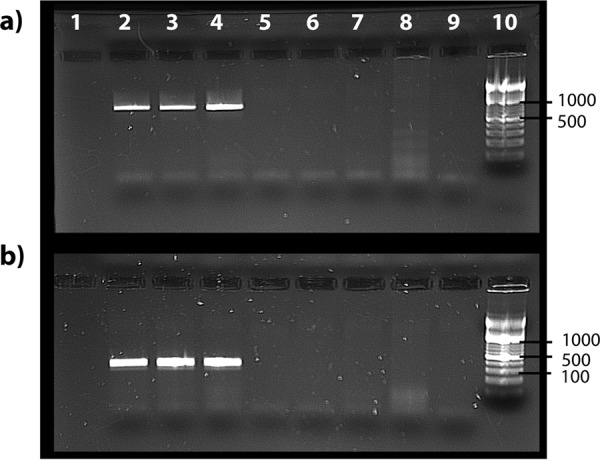
A diverse range of DNA sequences derived from circoviruses (family ) has been identified in samples obtained from humans and domestic animals, often in association with pathological conditions. In the majority of cases, however, little is known about the natural biology of the viruses from which these sequences are derived. Endogenous circoviral elements (CVe) are DNA sequences derived from circoviruses that occur in animal genomes and provide a useful source of information about circovirus-host relationships. In this study, we screened genome assemblies of 675 animal species and identified numerous circovirus-related sequences, including the first examples of CVe derived from cycloviruses. We confirmed the presence of these CVe in the germ line of the elongate twig ant (), thereby establishing that cycloviruses infect insects. We examined the evolutionary relationships between CVe and contemporary circoviruses, showing that CVe from ants and mites group relatively closely with cycloviruses in phylogenies. Furthermore, the relatively random interspersion of CVe from insect genomes with cyclovirus sequences recovered from vertebrate samples suggested that contamination might be an important consideration in studies reporting these viruses. Our study demonstrates how endogenous viral sequences can inform metagenomics-based virus discovery. In addition, it raises doubts about the role of cycloviruses as pathogens of humans and other vertebrates. Advances in DNA sequencing have dramatically increased the rate at which new viruses are being identified. However, the host species associations of most virus sequences identified in metagenomic samples are difficult to determine. Our analysis indicates that viruses proposed to infect vertebrates (in some cases being linked to human disease) may in fact be restricted to arthropod hosts. The detection of these sequences in vertebrate samples may reflect their widespread presence in the environment as viruses of parasitic arthropods.
已从人类和家畜样本中鉴定出多种源自圆环病毒(科)的 DNA 序列,这些序列通常与病理状况相关。然而,在大多数情况下,人们对这些序列所源自的病毒的自然生物学知之甚少。内源性圆环病毒元件(CVe)是源自在动物基因组中出现的圆环病毒的 DNA 序列,为圆环病毒-宿主关系提供了有用的信息来源。在这项研究中,我们筛选了 675 种动物物种的基因组组装,鉴定出了许多圆环病毒相关序列,包括源自环病毒的 CVe 的首例示例。我们在细长枝蚁()的生殖系中证实了这些 CVe 的存在,从而证实环病毒感染昆虫。我们研究了 CVe 与当代圆环病毒之间的进化关系,结果表明,来自蚂蚁和螨虫的 CVe 在系统发育中与环病毒密切相关。此外,昆虫基因组中的 CVe 与从脊椎动物样本中回收的环病毒序列相对随机的散布表明,在报告这些病毒的研究中,污染可能是一个重要的考虑因素。我们的研究表明,内源性病毒序列如何为基于宏基因组的病毒发现提供信息。此外,它还对环病毒作为人类和其他脊椎动物病原体的作用提出了质疑。DNA 测序技术的进步极大地提高了新病毒被发现的速度。然而,在宏基因组样本中鉴定出的大多数病毒序列的宿主种属关联难以确定。我们的分析表明,被提议感染脊椎动物(在某些情况下与人类疾病有关)的病毒实际上可能仅限于节肢动物宿主。这些序列在脊椎动物样本中的检测可能反映了它们作为寄生节肢动物病毒在环境中的广泛存在。