Department of Clinical Korean Medicine, Graduate School, Kyung Hee University, Seoul, South Korea.
Department of Medical Oncology and Hematology, College of Medicine, Kyung Hee University, Seoul, South Korea.
BMC Complement Altern Med. 2018 Jun 7;18(1):176. doi: 10.1186/s12906-018-2240-7.
Advanced hepatobiliary cancers are highly lethal cancers that require precise prediction in clinical practice. Serum ferritin level increases in malignancy and high serum ferritin level is associated with poor survival in various cancers. This study aimed to identify whether serum ferritin could independently predict the overall survival (OS) of patients with advanced hepatobiliary cancers.
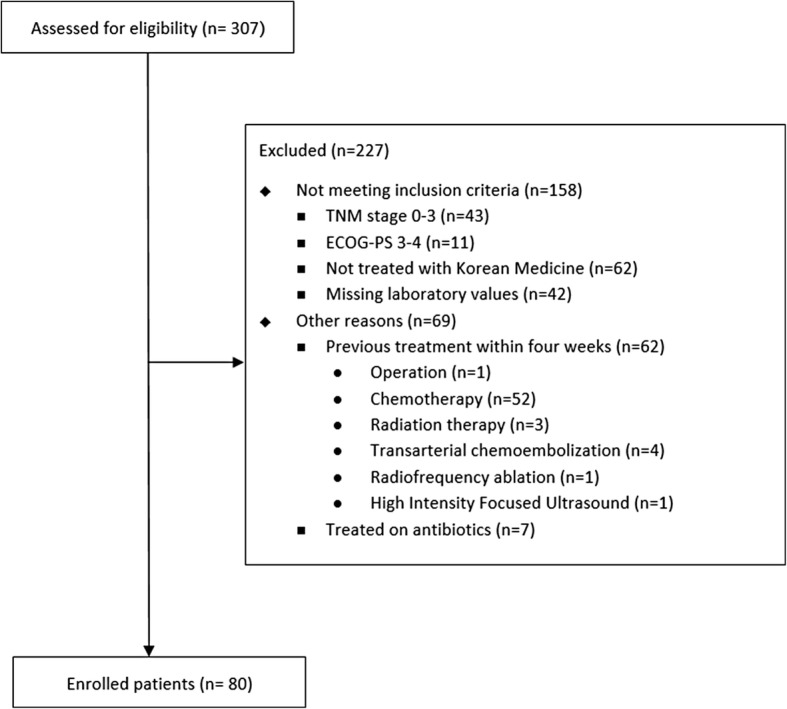
The retrospective cohort study was performed by reviewing medical records of patients with advanced hepatobiliary cancers from June 2006 to September 2016. The demographic and clinicopathological characteristics as well as the biochemical markers were evaluated at the initiation of Korean medicine (KM) treatment. The OS was calculated using Kaplan-Meier estimates. The Cox proportional hazard model was used to identify the independent prognostic significance of serum ferritin for survival.
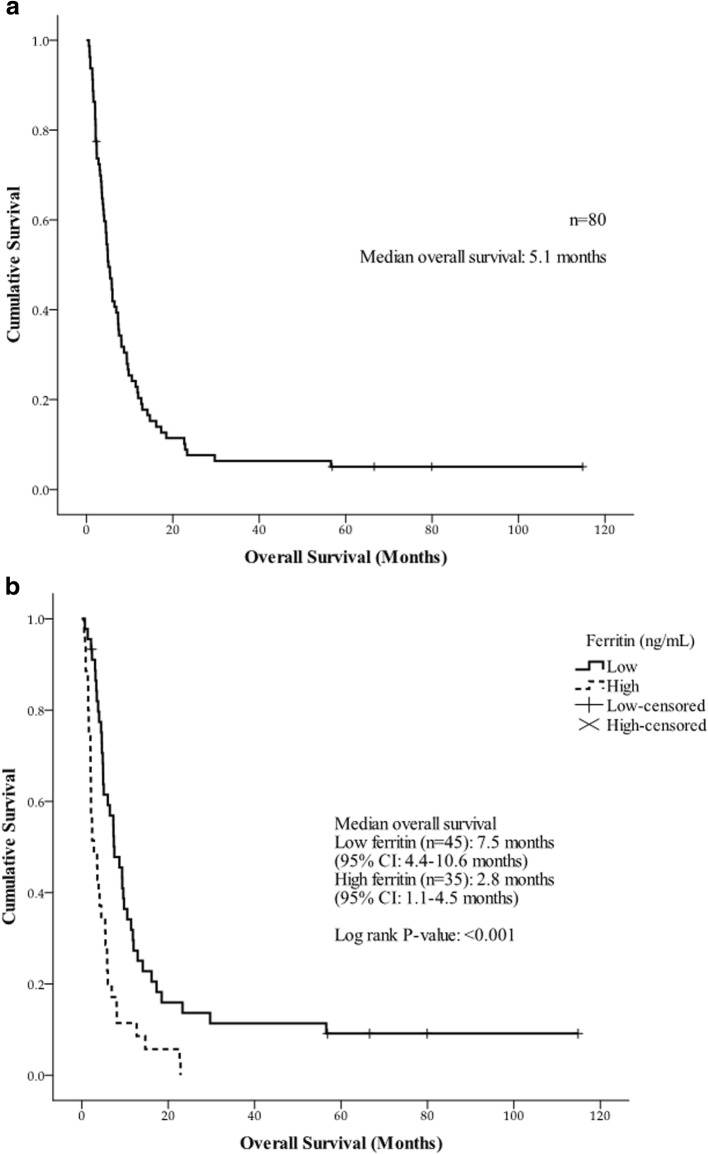
The median OS of all subjects was 5.1 months (range, 0.5-114.9 months). The median OS of group with low ferritin levels and that with high ferritin levels was 7.5 months (range, 0.7-114.9 months) and 2.8 months (range, 0.5-22.8 months), respectively (P < 0.001). The results of the univariate analysis showed that the Eastern Cooperative Oncology Group Performance Status (ECOG-PS) (P = 0.002), tumor type (P = 0.001), prior treatment (P = 0.023), serum ferritin (P < 0.001), hemoglobin (P = 0.002), total bilirubin (P = 0.002), gamma-glutamyl transpeptidase (P = 0.007), albumin (P = 0.013), white blood cell (P = 0.002), and C-reactive protein (CRP) (P < 0.001) were significant factors for the patients' survival outcome. On multivariate analysis controlling confounding factors, ferritin (P = 0.041), CRP (P = 0.010), ECOG-PS (P = 0.010), and tumor type (P = 0.018) were identified as independent prognostic factors for survival.
These results indicate that serum ferritin is a valid clinical biochemical marker to predict survival of patients with advanced hepatobiliary cancers.
晚期肝胆癌是高度致命的癌症,在临床实践中需要精确预测。恶性肿瘤中血清铁蛋白水平升高,高血清铁蛋白水平与各种癌症的不良预后相关。本研究旨在确定血清铁蛋白是否可以独立预测晚期肝胆癌患者的总生存期(OS)。
本回顾性队列研究通过回顾 2006 年 6 月至 2016 年 9 月期间接受晚期肝胆癌治疗的患者的病历。在接受中医治疗时评估人口统计学和临床病理特征以及生化标志物。使用 Kaplan-Meier 估计法计算 OS。使用 Cox 比例风险模型确定血清铁蛋白对生存的独立预后意义。
所有患者的中位 OS 为 5.1 个月(范围 0.5-114.9 个月)。低铁蛋白组和高铁蛋白组的中位 OS 分别为 7.5 个月(范围 0.7-114.9 个月)和 2.8 个月(范围 0.5-22.8 个月)(P < 0.001)。单因素分析结果表明,东部肿瘤协作组体能状态(ECOG-PS)(P = 0.002)、肿瘤类型(P = 0.001)、既往治疗(P = 0.023)、血清铁蛋白(P < 0.001)、血红蛋白(P = 0.002)、总胆红素(P = 0.002)、γ-谷氨酰转肽酶(P = 0.007)、白蛋白(P = 0.013)、白细胞(P = 0.002)和 C 反应蛋白(CRP)(P < 0.001)是影响患者生存结局的显著因素。多因素分析控制混杂因素后,铁蛋白(P = 0.041)、CRP(P = 0.010)、ECOG-PS(P = 0.010)和肿瘤类型(P = 0.018)被确定为生存的独立预后因素。
这些结果表明,血清铁蛋白是预测晚期肝胆癌患者生存的有效临床生化标志物。