Lee Sookyung, Song Anna, Eo Wankyu
1. Department of Clinical Oncology, College of Korean Medicine, Kyung Hee University;
2. Department of Clinical Korean Medicine, Graduate School, Kyung Hee University;
J Cancer. 2016 May 12;7(8):957-64. doi: 10.7150/jca.14797. eCollection 2016.
This study investigated the prognostic impact of serum ferritin for survival in patients with relapsed or refractory metastatic colorectal cancer (mCRC).
This retrospective cohort study reviewed clinicopathological characteristics and laboratory biomarkers in 120 mCRC patients being treated with Korean Medicine (KM). The overall survival (OS) of patients was calculated using the Kaplan-Meier method, and statistical significance was assessed using the log-rank test. Univariate and multivariate analyses of Cox proportional hazards regression were used to evaluate the prognostic impact for survival in relapsed or refractory mCRC patients.
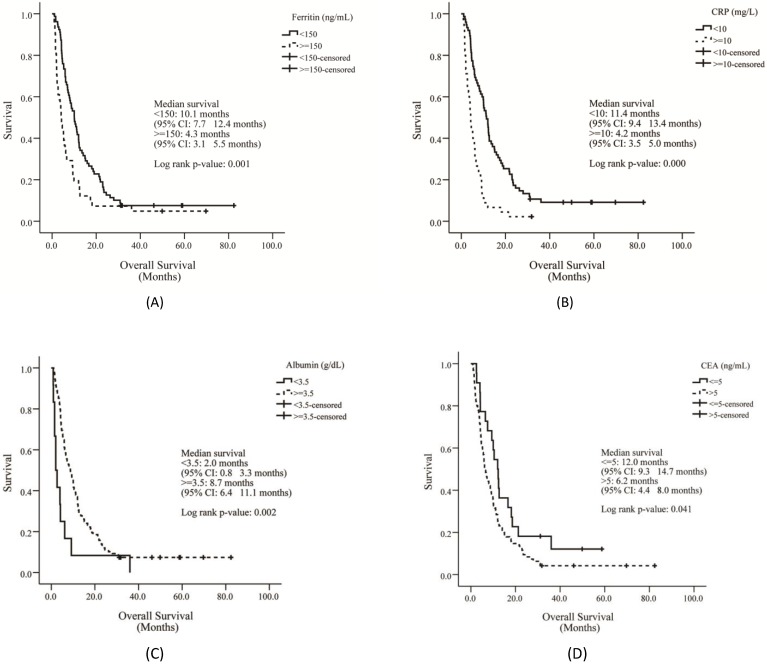
Of the patients, 62.5% had liver metastases, 74.1% underwent greater than second-line chemotherapy, and 80.8% underwent surgery. Median OS was 7.6 months for all patients after the initiation of KM treatment, which was begun 13.7 months, on average, after mCRC diagnosis. Concerning prognostic factors such as the presence of liver metastasis (p = 0.024), high carcinoembryonic antigen level (CEA > 5 ng/mL, p = 0.044), elevated C-reactive protein (CRP ≥ 10.0 mg/L, p = 0.000), high absolute monocyte count (AMC > 413.3 cells/μL, p = 0.034), elevated serum ferritin (ferritin ≥ 150 ng/mL, p = 0.002), low hemoglobin level (Hb < 12 g/dL, p = 0.026) and low albumin (albumin < 3.5 g/dL, p = 0.003) were associated with increased hazard ratios and poor survival. According to the multivariate proportional hazards model with backward and forward manners, albumin (albumin < 3.5 g/dL; hazard ratio (HR) 2.218, 95% confidence interval (CI) 1.135 - 3.990, p = 0.019), CRP (CRP ≥ 10.0 mg/L; HR 2.506, 95% CI 1.644 - 3.822, p = 0.000), CEA (CEA > 5 ng/mL; HR 2.040, 95% CI 1.203 - 3.460, p = 0.008), and serum ferritin (ferritin ≥ 150 ng/mL; HR 1.763, 95% CI 1.169 - 2.660, p = 0.007) were independent prognostic biomarkers of survival in mCRC patients.
These results indicate that serum ferritin acts as an independent prognostic biomarker for survival in relapsed or refractory mCRC patients.
本研究调查了血清铁蛋白对复发或难治性转移性结直肠癌(mCRC)患者生存的预后影响。
这项回顾性队列研究回顾了120例接受韩医学(KM)治疗的mCRC患者的临床病理特征和实验室生物标志物。采用Kaplan-Meier方法计算患者的总生存期(OS),并使用对数秩检验评估统计学意义。采用Cox比例风险回归的单因素和多因素分析来评估复发或难治性mCRC患者生存的预后影响。
患者中,62.5%有肝转移,74.1%接受了二线以上化疗,80.8%接受了手术。所有患者在开始KM治疗后的中位OS为7.6个月,KM治疗平均在mCRC诊断后13.7个月开始。关于预后因素,如肝转移的存在(p = 0.024)、癌胚抗原水平高(CEA > 5 ng/mL,p = 0.044)、C反应蛋白升高(CRP≥10.0 mg/L,p = 0.000)、绝对单核细胞计数高(AMC > 413.3细胞/μL,p = 0.034)、血清铁蛋白升高(铁蛋白≥150 ng/mL,p = 0.002)、血红蛋白水平低(Hb < 12 g/dL,p = 0.026)和白蛋白低(白蛋白< 3.5 g/dL,p = 0.003)与风险比增加和生存不良相关。根据采用前后向方式的多变量比例风险模型,白蛋白(白蛋白< 3.5 g/dL;风险比(HR)2.218,95%置信区间(CI)1.135 - 3.990,p = 0.019)、CRP(CRP≥10.0 mg/L;HR 2.506,95% CI 1.644 - 3.822,p = 0.000)、CEA(CEA > 5 ng/mL;HR 2.040,95% CI 1.203 - 3.460,p = 0.008)和血清铁蛋白(铁蛋白≥150 ng/mL;HR 1.763,95% CI 1.169 - 2.660,p = 0.007)是mCRC患者生存的独立预后生物标志物。
这些结果表明血清铁蛋白是复发或难治性mCRC患者生存的独立预后生物标志物。