Department of Molecular Pharmacology, Albert Einstein College of Medicine, Bronx, NY, USA.
Departamento de Bioquímica e Biologia Molecular, Centro de Ciências Naturais e Exatas, Universidade Federal de Santa Maria, Santa Maria, RS, Brazil.
Neurotox Res. 2018 Oct;34(3):584-596. doi: 10.1007/s12640-018-9915-1. Epub 2018 Jun 7.
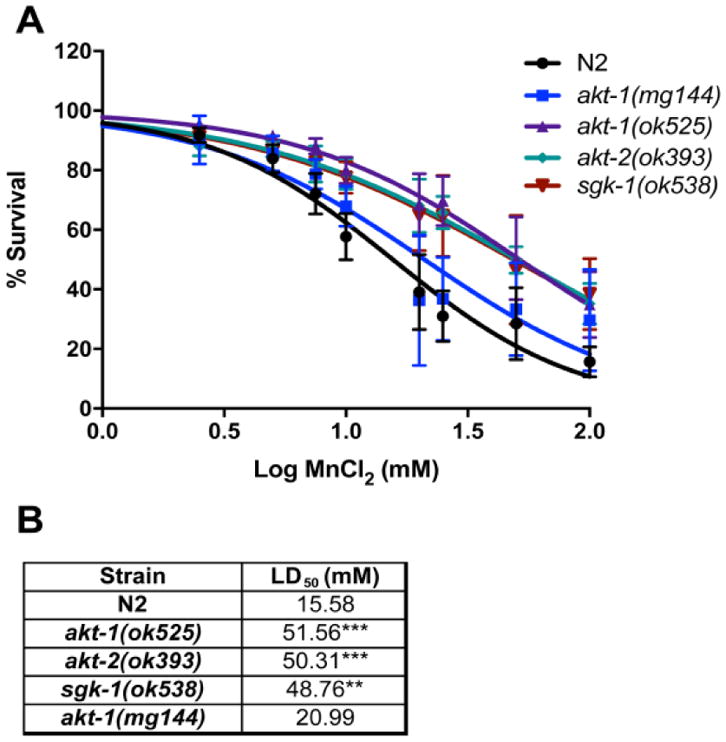
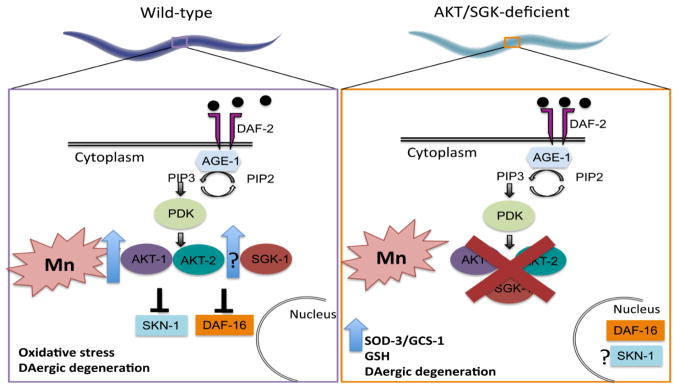
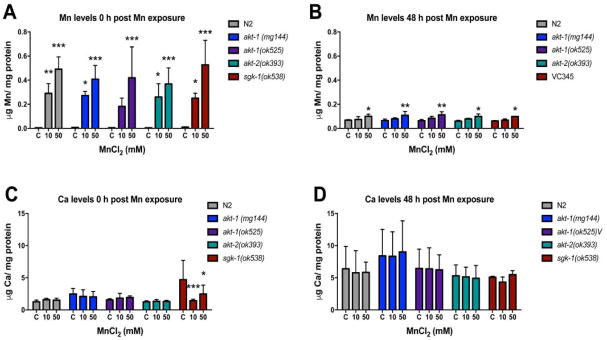
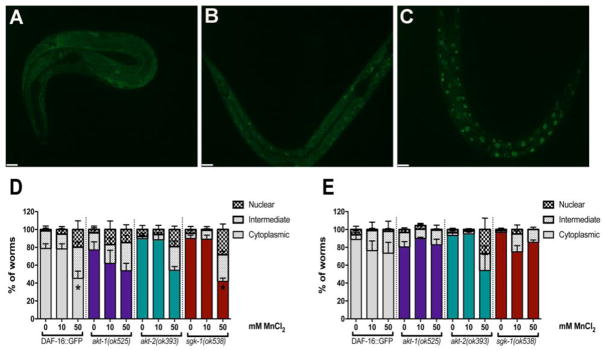
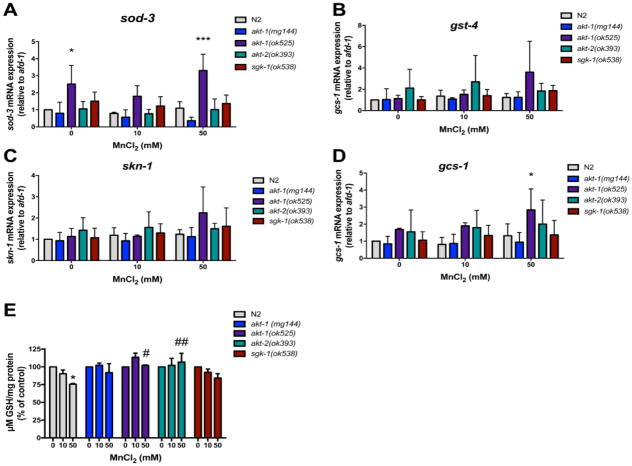
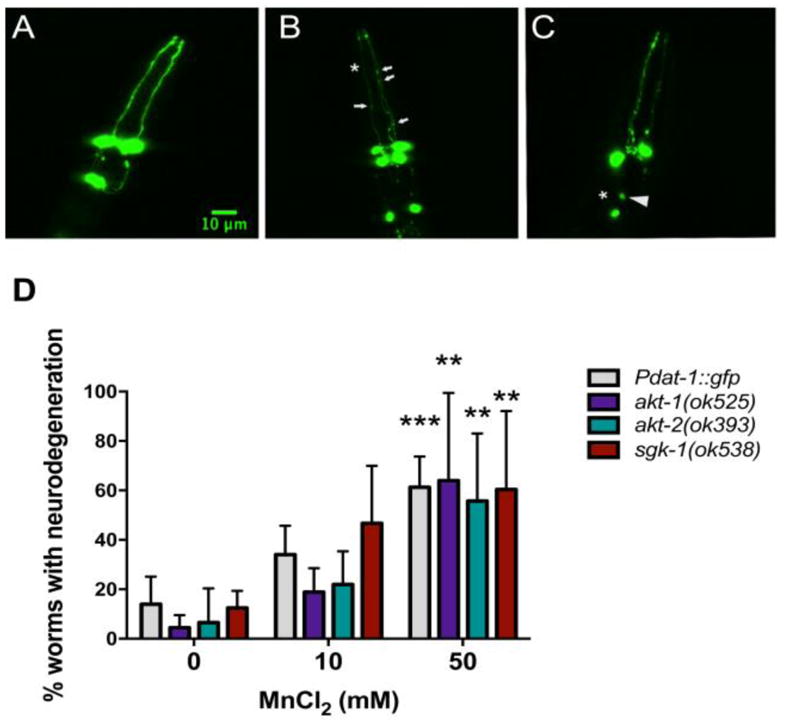
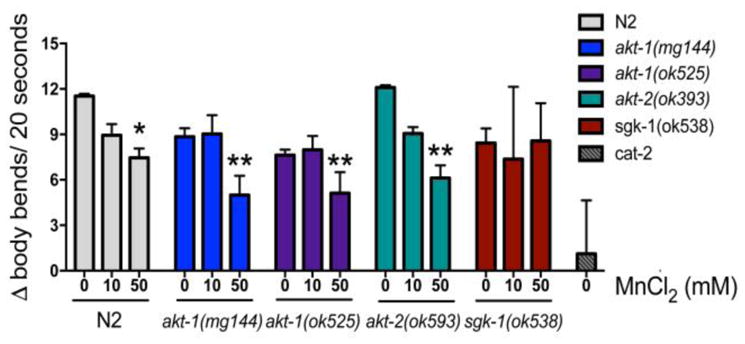
Excessive levels of the essential metal manganese (Mn) may cause a syndrome similar to Parkinson's disease. The model organism Caenorhabditis elegans mimics some of Mn effects in mammals, including dopaminergic neurodegeneration, oxidative stress, and increased levels of AKT. The evolutionarily conserved insulin/insulin-like growth factor-1 signaling pathway (IIS) modulates worm longevity, metabolism, and antioxidant responses by antagonizing the transcription factors DAF-16/FOXO and SKN-1/Nrf-2. AKT-1, AKT-2, and SGK-1 act upstream of these transcription factors. To study the role of these proteins in C. elegans response to Mn intoxication, wild-type N2 and loss-of-function mutants were exposed to Mn (2.5 to 100 mM) for 1 h at the L1 larval stage. Strains with loss-of-function in akt-1, akt-2, and sgk-1 had higher resistance to Mn compared to N2 in the survival test. All strains tested accumulated Mn similarly, as shown by ICP-MS. DAF-16 nuclear translocation was observed by fluorescence microscopy in WT and loss-of-function strains exposed to Mn. qRT-PCR data indicate increased expression of γ-glutamyl cysteine synthetase (GCS-1) antioxidant enzyme in akt-1 mutants. The expression of sod-3 (superoxide dismutase homologue) was increased in the akt-1 mutant worms, independent of Mn treatment. However, dopaminergic neurons degenerated even in the more resistant strains. Dopaminergic function was evaluated with the basal slowing response behavioral test and dopaminergic neuron integrity was evaluated using worms expressing green fluorescent protein (GFP) under the dopamine transporter (DAT-1) promoter. These results suggest that AKT-1/2 and SGK-1 play a role in C. elegans response to Mn intoxication. However, tissue-specific responses may occur in dopaminergic neurons, contributing to degeneration.
过量的必需金属锰(Mn)可能导致类似于帕金森病的综合征。模式生物秀丽隐杆线虫模拟了 Mn 在哺乳动物中的一些作用,包括多巴胺能神经退行性变、氧化应激和 AKT 水平升高。进化上保守的胰岛素/胰岛素样生长因子-1 信号通路(IIS)通过拮抗转录因子 DAF-16/FOXO 和 SKN-1/Nrf-2 来调节线虫的寿命、代谢和抗氧化反应。AKT-1、AKT-2 和 SGK-1 作用于这些转录因子的上游。为了研究这些蛋白在 C. elegans 对 Mn 中毒反应中的作用,野生型 N2 和功能丧失突变体在 L1 幼虫阶段暴露于 Mn(2.5 至 100 mM)1 小时。与 N2 相比,akt-1、akt-2 和 sgk-1 功能丧失突变体在存活试验中对 Mn 的抗性更高。所有测试的菌株对 Mn 的积累相似,如 ICP-MS 所示。在 WT 和 Mn 暴露的功能丧失菌株中,通过荧光显微镜观察到 DAF-16 核易位。qRT-PCR 数据表明,akt-1 突变体中抗氧化酶γ-谷氨酰半胱氨酸合成酶(GCS-1)的表达增加。akt-1 突变体蠕虫中 sod-3(超氧化物歧化酶同源物)的表达增加,与 Mn 处理无关。然而,即使在更具抗性的菌株中,多巴胺能神经元也会退化。使用基础减缓反应行为测试评估多巴胺能神经元功能,并使用多巴胺转运体(DAT-1)启动子下表达绿色荧光蛋白(GFP)的蠕虫评估多巴胺能神经元完整性。这些结果表明,AKT-1/2 和 SGK-1 在 C. elegans 对 Mn 中毒的反应中起作用。然而,多巴胺能神经元可能会发生组织特异性反应,导致退化。