Center for BrainHealth, School of Behavioral and Brain Sciences, University of Texas at Dallas, Dallas, TX, USA.
Department of Health Informatics, School of Health Professions, Rutgers University, Newark, NJ, USA.
Brain Struct Funct. 2018 Sep;223(7):3317-3326. doi: 10.1007/s00429-018-1690-5. Epub 2018 Jun 7.
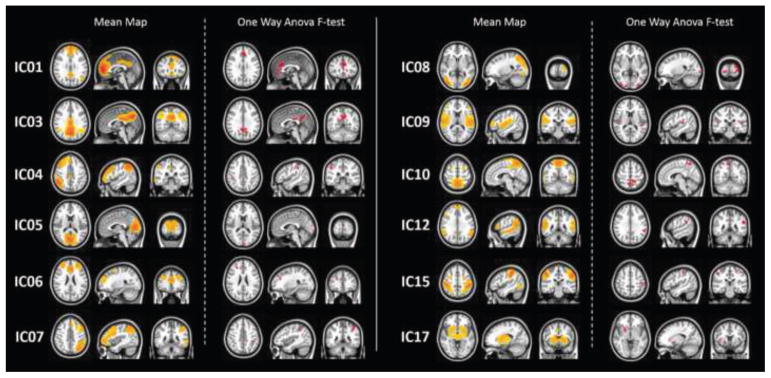
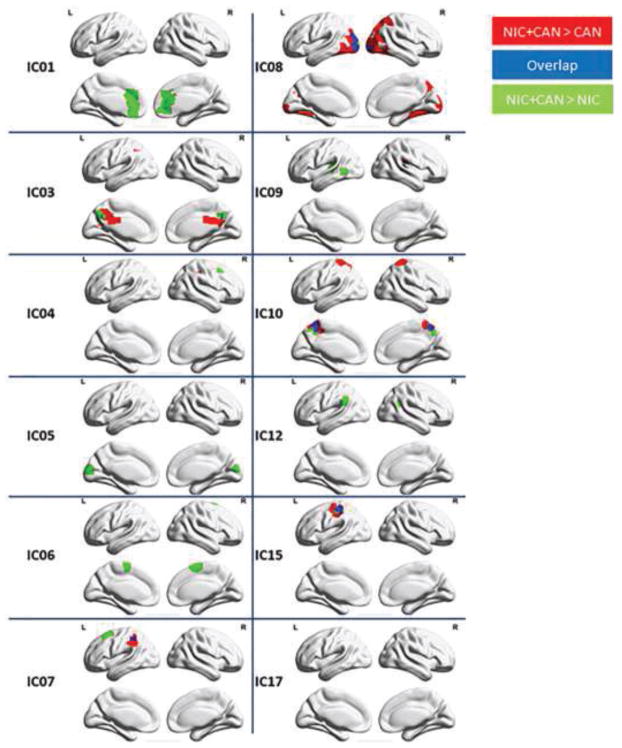
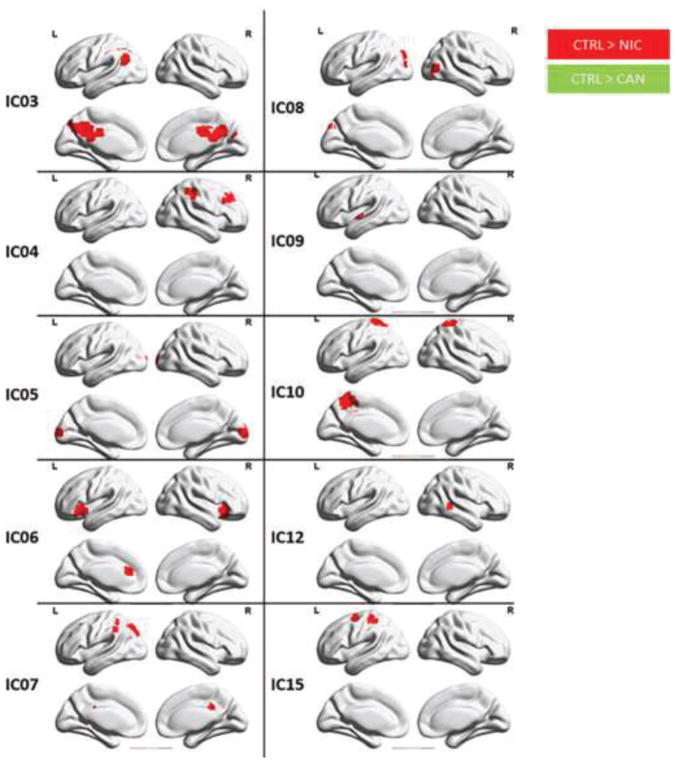
Concomitant cannabis and nicotine use is more prevalent than cannabis use alone; however, to date, most of the literature has focused on associations of isolated cannabis and nicotine use limiting the generalizability of existing research. To determine differential associations of concomitant use of cannabis and nicotine, isolated cannabis use and isolated nicotine use on brain network connectivity, we examined systems-level neural functioning via independent components analysis (ICA) on resting state networks (RSNs) in cannabis users (CAN, n = 53), nicotine users (NIC, n = 28), concomitant nicotine and cannabis users (NIC + CAN, n = 26), and non-users (CTRL, n = 30). Our results indicated that the CTRL group and NIC + CAN users had the greatest functional connectivity relative to CAN users and NIC users in 12 RSNs: anterior default mode network (DMN), posterior DMN, left frontal parietal network, lingual gyrus, salience network, right frontal parietal network, higher visual network, insular cortex, cuneus/precuneus, posterior cingulate gyrus/middle temporal gyrus, dorsal attention network, and basal ganglia network. Post hoc tests showed no significant differences between (1) CTRL and NIC + CAN and (2) NIC and CAN users. These findings of differential associations of isolated vs. combined nicotine and cannabis use demonstrate an interaction between cannabis and nicotine use on RSNs. These unique and combined mechanisms through which cannabis and nicotine influence cortical network functional connectivity are important to consider when evaluating the neurobiological pathways associated with cannabis and nicotine use.
同时使用大麻和尼古丁比单独使用大麻更为普遍;然而,迄今为止,大多数文献都集中在孤立的大麻和尼古丁使用的关联上,限制了现有研究的普遍性。为了确定同时使用大麻和尼古丁、单独使用大麻和单独使用尼古丁对脑网络连接的不同影响,我们通过静息态网络(RSN)的独立成分分析(ICA)检查了大麻使用者(CAN,n=53)、尼古丁使用者(NIC,n=28)、同时使用尼古丁和大麻的使用者(NIC+CAN,n=26)和非使用者(CTRL,n=30)的系统水平神经功能。我们的结果表明,与 CAN 使用者和 NIC 使用者相比,CTRL 组和 NIC+CAN 使用者在 12 个 RSN 中具有最大的功能连接:前默认模式网络(DMN)、后 DMN、左额顶网络、舌回、突显网络、右额顶网络、高级视觉网络、岛叶、楔前叶/中颞叶、背侧注意网络和基底神经节网络。事后检验显示,(1)CTRL 和 NIC+CAN 之间以及(2)NIC 和 CAN 使用者之间没有显著差异。这些关于孤立与联合使用尼古丁和大麻的不同关联的发现表明,大麻和尼古丁的使用之间存在相互作用,对 RSN 有影响。这些大麻和尼古丁影响皮质网络功能连接的独特和联合机制在评估与大麻和尼古丁使用相关的神经生物学途径时非常重要。