University of Wisconsin-Milwaukee, Department of Psychology, 2441 E. Hartford Ave Garland 224, Milwaukee, 53211 WI, USA.
University of Wisconsin-Milwaukee, Department of Psychology, 2441 E. Hartford Ave Garland 224, Milwaukee, 53211 WI, USA.
Neuroimage Clin. 2021;30:102664. doi: 10.1016/j.nicl.2021.102664. Epub 2021 Apr 8.
Cannabis is the most commonly used illicit substance in the United States, and nearly 1 in 4 young adults are current cannabis users. Chronic cannabis use is associated with changes in resting state functional connectivity (RSFC) in the default mode network (DMN) in adolescents and young adults; results are somewhat inconsistent across studies, potentially due to methodological differences. The aims of the present study were to examine potential differences in DMN RSFC between cannabis users and controls, and to examine, as an exploratory analysis, if gender moderated any findings. We further examined whether differences in RSFC related to differences in performance on selected neuropsychological measures.
Seventy-seven 16-26-year-old participants underwent an MRI scan (including resting state scan), neuropsychological battery, toxicology screening, and drug use interview. Differences in DMN connectivity were examined between groups (cannabis vs. control) and with an exploratory group by gender interaction, using a left posterior cingulate cortex (PCC) seed-based analysis conducted in AFNI.
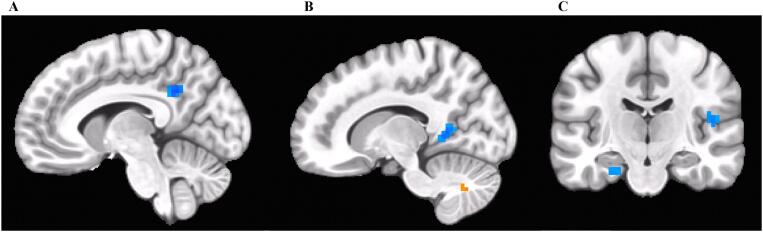
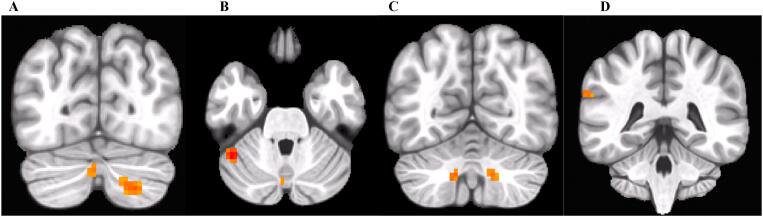
Cannabis users demonstrated weaker connectivity than controls between the left PCC and various DMN nodes, and the right Rolandic operculum/Heschl's gyrus. Cannabis users demonstrated stronger connectivity between the left PCC and the cerebellum and left supramarginal gyrus. The group by gender interaction was not significantly associated with connectivity differences. Stronger left PCC-cerebellum connectivity was associated with poorer performance on cognitive measures in cannabis users. In controls, intra-DMN connectivity was positively correlated with performance on a speeded selective/sustained attention measure.
Consistent with our hypotheses and other studies, cannabis users demonstrated weaker connectivity between the left PCC and DMN nodes. Chronic THC exposure may alter GABA and glutamate concentrations, which may alter brain communication. Future studies should be conducted with a larger sample size and examine gender differences and the mechanism by which these differences may arise.
大麻是美国最常使用的非法物质,近四分之一的年轻人是目前的大麻使用者。慢性大麻使用与青少年和年轻人默认模式网络(DMN)静息状态功能连接(RSFC)的变化有关;由于方法学上的差异,研究结果有些不一致。本研究的目的是检查大麻使用者和对照组之间 DMN RSFC 的潜在差异,并作为探索性分析,检查性别是否调节任何发现。我们还进一步检查了 RSFC 的差异是否与特定神经心理学测量的差异有关。
77 名 16-26 岁的参与者接受了 MRI 扫描(包括静息状态扫描)、神经心理学测试、毒理学筛查和药物使用访谈。使用 AFNI 中的左后扣带回皮层(PCC)种子基础分析,在组间(大麻与对照)和探索性的性别交互作用中检查 DMN 连接的差异。
与对照组相比,大麻使用者的左 PCC 与各种 DMN 节点和右 Rolandic 脑回/ Heschl 的 gyrus 之间的连接较弱。大麻使用者的左 PCC 与小脑和左缘上回之间的连接较强。组间性别交互作用与连接差异无显著相关性。左 PCC-小脑连接越强,大麻使用者的认知测量表现越差。在对照组中,DMN 内连接与速度选择性/持续注意力测量的表现呈正相关。
与我们的假设和其他研究一致,大麻使用者的左 PCC 与 DMN 节点之间的连接较弱。慢性 THC 暴露可能会改变 GABA 和谷氨酸的浓度,从而改变大脑的通讯。未来的研究应该在更大的样本量上进行,并检查性别差异以及这些差异产生的机制。