Lee Kanglock, Choi Ji Wook, Lee Yunhyeong, Han Joung-Ho, Park Seon Mee
Department of Internal Medicine, Chungbuk National University Hospital, Cheongju, Korea.
Department of Internal Medicine, Chungbuk National University College of Medicine, Cheongju, Korea.
Clin Endosc. 2019 Jan;52(1):83-86. doi: 10.5946/ce.2018.060. Epub 2018 Jun 12.
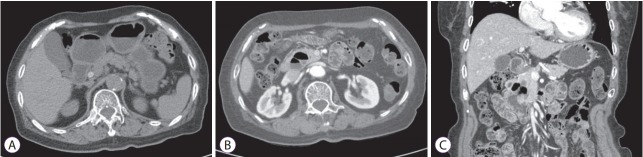
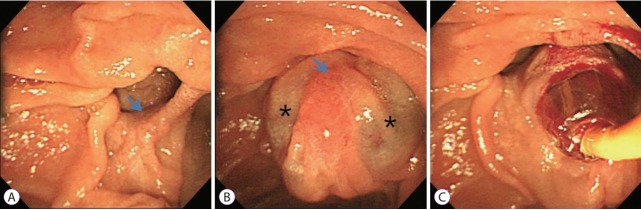
Endoscopic retrograde cholangiopancreatography (ERCP) of the intradiverticular papilla with its invisible orifice remains challenging. Several techniques have been introduced to evert the papillary opening to facilitate cannulation. A 79-year-old woman with bile duct stones underwent ERCP, which revealed that the papilla was located inside a large diverticulum and tended to rotate inward with a trial of papillary cannulation. Submucosal papillary injection of 3 cc of normal saline was performed at 3 and 9 o'clock. Eversion and fixation of a papilla in the diverticulum with this technique allowed selective cannulation of the biliary tree. Stones were retrieved after endoscopic papillary balloon dilation without complications. She had an uneventful post-procedural course. Our findings suggest that submucosal saline injection technique is safe and effective for selective cannulation and can be recommended when cannulation is very difficult because of an intradiverticular papilla.
对开口隐匿的憩室内乳头进行内镜逆行胰胆管造影(ERCP)仍具有挑战性。已经引入了几种技术来翻转乳头开口以利于插管。一名患有胆管结石的79岁女性接受了ERCP,结果显示乳头位于一个大憩室内,在试行乳头插管时容易向内旋转。在3点和9点处进行了3毫升生理盐水的乳头黏膜下注射。用该技术使憩室内乳头翻转并固定,从而能够选择性地插管至胆管树。在内镜下乳头球囊扩张后取出结石,未发生并发症。术后过程顺利。我们的研究结果表明,黏膜下盐水注射技术对于选择性插管是安全有效的,当因憩室内乳头导致插管非常困难时可以推荐使用。