Governor Kremers Centre, Maastricht University Medical Centre+, Maastricht, The Netherlands.
Department of Bioinformatics, NUTRIM School of Nutrition and Translational Research in Metabolism, Maastricht University, Maastricht, The Netherlands.
Mol Psychiatry. 2019 Jan;24(1):10-17. doi: 10.1038/s41380-018-0095-4. Epub 2018 Jun 11.
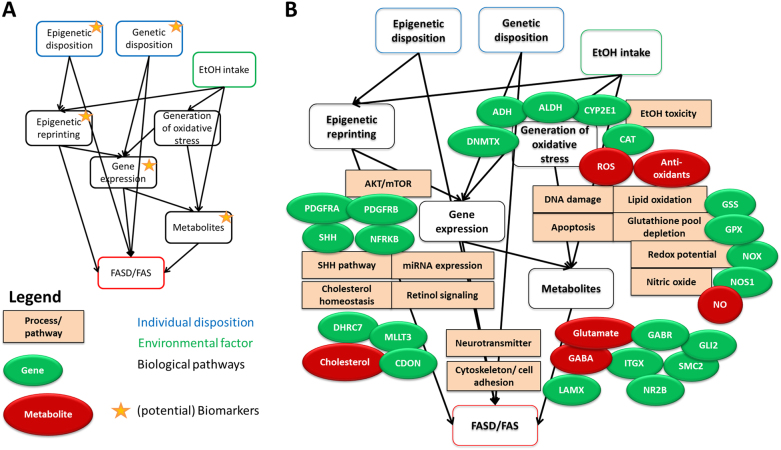
Alcohol exposure during pregnancy affects the development of the fetus in various ways and may lead to Fetal Alcohol Spectrum Disorders (FASD). FASD is one of the leading preventable forms of neurodevelopmental disorders. In the light of prevention and early intervention, knowledge on how ethanol exposure induces fetal damage is urgently needed. Besides direct ethanol and acetaldehyde toxicity, alcohol increases oxidative stress, and subsequent general effects (e.g., epigenetic imprinting, gene expression, and metabolite levels). The current review provides an overview of the existing knowledge about specific downstream pathways for FASD that affects e.g., the SHH pathway, cholesterol homeostasis, neurotransmitter signaling, and effects on the cytoskeleton. Available human data vary greatly, while animal studies with controlled ethanol exposition are only to a certain limit transferable to humans. The main deficits in knowledge about FASD are the lack of pathophysiological understanding and dose-response relationships, together with the lack of reliable biomarkers for either FASD detection or estimation of susceptibility. In addition to single outcome experiments, omics data should be generated to overcome this problem. Therefore, for future studies we recommend holistic data driven analysis, which allows integrative analyses over multiple levels of genetic variation, transcriptomics and metabolomics data to investigate the whole image of FASD development and to provide insight in potential drug targets for intervention.
孕期饮酒会以各种方式影响胎儿的发育,并可能导致胎儿酒精谱系障碍(FASD)。FASD 是可预防的神经发育障碍的主要形式之一。鉴于预防和早期干预,迫切需要了解乙醇暴露如何导致胎儿损伤。除了直接的乙醇和乙醛毒性外,酒精还会增加氧化应激,从而产生一般影响(例如,表观遗传印迹、基因表达和代谢物水平)。本综述概述了关于影响 FASD 的特定下游途径的现有知识,例如 SHH 途径、胆固醇稳态、神经递质信号传递以及对细胞骨架的影响。现有的人类数据差异很大,而具有受控乙醇暴露的动物研究在一定程度上只能转移到人类。关于 FASD 的主要知识缺陷是缺乏病理生理学理解和剂量反应关系,以及缺乏用于检测 FASD 或估计易感性的可靠生物标志物。除了单一结果实验外,还应生成组学数据以克服这个问题。因此,我们建议未来的研究进行整体数据驱动分析,这种分析允许对遗传变异、转录组学和代谢组学数据进行多层次的综合分析,以研究 FASD 发展的全貌,并为干预的潜在药物靶点提供深入了解。