Department of Laboratory Medicine, The Affiliated People's Hospital, Jiangsu University, Zhenjiang, China.
Department of Immunology, Jiangsu Key Laboratory of Laboratory Medicine, School of Medicine, Jiangsu University, Zhenjiang, China.
Front Immunol. 2018 May 28;9:1112. doi: 10.3389/fimmu.2018.01112. eCollection 2018.
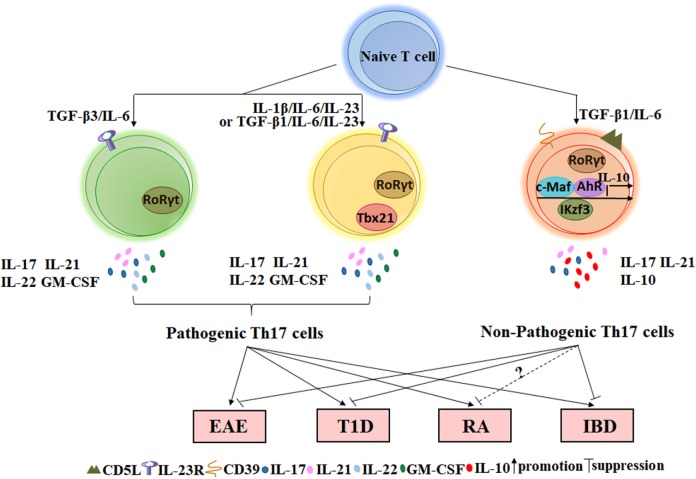
Th17 cells are generally considered to be positive regulators of immune responses because they produce pro-inflammatory cytokines, including IL-17A, IL-17F, and IL-22. Cytokine production not only promotes accumulation of immune cells, such as macrophages, neutrophils and lymphocytes, at inflammatory sites but can also cause tissue pathologies. Conversely, certain Th17 cells can also negatively regulate immune responses by secreting immunosuppressive factors, such as IL-10; these cells are termed non-pathogenic Th17 cells. In this review, we summarize recent advances in the development and regulatory functions of non-pathogenic Th17 cells in autoimmune diseases.
Th17 细胞通常被认为是免疫反应的正向调节者,因为它们产生促炎细胞因子,包括 IL-17A、IL-17F 和 IL-22。细胞因子的产生不仅促进了免疫细胞(如巨噬细胞、中性粒细胞和淋巴细胞)在炎症部位的积聚,还可能导致组织病理学改变。相反,某些 Th17 细胞也可以通过分泌免疫抑制因子,如 IL-10,来负向调节免疫反应;这些细胞被称为无致病性 Th17 细胞。在这篇综述中,我们总结了无致病性 Th17 细胞在自身免疫性疾病中的发育和调节功能的最新进展。