Guangdong Provincial Key Laboratory of Malignant Tumor Epigenetics and Gene Regulation, Department of Cardiology, Sun Yat-sen Memorial Hospital, Sun Yat-sen University, Guangzhou, China.
RNA Biomedical Institute, Sun Yat-sen Memorial Hospital, Sun Yat-sen University, GuangZhou, China.
J Cell Mol Med. 2018 Sep;22(9):4024-4033. doi: 10.1111/jcmm.13692. Epub 2018 Jun 12.
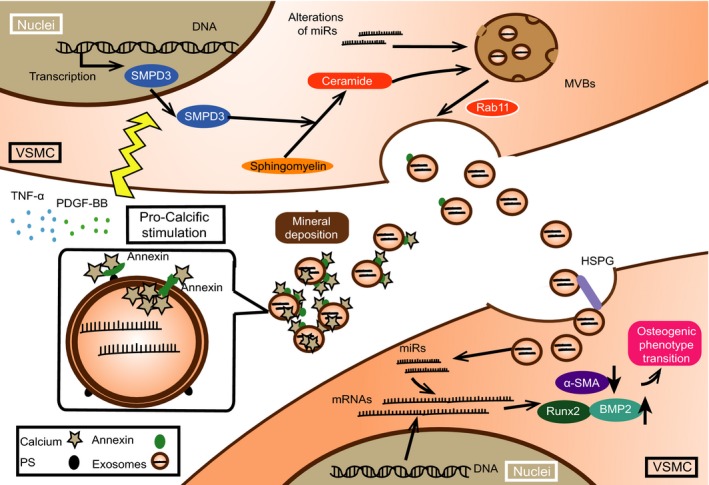
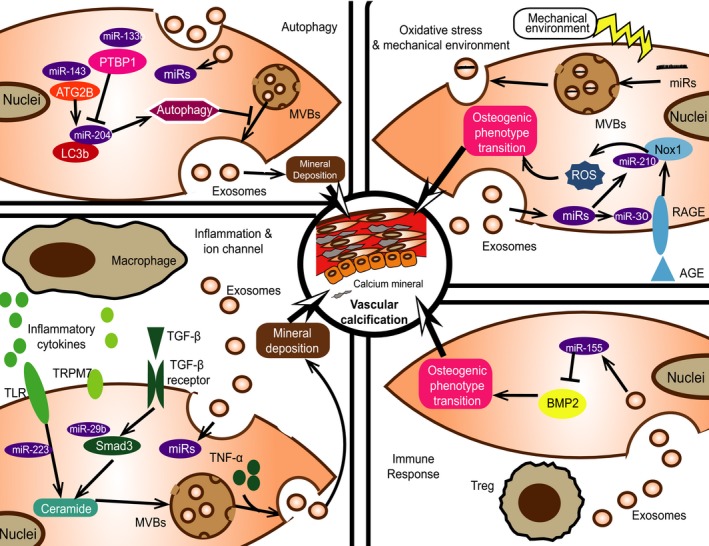
Vascular calcification (VC) is caused by hydroxyapatite deposition in the intimal and medial layers of the vascular wall, leading to severe cardiovascular events in patients with hypertension, chronic kidney disease and diabetes mellitus. VC occurrences involve complicated mechanism networks, such as matrix vesicles or exosomes production, osteogenic differentiation, reduced cell viability, aging and so on. However, with present therapeutic methods targeting at VC ineffectively, novel targets for VC treatment are demanded. Exosomes are proven to participate in VC and function as initializers for mineral deposition. Secreted exosomes loaded with microRNAs are also demonstrated to modulate VC procession in recipient vascular smooth muscle cells. In this review, we targeted at the roles of exosomes during VC, especially at their effects on transporting biological information among cells. Moreover, we will discuss the potential mechanisms of exosomes in VC.
血管钙化(VC)是由于羟磷灰石在血管壁内膜和中膜层的沉积引起的,可导致高血压、慢性肾脏病和糖尿病患者发生严重心血管事件。VC 的发生涉及复杂的机制网络,如基质小泡或外泌体的产生、成骨分化、细胞活力降低、衰老等。然而,目前针对 VC 的治疗方法效果不佳,因此需要寻找 VC 治疗的新靶点。外泌体已被证明参与 VC 形成,并作为矿物质沉积的启动子。含有 microRNAs 的分泌型外泌体也被证明可调节接受的血管平滑肌细胞中的 VC 进程。在本综述中,我们针对外泌体在 VC 中的作用,特别是其在细胞间传递生物信息方面的作用进行了探讨。此外,我们还将讨论外泌体在 VC 中的潜在作用机制。