Department of Epidemiology and Biostatistics, Milken Institute School of Public Health, George Washington University, Washington DC, United States of America.
Department of Epidemiology, School of Public Health, University of Washington, Seattle, WA, United States of America.
PLoS One. 2018 Jun 12;13(6):e0198412. doi: 10.1371/journal.pone.0198412. eCollection 2018.
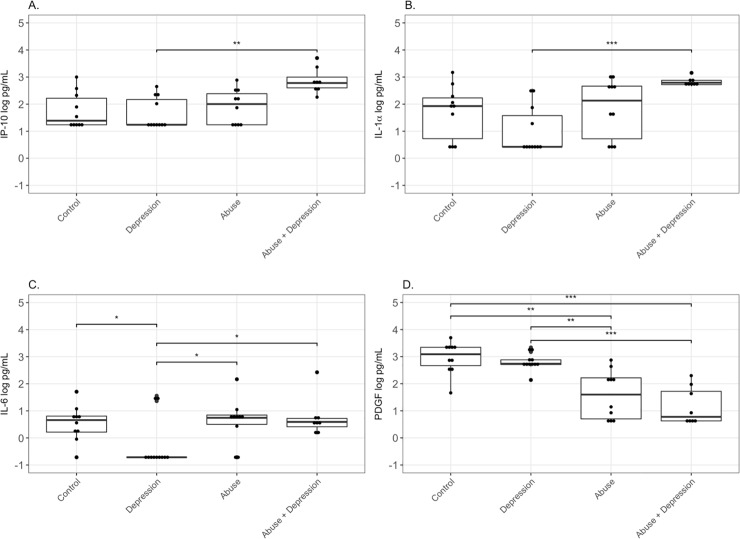
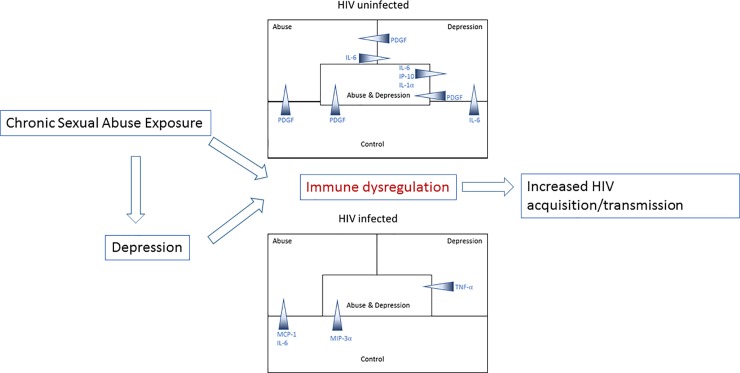
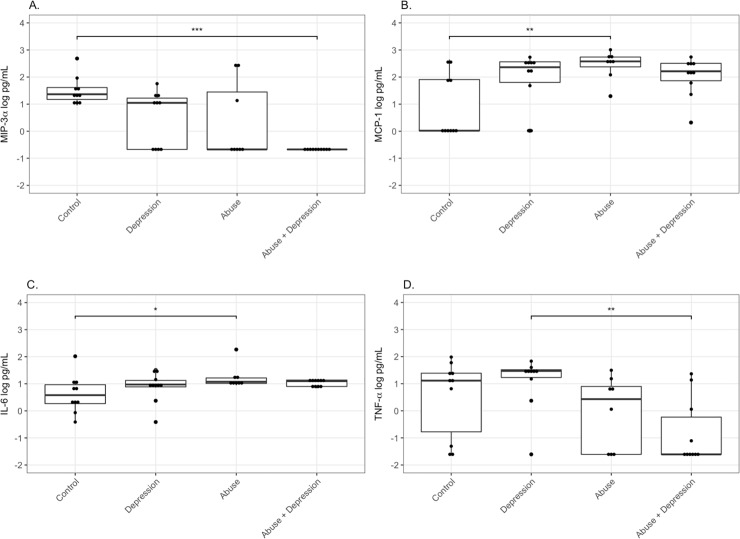
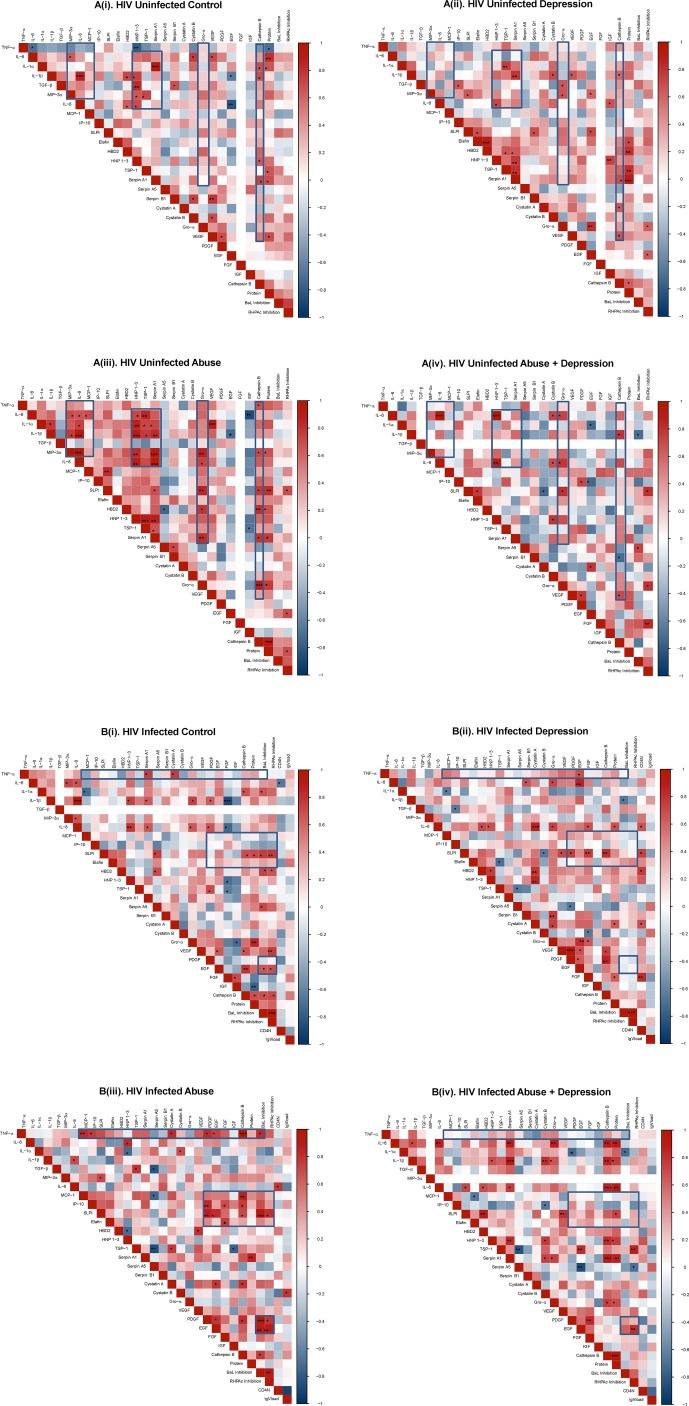
Sexual violence is associated with increased risk of HIV acquisition/transmission in women. Forced sex can result in physical trauma to the reproductive tract as well as severe psychological distress. However, immuno-biological mechanisms linking sexual violence and HIV susceptibility are incompletely understood. Using the Women's Interagency HIV Study repository, a total of 77 women were selected to form 4 groups, stratified by HIV serostatus, in the following categories: 1) no sexual abuse history and low depressive symptom score (below clinically significant cut-off, scores <16) (Control); 2) no sexual abuse history but high depressive symptom score, ≥16 (Depression); 3) chronic sexual abuse exposure and low depressive symptom score (Abuse); 4) chronic sexual abuse exposure and high depressive symptom score (Abuse+Depression). Inflammation-associated cytokines/chemokines/proteases (TNF-α, IL-6, IL-1α, IL-1β, TGF-β MIP-3α, IP-10, MCP-1, Cathepsin B), anti-inflammatory/anti-HIV mediators (Secretory leukocyte protease inhibitor (SLPI), Elafin, beta defensin 2 (HBD2), alpha defensins (HNP 1-3), Thrombospondin (TSP-1), Serpin A1, A5, Cystatin A, B), and wound-healing mediators (Gro-α, VEGF, PDGF, EGF, FGF, IGF), were measured in cervical-vaginal lavage (CVL) using ELISA. Linear regression was used to model association of biomarkers with depression and abuse as predictor variables; the interaction between depression and abuse was also tested. Anti-HIV activity in CVL was tested using TZM-bl indicator cell line. In HIV-uninfected women, median levels of IL-6 (p = 0.04), IL-1α (p<0.01), TGF-β (p = 0.01), IP-10 (p = <0.01), PDGF (p<0.01) and FGF (p<0.01), differed significantly between groups. Specifically, an association was found between chronic sexual abuse and increased IL-1α (p<0.01), MIP-3α (p = 0.04), IP-10 (p<0.01), Serpin B1 (p = 0.01), FGF (p = 0.04) and decreased TGF-β (p<0.01), MCP-1 (p = 0.02), PDGF (p<0.01). Further, there was evidence of significant interactions between chronic sexual abuse and current depression for IL-1α, IP-10, Serpin A1, Cystatin B, and FGF. In HIV-infected women, median levels of TNF-α (p<0.01), IL-6 (p = 0.05), MIP-3α (p<0.01), and MCP-1 (p = 0.01), differed significantly between groups. Specifically, an association was found between chronic sexual abuse and increased MCP-1 (p = 0.03), Gro-α (p = 0.01) and decreased TNF-α (p<0.01), IL-1α (p = 0.02), MIP-3α (p<0.01) and Cathepsin B (p = 0.03). Current depressive symptoms were associated with significantly decreased MIP-3α (p<0.01). There was evidence of significant interactions between chronic sexual abuse and current depression for MCP-1 and FGF. No significant differences were observed in anti-HIV activity among all eight groups. Heat-map analyses revealed distinct immune network patterns, particularly in the Abuse groups for both HIV-infected and uninfected women. Our data indicates a complex relationship between chronic sexual abuse exposure, depressive symptoms, and FRT immune mediators that are also affected by HIV status. Association of chronic sexual abuse with increase in inflammation-associated cytokine/chemokine expression, along with impaired wound-healing associated growth-factors can create a microenvironment that can facilitate HIV infection. Evaluation of longitudinal changes in exposures and biomarkers are needed to untangle the immuno-biological mechanisms that may put women who endure life-long sexual abuse at increased risk for HIV.
性暴力会增加女性感染/传播艾滋病毒的风险。强迫性行为会导致生殖道的身体创伤以及严重的心理困扰。然而,性暴力与艾滋病毒易感性之间的免疫生物学机制尚不完全清楚。利用妇女机构间艾滋病毒研究资料库,总共选择了 77 名妇女,分为 4 组,按艾滋病毒血清阳性状况分层,分为以下类别:1)没有性虐待史和低抑郁症状评分(低于临床显著截止值,评分<16)(对照组);2)没有性虐待史但有高抑郁症状评分,≥16(抑郁组);3)慢性性虐待史和低抑郁症状评分(虐待组);4)慢性性虐待史和高抑郁症状评分(虐待+抑郁组)。在宫颈阴道灌洗液(CVL)中使用 ELISA 测量炎症相关细胞因子/趋化因子/蛋白酶(TNF-α、IL-6、IL-1α、IL-1β、TGF-β、MIP-3α、IP-10、MCP-1、组织蛋白酶 B)、抗炎/抗 HIV 介质(分泌白细胞蛋白酶抑制剂(SLPI)、Elafin、β-防御素 2(HBD2)、α-防御素(HNP 1-3)、血栓调节蛋白(TSP-1)、Serpin A1、A5、Cystatin A、B)和伤口愈合介质(Gro-α、VEGF、PDGF、EGF、FGF、IGF)。线性回归用于建立生物标志物与抑郁和虐待作为预测变量的关联;还测试了抑郁和虐待之间的相互作用。使用 TZM-bl 指示细胞系测试 CVL 中的抗 HIV 活性。在未感染艾滋病毒的女性中,IL-6(p=0.04)、IL-1α(p<0.01)、TGF-β(p=0.01)、IP-10(p<0.01)、PDGF(p<0.01)和 FGF(p<0.01)的中位数水平在各组之间有显著差异。具体来说,在慢性性虐待与增加的 IL-1α(p<0.01)、MIP-3α(p=0.04)、IP-10(p<0.01)、Serpin B1(p=0.01)、FGF(p=0.04)和降低 TGF-β(p<0.01)、MCP-1(p=0.02)、PDGF(p<0.01)之间存在关联。此外,在慢性性虐待和当前抑郁之间存在 IL-1α、IP-10、Serpin A1、Cystatin B 和 FGF 显著的相互作用证据。在感染艾滋病毒的女性中,TNF-α(p<0.01)、IL-6(p=0.05)、MIP-3α(p<0.01)和 MCP-1(p=0.01)的中位数水平在各组之间有显著差异。具体来说,在慢性性虐待与增加的 MCP-1(p=0.03)、Gro-α(p=0.01)和降低的 TNF-α(p<0.01)、IL-1α(p=0.02)、MIP-3α(p<0.01)和组织蛋白酶 B(p=0.03)之间存在关联。当前的抑郁症状与显著降低的 MIP-3α(p<0.01)相关。在慢性性虐待和当前抑郁之间存在 MCP-1 和 FGF 显著的相互作用证据。在所有 8 组中,没有观察到抗 HIV 活性的显著差异。热图分析显示出独特的免疫网络模式,特别是在感染和未感染艾滋病毒的女性的虐待组中。我们的数据表明,慢性性虐待暴露、抑郁症状和 FRT 免疫介质之间存在复杂的关系,这些关系也受到艾滋病毒状况的影响。慢性性虐待与炎症相关细胞因子/趋化因子表达的增加以及伤口愈合相关生长因子的受损有关,这可能会形成一个微环境,从而促进 HIV 感染。需要评估暴露和生物标志物的纵向变化,以理清可能使长期遭受性虐待的妇女面临更高 HIV 风险的免疫生物学机制。