Zhang Melvyn, Ying JiangBo, Song Guo, Fung Daniel Ss, Smith Helen
National Addictions Management Service, Institute of Mental Health, Singapore, Singapore.
Department of Developmental Psychiatry, Institute of Mental Health, Singapore, Singapore.
JMIR Res Protoc. 2018 Jun 12;7(6):e153. doi: 10.2196/resprot.9740.
Cognitive biases refer to automatic attentional and interpretational tendencies, which could be retained by cognitive bias modification interventions. Cristea et al and Jones et al have published reviews (in 2016 and 2017 respectively) on the effectiveness of such interventions. The advancement of technologies such as electronic health (eHealth) and mobile health (mHealth) has led to them being harnessed for the delivery of cognitive bias modification. To date, at least eight studies have demonstrated the feasibility of mobile technologies for the delivery of cognitive bias modification. Most of the studies are limited to a description of the conventional cognitive bias modification methodology that has been adopted. None of the studies shared the developmental process for the methodology involved, such that future studies could adopt it in the cost-effective replication of such interventions.
It is important to have a common platform that could facilitate the design and customization of cognitive bias modification interventions for a variety of psychiatric and addictive disorders. It is the aim of the current research protocol to describe the design of a research platform that allows for customization of cognitive bias modification interventions for addictive disorders.
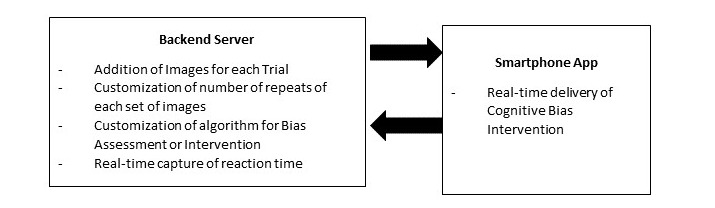
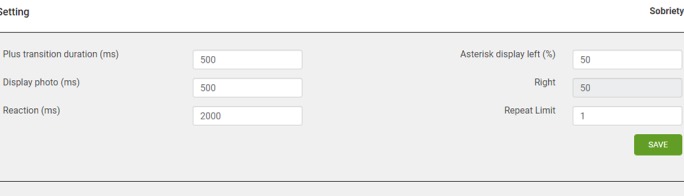
A multidisciplinary team of 2 addiction psychiatrists, a psychologist with expertise in cognitive bias modification, and a computer engineer, were involved in the development of the intervention. The proposed platform would comprise of a mobile phone version of the cognitive bias task which is controlled by a server that could customize the algorithm for the tasks and collate the reaction-time data in realtime. The server would also allow the researcher to program the specific set of images that will be present in the task. The mobile phone app would synchronize with the backend server in real-time. An open-sourced cross-platform gaming software from React Native was used in the current development.
Multimedia Appendix 1 contains a video demonstrating the operation of the app, as well as a sample dataset of the reaction times (used for the computation of attentional biases) captured by the app.
The current design can be utilized for cognitive bias modification across a spectrum of disorders and is not limited to one disorder. It will be of value for future research to utilize the above platform and compare the efficacy of mHealth approaches, such as the one described in this study, with conventional Web-based approaches in the delivery of attentional bias modification interventions.
RR1-10.2196/9740.
认知偏差是指自动的注意力和解释倾向,认知偏差修正干预措施可以改变这些倾向。克里斯蒂亚等人以及琼斯等人分别在2016年和2017年发表了关于此类干预措施有效性的综述。电子健康(eHealth)和移动健康(mHealth)等技术的进步促使它们被用于提供认知偏差修正。迄今为止,至少有八项研究证明了移动技术用于提供认知偏差修正的可行性。大多数研究仅限于对所采用的传统认知偏差修正方法的描述。没有一项研究分享所涉及方法的开发过程,以便未来的研究能够在经济高效地复制此类干预措施时采用它。
拥有一个能够促进针对各种精神疾病和成瘾性疾病设计和定制认知偏差修正干预措施的通用平台非常重要。本研究方案的目的是描述一个研究平台的设计,该平台允许针对成瘾性疾病定制认知偏差修正干预措施。
一个由2名成瘾精神科医生、一名在认知偏差修正方面有专长的心理学家和一名计算机工程师组成的多学科团队参与了该干预措施的开发。拟议的平台将包括一个认知偏差任务的手机版本,该版本由一个服务器控制,该服务器可以为任务定制算法并实时整理反应时间数据。该服务器还将允许研究人员对任务中出现的特定图像集进行编程。手机应用程序将与后端服务器实时同步。当前开发中使用了来自React Native的开源跨平台游戏软件。
多媒体附录1包含一个演示应用程序操作的视频,以及该应用程序捕获的反应时间(用于计算注意力偏差)的示例数据集。
当前的设计可用于跨一系列疾病的认知偏差修正,不限于一种疾病。未来的研究利用上述平台并比较移动健康方法(如本研究中所述的方法)与传统基于网络的方法在提供注意力偏差修正干预措施方面的疗效将具有价值。
RR1-10.2196/9740