• 文献检索
  • 文档翻译
  • 深度研究
  • 学术资讯
  • Suppr Zotero 插件Zotero 插件
  • 邀请有礼
  • 套餐&价格
  • 历史记录
应用&插件
Suppr Zotero 插件Zotero 插件浏览器插件Mac 客户端Windows 客户端微信小程序
定价
高级版会员购买积分包购买API积分包
服务
文献检索文档翻译深度研究API 文档MCP 服务
关于我们
关于 Suppr公司介绍联系我们用户协议隐私条款
关注我们

Suppr 超能文献

核心技术专利:CN118964589B侵权必究
粤ICP备2023148730 号-1Suppr @ 2026

文献检索

告别复杂PubMed语法,用中文像聊天一样搜索,搜遍4000万医学文献。AI智能推荐,让科研检索更轻松。

立即免费搜索

文件翻译

保留排版,准确专业,支持PDF/Word/PPT等文件格式,支持 12+语言互译。

免费翻译文档

深度研究

AI帮你快速写综述,25分钟生成高质量综述,智能提取关键信息,辅助科研写作。

立即免费体验

及时发现康复问题:自动语言分析和监督式机器学习在在线药物滥用论坛中的应用

Detecting Recovery Problems Just in Time: Application of Automated Linguistic Analysis and Supervised Machine Learning to an Online Substance Abuse Forum.

作者信息

Kornfield Rachel, Sarma Prathusha K, Shah Dhavan V, McTavish Fiona, Landucci Gina, Pe-Romashko Klaren, Gustafson David H

机构信息

School of Journalism and Mass Communication, University of Wisconsin-Madison, Madison, WI, United States.

Department of Electrical & Computer Engineering, University of Wisconsin-Madison, Madison, WI, United States.

出版信息

J Med Internet Res. 2018 Jun 12;20(6):e10136. doi: 10.2196/10136.

DOI:10.2196/10136
PMID:29895517
原文链接:https://pmc.ncbi.nlm.nih.gov/articles/PMC6019846/
Abstract

BACKGROUND

Online discussion forums allow those in addiction recovery to seek help through text-based messages, including when facing triggers to drink or use drugs. Trained staff (or "moderators") may participate within these forums to offer guidance and support when participants are struggling but must expend considerable effort to continually review new content. Demands on moderators limit the scalability of evidence-based digital health interventions.

OBJECTIVE

Automated identification of recovery problems could allow moderators to engage in more timely and efficient ways with participants who are struggling. This paper aimed to investigate whether computational linguistics and supervised machine learning can be applied to successfully flag, in real time, those discussion forum messages that moderators find most concerning.

METHODS

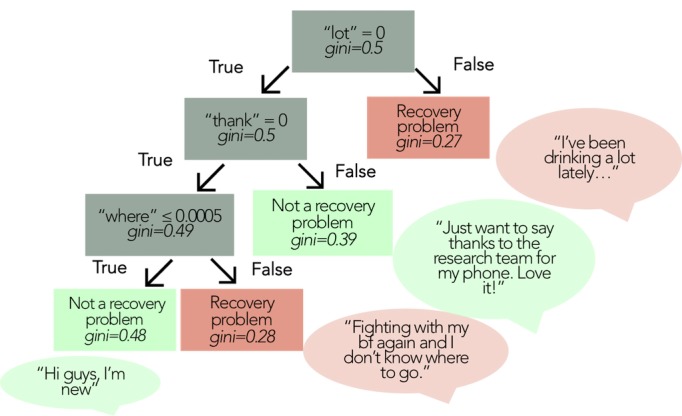
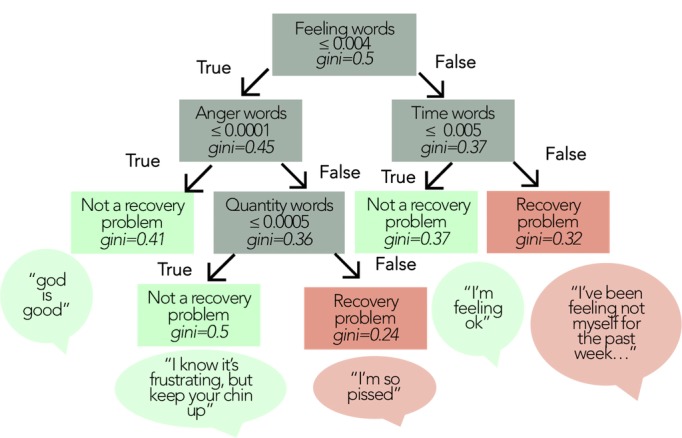
Training data came from a trial of a mobile phone-based health intervention for individuals in recovery from alcohol use disorder, with human coders labeling discussion forum messages according to whether or not authors mentioned problems in their recovery process. Linguistic features of these messages were extracted via several computational techniques: (1) a Bag-of-Words approach, (2) the dictionary-based Linguistic Inquiry and Word Count program, and (3) a hybrid approach combining the most important features from both Bag-of-Words and Linguistic Inquiry and Word Count. These features were applied within binary classifiers leveraging several methods of supervised machine learning: support vector machines, decision trees, and boosted decision trees. Classifiers were evaluated in data from a later deployment of the recovery support intervention.

RESULTS

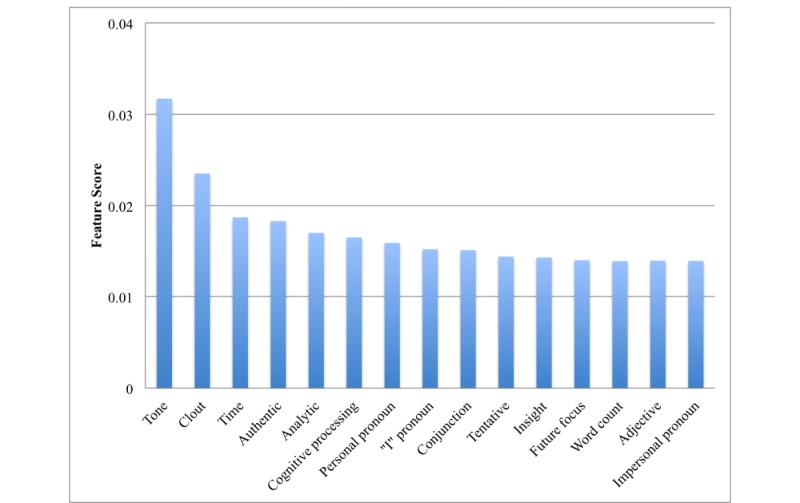
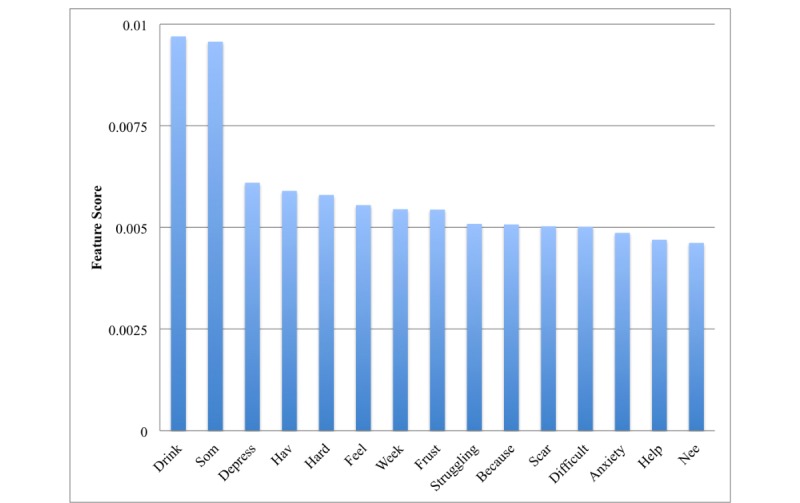
To distinguish recovery problem disclosures, the Bag-of-Words approach relied on domain-specific language, including words explicitly linked to substance use and mental health ("drink," "relapse," "depression," and so on), whereas the Linguistic Inquiry and Word Count approach relied on language characteristics such as tone, affect, insight, and presence of quantifiers and time references, as well as pronouns. A boosted decision tree classifier, utilizing features from both Bag-of-Words and Linguistic Inquiry and Word Count performed best in identifying problems disclosed within the discussion forum, achieving 88% sensitivity and 82% specificity in a separate cohort of patients in recovery.

CONCLUSIONS

Differences in language use can distinguish messages disclosing recovery problems from other message types. Incorporating machine learning models based on language use allows real-time flagging of concerning content such that trained staff may engage more efficiently and focus their attention on time-sensitive issues.
https://cdn.ncbi.nlm.nih.gov/pmc/blobs/cb06/6019846/1bdba8f31e91/jmir_v20i6e10136_fig6.jpg
https://cdn.ncbi.nlm.nih.gov/pmc/blobs/cb06/6019846/1dc13633a274/jmir_v20i6e10136_fig1.jpg
https://cdn.ncbi.nlm.nih.gov/pmc/blobs/cb06/6019846/a26ad8992e49/jmir_v20i6e10136_fig2.jpg
https://cdn.ncbi.nlm.nih.gov/pmc/blobs/cb06/6019846/b9e58cc6ef75/jmir_v20i6e10136_fig3.jpg
https://cdn.ncbi.nlm.nih.gov/pmc/blobs/cb06/6019846/1d75686f60cc/jmir_v20i6e10136_fig4.jpg
https://cdn.ncbi.nlm.nih.gov/pmc/blobs/cb06/6019846/1bdba8f31e91/jmir_v20i6e10136_fig6.jpg
https://cdn.ncbi.nlm.nih.gov/pmc/blobs/cb06/6019846/1dc13633a274/jmir_v20i6e10136_fig1.jpg
https://cdn.ncbi.nlm.nih.gov/pmc/blobs/cb06/6019846/a26ad8992e49/jmir_v20i6e10136_fig2.jpg
https://cdn.ncbi.nlm.nih.gov/pmc/blobs/cb06/6019846/b9e58cc6ef75/jmir_v20i6e10136_fig3.jpg
https://cdn.ncbi.nlm.nih.gov/pmc/blobs/cb06/6019846/1d75686f60cc/jmir_v20i6e10136_fig4.jpg
https://cdn.ncbi.nlm.nih.gov/pmc/blobs/cb06/6019846/1bdba8f31e91/jmir_v20i6e10136_fig6.jpg
摘要

背景

在线讨论论坛使处于成瘾康复期的人能够通过文本信息寻求帮助,包括在面临饮酒或使用毒品的诱因时。训练有素的工作人员(或“版主”)可能会参与这些论坛,在参与者遇到困难时提供指导和支持,但必须花费大量精力持续审查新内容。对版主的要求限制了循证数字健康干预措施的可扩展性。

目的

自动识别康复问题可以使版主以更及时、高效的方式与遇到困难的参与者互动。本文旨在研究计算语言学和监督机器学习是否可以应用于实时成功标记版主认为最值得关注的那些讨论论坛信息。

方法

训练数据来自一项针对酒精使用障碍康复者的基于手机的健康干预试验,由人工编码员根据作者是否提及康复过程中的问题对讨论论坛信息进行标注。这些信息的语言特征通过几种计算技术提取:(1)词袋法,(2)基于词典的语言查询与字数统计程序,以及(3)一种结合词袋法和语言查询与字数统计中最重要特征的混合方法。这些特征应用于利用几种监督机器学习方法的二元分类器中:支持向量机、决策树和增强决策树。分类器在康复支持干预措施后期部署的数据中进行评估。

结果

为了区分康复问题披露,词袋法依赖于特定领域的语言,包括与物质使用和心理健康明确相关的词汇(“饮酒”、“复发”、“抑郁”等),而语言查询与字数统计方法依赖于语言特征,如语气、情感、洞察力、量词和时间参照的存在以及代词的使用。一个利用词袋法和语言查询与字数统计特征的增强决策树分类器在识别讨论论坛中披露的问题方面表现最佳,在另一组康复患者中实现了8

相似文献

1
Detecting Recovery Problems Just in Time: Application of Automated Linguistic Analysis and Supervised Machine Learning to an Online Substance Abuse Forum.及时发现康复问题:自动语言分析和监督式机器学习在在线药物滥用论坛中的应用
J Med Internet Res. 2018 Jun 12;20(6):e10136. doi: 10.2196/10136.
2
Using Machine Learning of Online Expression to Explain Recovery Trajectories: Content Analytic Approach to Studying a Substance Use Disorder Forum.利用在线表达的机器学习来解释恢复轨迹:研究物质使用障碍论坛的内容分析方法。
J Med Internet Res. 2023 Aug 22;25:e45589. doi: 10.2196/45589.
3
What Do You Say Before You Relapse? How Language Use in a Peer-to-peer Online Discussion Forum Predicts Risky Drinking among Those in Recovery.复发前你会说什么?同伴在线讨论论坛中的语言使用如何预测康复者的危险饮酒行为。
Health Commun. 2018 Sep;33(9):1184-1193. doi: 10.1080/10410236.2017.1350906. Epub 2017 Aug 9.
4
Assessing Suicide Risk and Emotional Distress in Chinese Social Media: A Text Mining and Machine Learning Study.评估中国社交媒体中的自杀风险和情绪困扰:一项文本挖掘与机器学习研究。
J Med Internet Res. 2017 Jul 10;19(7):e243. doi: 10.2196/jmir.7276.
5
Linguistic predictors from Facebook postings of substance use disorder treatment retention versus discontinuation.社交媒体帖文中的语言预测因子与物质使用障碍治疗的保留和中断。
Am J Drug Alcohol Abuse. 2022 Sep 3;48(5):573-585. doi: 10.1080/00952990.2022.2091450. Epub 2022 Jul 19.
6
A comparison of rule-based and machine learning approaches for classifying patient portal messages.基于规则和机器学习方法在患者门户消息分类中的比较。
Int J Med Inform. 2017 Sep;105:110-120. doi: 10.1016/j.ijmedinf.2017.06.004. Epub 2017 Jun 23.
7
Studying How Individuals Who Express the Feeling of Loneliness in an Online Loneliness Forum Communicate in a Nonloneliness Forum: Observational Study.研究在在线孤独论坛中表达孤独感的个体如何在非孤独论坛中进行交流:观察性研究。
JMIR Form Res. 2021 Jul 20;5(7):e28738. doi: 10.2196/28738.
8
Understanding Mental Health Issues in Different Subdomains of Social Networking Services: Computational Analysis of Text-Based Reddit Posts.理解不同社交网络服务领域的心理健康问题:基于文本的 Reddit 帖子的计算分析。
J Med Internet Res. 2023 Nov 30;25:e49074. doi: 10.2196/49074.
9
Schizophrenia Detection Using Machine Learning Approach from Social Media Content.基于社交媒体内容的机器学习方法进行精神分裂症检测。
Sensors (Basel). 2021 Sep 3;21(17):5924. doi: 10.3390/s21175924.
10
Social Reminiscence in Older Adults' Everyday Conversations: Automated Detection Using Natural Language Processing and Machine Learning.老年人日常对话中的社会怀旧:使用自然语言处理和机器学习的自动检测。
J Med Internet Res. 2020 Sep 15;22(9):e19133. doi: 10.2196/19133.

引用本文的文献

1
Assessing a pilot scheme of intensive support and assertive linkage in levels of engagement, retention, and recovery capital for people in recovery housing using quasi-experimental methods.使用准实验方法评估强化支持和果断联系试点计划,以评估康复住房中康复人员的参与度、保留率和恢复资本水平。
J Subst Use Addict Treat. 2024 Mar;158:209283. doi: 10.1016/j.josat.2023.209283. Epub 2023 Dec 28.
2
Using Machine Learning of Online Expression to Explain Recovery Trajectories: Content Analytic Approach to Studying a Substance Use Disorder Forum.利用在线表达的机器学习来解释恢复轨迹:研究物质使用障碍论坛的内容分析方法。
J Med Internet Res. 2023 Aug 22;25:e45589. doi: 10.2196/45589.
3

本文引用的文献

1
Implementing a Mobile Health System to Integrate the Treatment of Addiction Into Primary Care: A Hybrid Implementation-Effectiveness Study.实施移动健康系统以将成瘾治疗纳入初级保健:一项混合实施-效果研究。
J Med Internet Res. 2018 Jan 30;20(1):e37. doi: 10.2196/jmir.8928.
2
Clinical documentation variations and NLP system portability: a case study in asthma birth cohorts across institutions.临床文档差异与自然语言处理系统的可移植性:跨机构哮喘出生队列的案例研究
J Am Med Inform Assoc. 2018 Mar 1;25(3):353-359. doi: 10.1093/jamia/ocx138.
3
Clinical information extraction applications: A literature review.
Advancing Artificial Intelligence in Health Settings Outside the Hospital and Clinic.
推动医院和诊所之外的健康领域的人工智能发展。
NAM Perspect. 2020 Nov 30;2020. doi: 10.31478/202011f. eCollection 2020.
4
Alcohol Use Disorder in the Age of Technology: A Review of Wearable Biosensors in Alcohol Use Disorder Treatment.科技时代的酒精使用障碍:酒精使用障碍治疗中可穿戴生物传感器的综述
Front Psychiatry. 2021 Mar 22;12:642813. doi: 10.3389/fpsyt.2021.642813. eCollection 2021.
5
Learning From Others Without Sacrificing Privacy: Simulation Comparing Centralized and Federated Machine Learning on Mobile Health Data.从他人身上学习而不牺牲隐私:移动健康数据集中式和联邦机器学习的模拟比较。
JMIR Mhealth Uhealth. 2021 Mar 30;9(3):e23728. doi: 10.2196/23728.
6
Online digital recovery support services: An overview of the science and their potential to help individuals with substance use disorder during COVID-19 and beyond.在线数字康复支持服务:概述科学及其在 COVID-19 期间及以后帮助有物质使用障碍的个体的潜力。
J Subst Abuse Treat. 2021 Jan;120:108152. doi: 10.1016/j.jsat.2020.108152. Epub 2020 Oct 4.
7
Lightme: analysing language in internet support groups for mental health.Lightme:分析心理健康互联网支持小组中的语言。
Health Inf Sci Syst. 2020 Oct 13;8(1):34. doi: 10.1007/s13755-020-00115-7. eCollection 2020 Dec.
8
Associations Between Substance Use and Instagram Participation to Inform Social Network-Based Screening Models: Multimodal Cross-Sectional Study.物质使用与 Instagram 参与度的关联:基于社交网络的筛查模型的多模态横断面研究。
J Med Internet Res. 2020 Sep 16;22(9):e21916. doi: 10.2196/21916.
9
Transfer Learning for Risk Classification of Social Media Posts: Model Evaluation Study.社交媒体帖子风险分类的迁移学习:模型评估研究
J Med Internet Res. 2020 May 13;22(5):e15371. doi: 10.2196/15371.
10
Understanding User Experience: Exploring Participants' Messages With a Web-Based Behavioral Health Intervention for Adolescents With Chronic Pain.理解用户体验:通过基于网络的行为健康干预措施探索慢性疼痛青少年参与者的信息。
J Med Internet Res. 2019 Apr 15;21(4):e11756. doi: 10.2196/11756.
临床信息提取应用:文献综述。
J Biomed Inform. 2018 Jan;77:34-49. doi: 10.1016/j.jbi.2017.11.011. Epub 2017 Nov 21.
4
Discovering Shifts to Suicidal Ideation from Mental Health Content in Social Media.从社交媒体上的心理健康内容中发现向自杀意念的转变。
Proc SIGCHI Conf Hum Factor Comput Syst. 2016 May;2016:2098-2110. doi: 10.1145/2858036.2858207.
5
What Do You Say Before You Relapse? How Language Use in a Peer-to-peer Online Discussion Forum Predicts Risky Drinking among Those in Recovery.复发前你会说什么?同伴在线讨论论坛中的语言使用如何预测康复者的危险饮酒行为。
Health Commun. 2018 Sep;33(9):1184-1193. doi: 10.1080/10410236.2017.1350906. Epub 2017 Aug 9.
6
Implementing an mHealth system for substance use disorders in primary care: a mixed methods study of clinicians' initial expectations and first year experiences.在初级保健中实施用于物质使用障碍的移动健康系统:一项关于临床医生初始期望和第一年经历的混合方法研究
BMC Med Inform Decis Mak. 2016 Sep 29;16(1):126. doi: 10.1186/s12911-016-0365-5.
7
Validating Machine Learning Algorithms for Twitter Data Against Established Measures of Suicidality.验证针对自杀倾向的已确立衡量标准的 Twitter 数据的机器学习算法。
JMIR Ment Health. 2016 May 16;3(2):e21. doi: 10.2196/mental.4822.
8
Social Media, Big Data, and Mental Health: Current Advances and Ethical Implications.社交媒体、大数据与心理健康:当前进展及伦理影响
Curr Opin Psychol. 2016 Jun;9:77-82. doi: 10.1016/j.copsyc.2016.01.004.
9
Smartphone-Based Conversational Agents and Responses to Questions About Mental Health, Interpersonal Violence, and Physical Health.基于智能手机的对话代理以及对心理健康、人际暴力和身体健康相关问题的回应。
JAMA Intern Med. 2016 May 1;176(5):619-25. doi: 10.1001/jamainternmed.2016.0400.
10
A Pilot Test of a Mobile App for Drug Court Participants.一款面向毒品法庭参与者的移动应用程序的试点测试。
Subst Abuse. 2016 Feb 14;10:1-7. doi: 10.4137/SART.S33390. eCollection 2016.