Department of Otorhinolaryngology, Head and Neck Surgery, University Medical Center Utrecht, Utrecht University, Utrecht, The Netherlands.
Brain Center Rudolf Magnus, University Medical Center Utrecht, Utrecht, The Netherlands.
BMJ Open. 2018 Jun 11;8(6):e021068. doi: 10.1136/bmjopen-2017-021068.
To develop and internally validate a prediction model for tinnitus recovery following unilateral cochlear implantation.
A cross-sectional retrospective study.
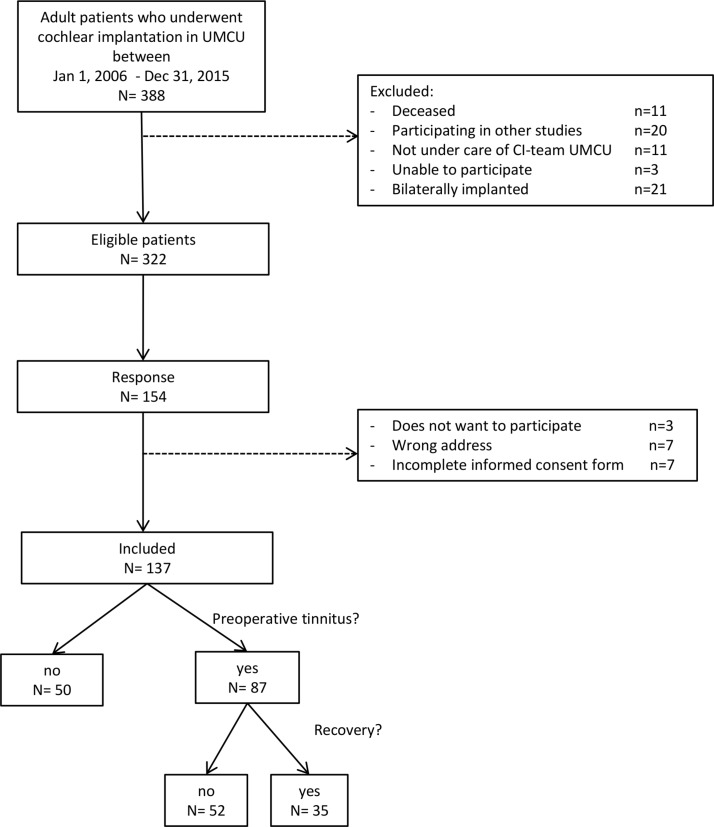
A questionnaire concerning tinnitus was sent to patients with bilateral severe to profound hearing loss, who underwent unilateral cochlear implantation at the University Medical Center Utrecht, the Netherlands, between 1 January 2006 and 31 December 2015.
Of 137 included patients, 87 patients experienced tinnitus preoperatively. Data of these 87 patients were used to develop the prediction model.
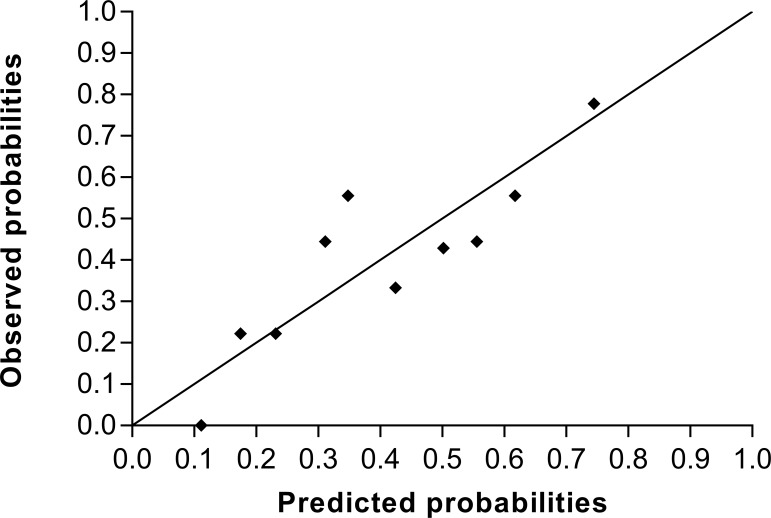
The outcome of the prediction model was tinnitus recovery. Investigated predictors were: age, gender, duration of deafness, preoperative hearing performance, tinnitus duration, severity and localisation, follow-up duration, localisation of cochlear implant (CI) compared with tinnitus side, surgical approach, insertion depth of the electrode, CI brand and difference in hearing threshold following cochlear implantation. Multivariable backward logistic regression was performed. Missing data were handled using multiple imputation. The performance of the model was assessed by the calibrative and discriminative ability of the model. The prediction model was internally validated using bootstrapping techniques.
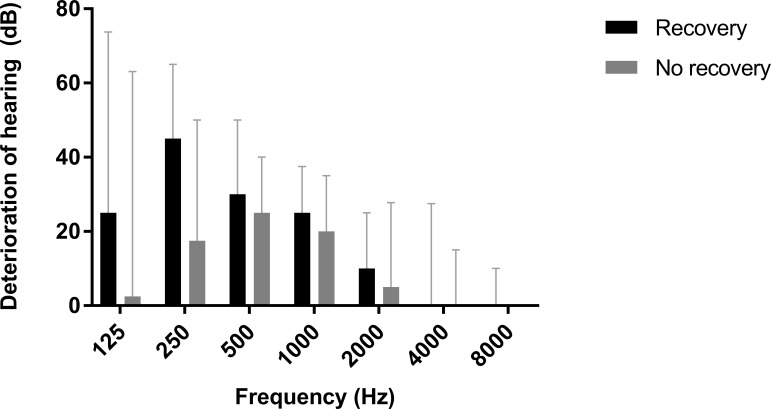
The tinnitus recovery rate was 40%. A lower preoperative Consonant-Vowel-Consonant (CVC) score, unilateral localisation of tinnitus and larger deterioration of residual hearing at 250 Hz revealed to be relevant predictors for tinnitus recovery. The area under the receiver operating characteristics curve (AUC) of the initial model was 0.722 (IQR: 0.703-0.729). After internal validation of this prediction model, the AUC decreased to 0.696 (IQR: 0.667-0.700).
Lower preoperative CVC score, unilateral localisation of tinnitus and larger deterioration of residual hearing at 250 Hz were significant predictors for tinnitus recovery following unilateral cochlear implantation. The performance of the model developed in this retrospective study is promising. However, before clinical use of the model, the conduction of a larger prospective study is recommended.
开发并内部验证单侧人工耳蜗植入后耳鸣恢复的预测模型。
横断面回顾性研究。
荷兰乌得勒支大学医学中心向双侧重度至极重度听力损失患者发送了一份关于耳鸣的问卷,这些患者在 2006 年 1 月 1 日至 2015 年 12 月 31 日期间接受了单侧人工耳蜗植入。
在 137 名纳入的患者中,87 名患者术前患有耳鸣。这些 87 名患者的数据用于开发预测模型。
预测模型的结果是耳鸣恢复。研究的预测因素包括:年龄、性别、耳聋持续时间、术前听力表现、耳鸣持续时间、严重程度和定位、随访时间、人工耳蜗植入(CI)与耳鸣侧的定位比较、手术方法、电极插入深度、CI 品牌以及人工耳蜗植入后听力阈值的差异。采用多变量向后逻辑回归进行分析。使用多重插补处理缺失数据。通过模型的校准和判别能力评估模型的性能。使用自举技术对内部分类模型进行内部验证。
耳鸣恢复率为 40%。术前 CVC(Consonant-Vowel-Consonant)评分较低、耳鸣单侧定位和 250Hz 残余听力恶化较大与耳鸣恢复相关。初始模型的受试者工作特征曲线(ROC)曲线下面积(AUC)为 0.722(IQR:0.703-0.729)。对该预测模型进行内部验证后,AUC 下降至 0.696(IQR:0.667-0.700)。
术前 CVC 评分较低、耳鸣单侧定位和 250Hz 残余听力恶化较大是单侧人工耳蜗植入后耳鸣恢复的显著预测因素。该回顾性研究中开发的模型的性能有一定的前景。但是,在模型的临床应用之前,建议进行更大的前瞻性研究。