Irrera Natasha, Arcoraci Vincenzo, Mannino Federica, Vermiglio Giovanna, Pallio Giovanni, Minutoli Letteria, Bagnato Gianluca, Anastasi Giuseppe Pio, Mazzon Emanuela, Bramanti Placido, Squadrito Francesco, Altavilla Domenica, Bitto Alessandra
Department of Clinical and Experimental Medicine, AOU Policlinico G. Martino, University of Messina, Messina, Italy.
Department of Biomedical and Dental Sciences and Morphological and Functional Sciences, AOU Policlinico G. Martino, University of Messina, Messina, Italy.
Front Pharmacol. 2018 May 29;9:506. doi: 10.3389/fphar.2018.00506. eCollection 2018.
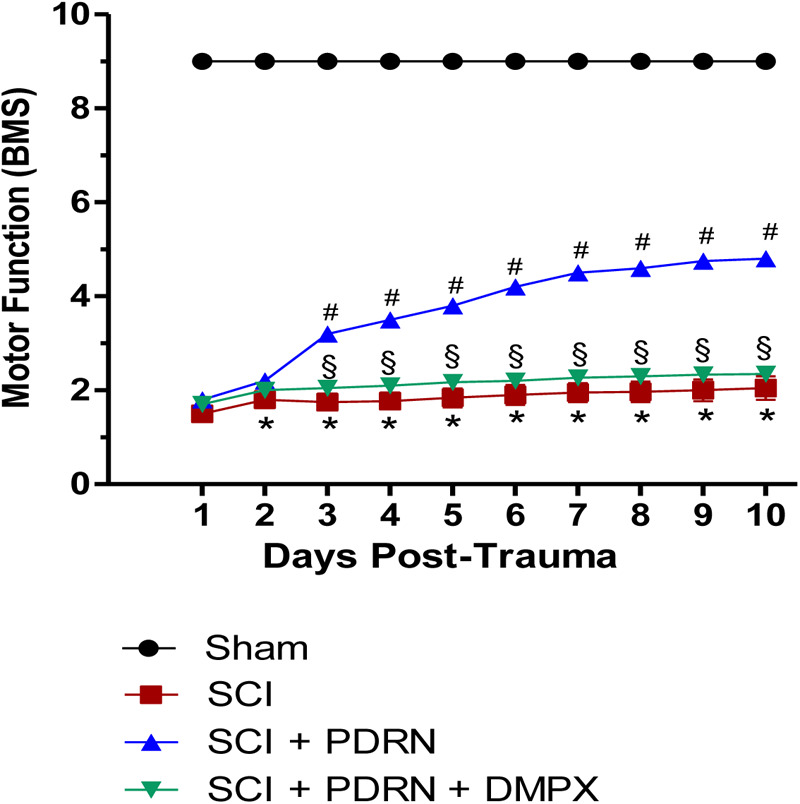
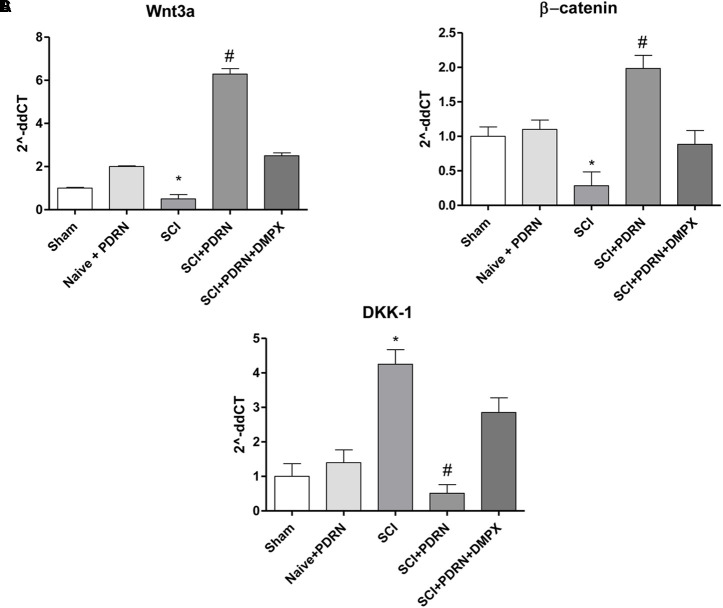
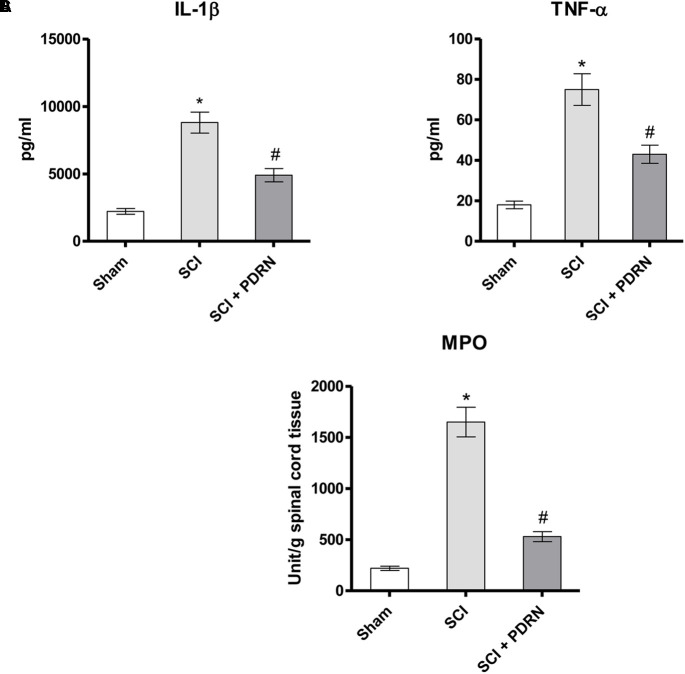
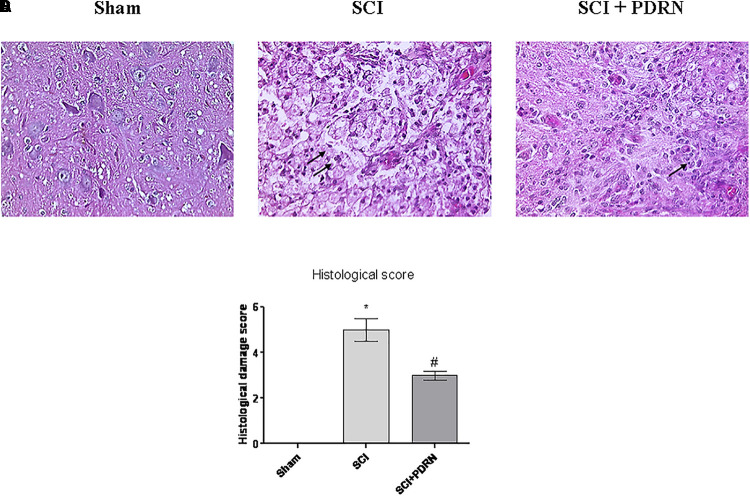
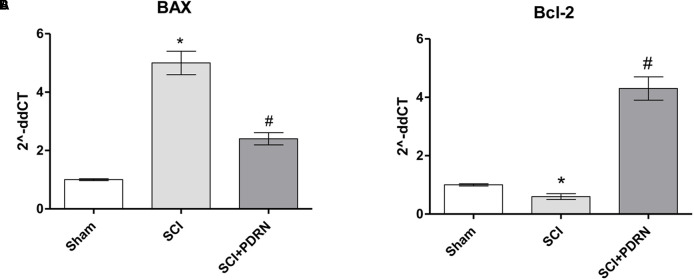
Spinal cord injury (SCI) is a complex clinical and progressive condition characterized by neuronal loss, axonal destruction and demyelination. In the last few years, adenosine receptors have been studied as a target for many diseases, including neurodegenerative conditions. The aim of this study was to investigate the effects of an adenosine receptor agonist, PDRN, in an experimental model of SCI. Moreover, since adenosine receptors stimulation may also activate the Wnt pathway, we wanted to study PDRN effects on Wnt signaling following SCI. Spinal trauma was induced by extradural compression of spinal cord at T5-T8 level in C57BL6/J mice. Animals were randomly assigned to the following groups: Sham ( = 10), SCI ( = 14), SCI+PDRN (8 mg/kg/i.p.; = 14), SCI+PDRN+DMPX (8 and 10 mg/kg/i.p., respectively; = 14). DMPX was used as an adenosine receptor antagonist to evaluate whether adenosine receptor block might prevent PDRN effects. PDRN systemically administered 1 h following SCI, protected from tissue damage, demyelination, and reduced motor deficits evaluated after 10 days. PDRN also reduced the release of the pro-inflammatory cytokines TNF-α and IL-1β, reduced BAX expression and preserved Bcl-2. Furthermore, PDRN stimulated Wnt/β-catenin pathway and decreased apoptotic process 24 h following SCI, whereas DMPX administration prevented PDRN effects on Wnt/β-catenin signaling. These results confirm PDRN anti-inflammatory activity and demonstrate that a crosstalk between Wnt/β-catenin signaling is possible by adenosine receptors activation. Moreover, these data let us hypothesize that PDRN might promote neural repair through axonal regeneration and/or neurogenesis.
脊髓损伤(SCI)是一种复杂的临床进展性疾病,其特征为神经元丢失、轴突破坏和脱髓鞘。在过去几年中,腺苷受体已作为包括神经退行性疾病在内的多种疾病的治疗靶点进行了研究。本研究的目的是在SCI实验模型中研究腺苷受体激动剂PDRN的作用。此外,由于腺苷受体刺激也可能激活Wnt通路,我们想研究PDRN对SCI后Wnt信号传导的影响。通过在C57BL6/J小鼠的T5 - T8水平进行硬膜外脊髓压迫诱导脊髓损伤。将动物随机分为以下几组:假手术组(n = 10)、SCI组(n = 14)、SCI + PDRN组(8 mg/kg腹腔注射;n = 14)、SCI + PDRN + DMPX组(分别为8和10 mg/kg腹腔注射;n = 14)。DMPX用作腺苷受体拮抗剂,以评估腺苷受体阻断是否可预防PDRN的作用。SCI后1小时全身给予PDRN,可预防组织损伤、脱髓鞘,并减少10天后评估的运动功能障碍。PDRN还减少了促炎细胞因子TNF-α和IL-1β的释放,降低了BAX表达并维持了Bcl-2水平。此外,PDRN在SCI后24小时刺激Wnt/β-连环蛋白通路并减少凋亡过程,而给予DMPX可阻止PDRN对Wnt/β-连环蛋白信号传导的作用。这些结果证实了PDRN的抗炎活性,并表明腺苷受体激活可能导致Wnt/β-连环蛋白信号传导之间存在相互作用。此外,这些数据使我们推测PDRN可能通过轴突再生和/或神经发生促进神经修复。