Wensaas Knut-Arne, Heron Jon, Redmond Niamh, Turnbull Sophie, Christensen Hannah, Thornton Hannah, Peters Tim J, Blair Peter S, Hay Alastair D
Research Unit for General Practice, Uni Research Health, Bergen, Norway.
Population Health Sciences, Bristol Medical School, University of Bristol, Bristol, UK.
Fam Pract. 2018 Dec 12;35(6):676-683. doi: 10.1093/fampra/cmy021.
Little is known about respiratory tract infection (RTI) severity in children following consultation.
To investigate post-consultation symptom trajectories in children with acute cough and RTI and whether baseline characteristics predict trajectory group.
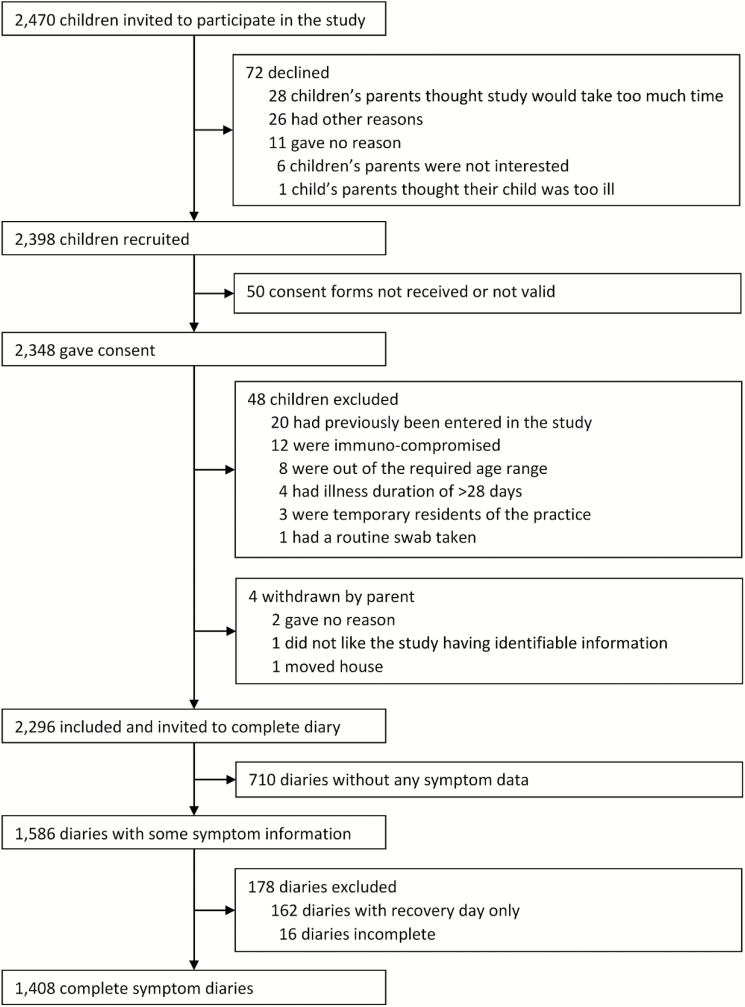
Prospective cohort study of 2296 children (3 months-16 years) whose parents were invited to report cough severity and duration using a 7-point Likert scale. Longitudinal latent class analysis (LLCA) was used to identify post-consultation symptom trajectories in the first 15 days, and multinomial models to predict class membership.
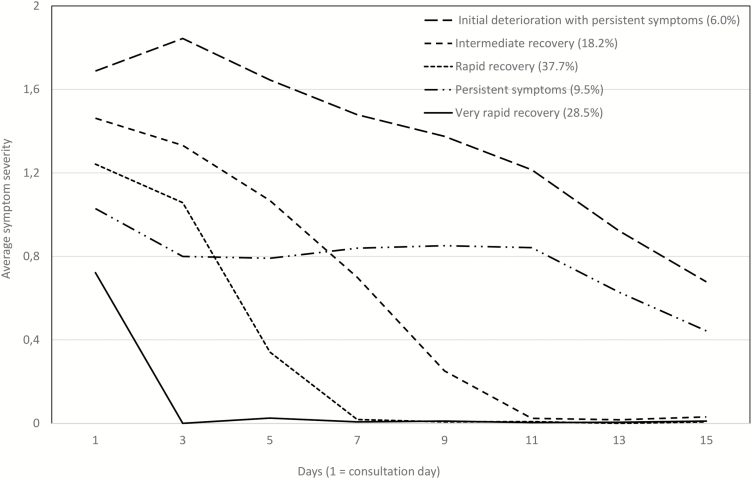
Complete data were available for 1408 children (61%). The best LLCA model identified five post-consultation symptom trajectory groups: 'very rapid recovery' (28.5%), 'rapid recovery' (37.7%), 'intermediate recovery' (18.2%), 'persistent symptoms' (9.5%) and 'initial deterioration with persistent symptoms' (6.0%). Compared with very rapid recovery, parent-reported severe cough in the 24 hours prior to consultation increased the likelihood of rapid recovery (OR 1.79 [95% CI 1.23, 2.60]), intermediate recovery (OR 2.13 [1.38, 3.30] and initial deterioration with persistent symptoms (OR 2.29 [1.26, 4.16]). Initial deterioration was also associated with 'severe barking cough' (OR 3.64 [1.50, 8.82]), 'severely reduced energy in the 24 hours prior to consultation' (OR 3.80 [1.62, 8.87] and higher parent-assessed illness severity at consultation (OR 2.21 [1.17, 4.18]).
We identified five distinct symptom trajectory groups showing the majority of children improved post-consultation, with only one group experiencing illness deterioration. The few characteristics associated with group membership did not fall into a pattern that seemed clinically useful.
关于儿童呼吸道感染(RTI)咨询后的严重程度,人们了解甚少。
调查急性咳嗽和RTI患儿咨询后的症状轨迹,以及基线特征是否能预测轨迹组。
对2296名3个月至16岁儿童进行前瞻性队列研究,邀请其父母使用7点李克特量表报告咳嗽的严重程度和持续时间。纵向潜在类别分析(LLCA)用于确定咨询后前15天的症状轨迹,多项模型用于预测类别归属。
1408名儿童(61%)有完整数据。最佳LLCA模型确定了五个咨询后症状轨迹组:“非常快速恢复”(28.5%)、“快速恢复”(37.7%)、“中度恢复”(18.2%)、“持续症状”(9.5%)和“初始恶化伴持续症状”(6.0%)。与非常快速恢复相比,父母报告的咨询前24小时内严重咳嗽增加了快速恢复(OR 1.79 [95% CI 1.23, 2.60])、中度恢复(OR 2.13 [1.38, 3.30])和初始恶化伴持续症状(OR 2.29 [1.26, 4.16])的可能性。初始恶化还与“严重犬吠样咳嗽”(OR 3.64 [1.50, 8.82])、“咨询前24小时内精力严重下降”(OR 3.80 [1.62, 8.87])以及咨询时父母评估的疾病严重程度较高(OR 2.21 [1.17, 4.18])相关。
我们确定了五个不同的症状轨迹组,表明大多数儿童咨询后病情好转,只有一组病情恶化。与组归属相关的少数特征并未形成一种看似具有临床实用性的模式。