Technische Universität Berlin, Institut für Bionik und Evolutionstechnik, Berlin, Germany.
Technische Universität Berlin, Institut für Biotechnologie, Berlin, Germany.
PLoS Biol. 2018 Jun 14;16(6):e2004405. doi: 10.1371/journal.pbio.2004405. eCollection 2018 Jun.
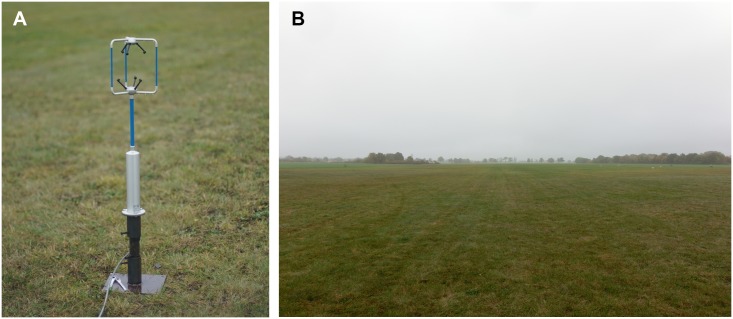
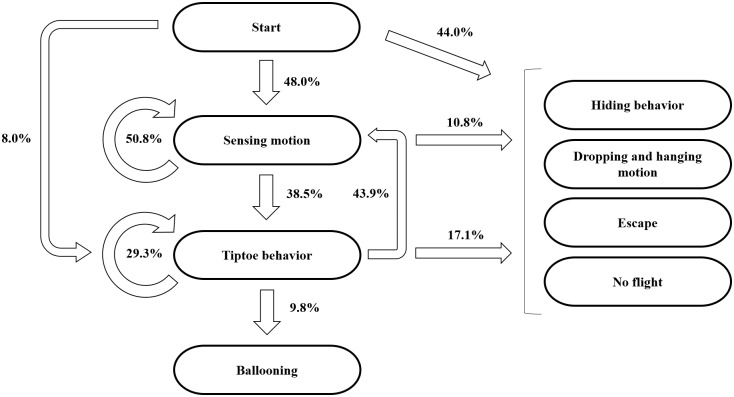
The physical mechanism of aerial dispersal of spiders, "ballooning behavior," is still unclear because of the lack of serious scientific observations and experiments. Therefore, as a first step in clarifying the phenomenon, we studied the ballooning behavior of relatively large spiders (heavier than 5 mg) in nature. Additional wind tunnel tests to identify ballooning silks were implemented in the laboratory. From our observation, it seems obvious that spiders actively evaluate the condition of the wind with their front leg (leg I) and wait for the preferable wind condition for their ballooning takeoff. In the wind tunnel tests, as-yet-unknown physical properties of ballooning fibers (length, thickness, and number of fibers) were identified. Large spiders, 16-20 mg Xysticus spp., spun 50-60 nanoscale fibers, with a diameter of 121-323 nm. The length of these threads was 3.22 ± 1.31 m (N = 22). These physical properties of ballooning fibers can explain the ballooning of large spiders with relatively light updrafts, 0.1-0.5 m s-1, which exist in a light breeze of 1.5-3.3 m s-1. Additionally, in line with previous research on turbulence in atmospheric boundary layers and from our wind measurements, it is hypothesized that spiders use the ascending air current for their aerial dispersal, the "ejection" regime, which is induced by hairpin vortices in the atmospheric boundary layer turbulence. This regime is highly correlated with lower wind speeds. This coincides well with the fact that spiders usually balloon when the wind speed is lower than 3 m s-1.
蜘蛛的空中散布的物理机制,即“气球飘荡行为”,由于缺乏严肃的科学观察和实验,其机制仍不清楚。因此,作为澄清这种现象的第一步,我们在自然界中研究了相对较大的蜘蛛(重量超过 5 毫克)的气球飘荡行为。我们在实验室中进行了额外的风洞测试,以识别用于气球飘荡的蛛丝。从我们的观察中,似乎很明显蜘蛛会用它们的前腿(腿 I)主动评估风的状况,并等待适合它们气球飘荡起飞的风况。在风洞测试中,我们发现了用于气球飘荡的纤维(长度、厚度和纤维数量)的未知物理特性。大型蜘蛛,16-20 毫克的 Xysticus 属,会吐出 50-60 纳米的纤维,直径为 121-323 纳米。这些线的长度为 3.22±1.31 米(N=22)。这些用于气球飘荡的纤维的物理特性可以解释相对较轻的上升气流(0.1-0.5 m s-1)能够使较大的蜘蛛进行气球飘荡的现象,这种上升气流存在于 1.5-3.3 m s-1 的微风中。此外,根据先前关于大气边界层湍流的研究和我们的风测量结果,假设蜘蛛利用上升气流进行空中散布,这是一种“喷射”状态,是由大气边界层湍流中的发夹型涡旋引起的。这种状态与较低的风速高度相关。这与蜘蛛通常在风速低于 3 m s-1 时进行气球飘荡的事实非常吻合。