Vascular Physiology Unit, National Centre for Cardiovascular Prevention and Outcomes, Institute of Cardiovascular Science, University College London, London, United Kingdom.
Department of Pediatric Clinical Physiology, The Queen Silvia Children's Hospital, The Sahlgrenska Academy and University Hospital, Gothenburg, Sweden.
PLoS One. 2018 Jun 14;13(6):e0198547. doi: 10.1371/journal.pone.0198547. eCollection 2018.
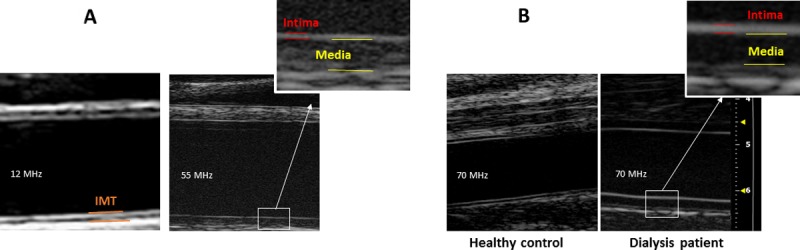
Patients with chronic kidney disease (CKD) are exposed to both traditional 'Framingham' and uremia related cardiovascular risk factors that drive atherosclerotic and arteriosclerotic disease, but these cannot be differentiated using conventional ultrasound. We used ultra-high-frequency ultrasound (UHFUS) to differentiate medial thickness (MT) from intimal thickness (IT) in CKD patients, identify their determinants and monitor their progression.
Fifty-four children and adolescents with CKD and 12 healthy controls underwent UHFUS measurements using 55-70MHz transducers in common carotid and dorsal pedal arteries. Annual follow-up imaging was performed in 31 patients.
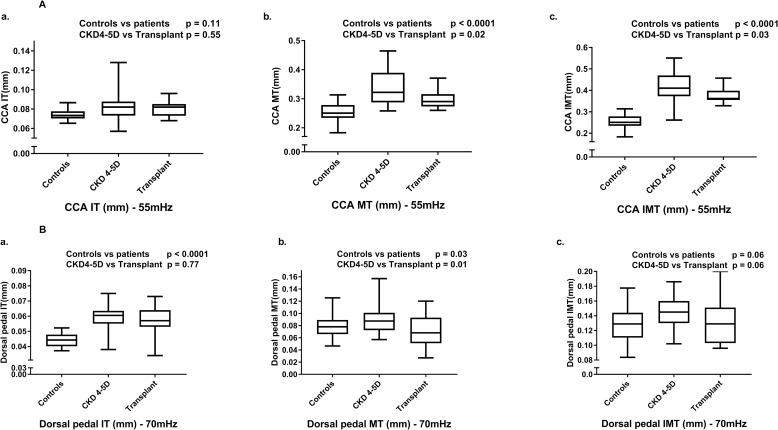
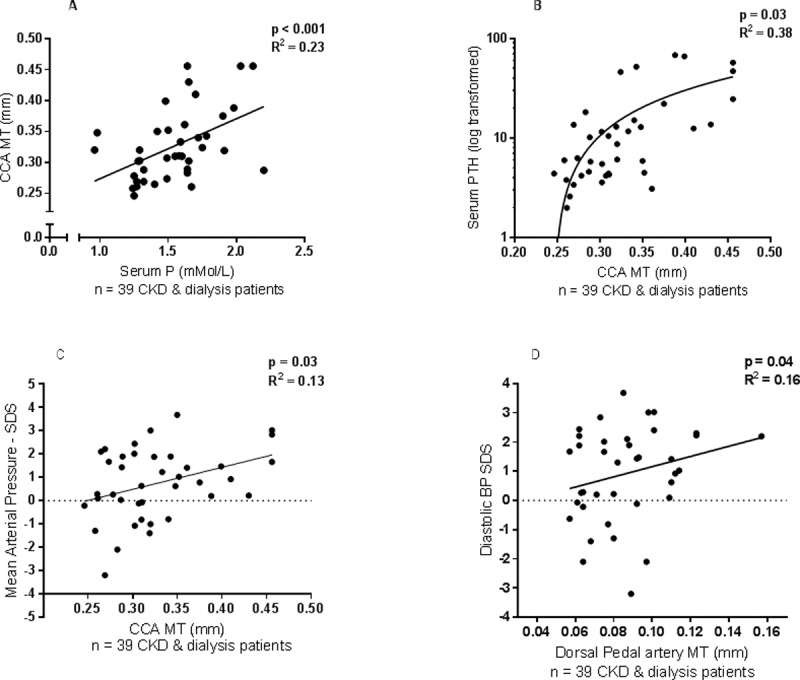
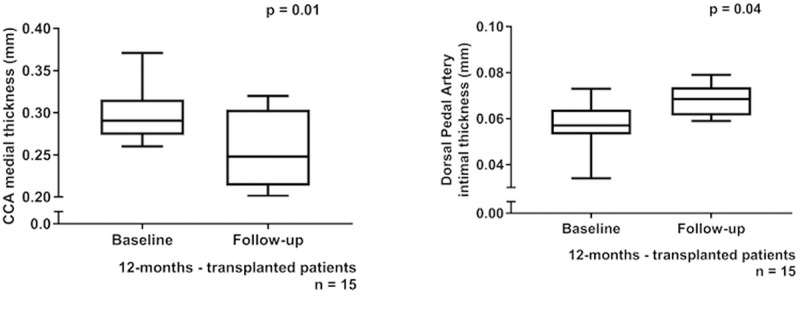
CKD patients had higher carotid MT and dorsal pedal IT and MT compared to controls. The carotid MT in CKD correlated with serum phosphate (p<0.001, r = 0.42), PTH (p = 0.03, r = 0.36) and mean arterial pressure (p = 0.03, r = 0.34). Following multivariable analysis, being on dialysis, serum phosphate levels and mean arterial pressure remained the only independent predictors of carotid MT (R2 64%). Transplanted children had lower carotid and dorsal pedal MT compared to CKD and dialysis patients (p = 0.02 and p = 0.01 respectively). At 1-year follow-up, transplanted children had a decrease in carotid MT (p = 0.01), but an increase in dorsal pedal IT (p = 0.04) that independently correlated with annualized change in BMI.
Using UHFUS, we have shown that CKD is associated with exclusively medial arterial changes that attenuate when the uremic milieu is ameliorated after transplantation. In contrast, after transplantation intimal disease develops as hypertension and obesity become prevalent, representing rapid vascular remodeling in response to a changing cardiovascular risk factor profile.
患有慢性肾脏病(CKD)的患者同时暴露于传统的“弗雷明汉”和尿毒症相关的心血管风险因素下,这些因素会导致动脉粥样硬化和动脉硬化性疾病,但这些因素不能通过常规超声来区分。我们使用超高频超声(UHFUS)来区分 CKD 患者的中层厚度(MT)和内膜厚度(IT),确定其决定因素并监测其进展。
54 名儿童和青少年 CKD 患者和 12 名健康对照者使用 55-70MHz 换能器进行颈总动脉和背足动脉的 UHFUS 测量。31 例患者进行了年度随访成像。
与对照组相比,CKD 患者的颈总动脉 MT 和背足动脉 IT 和 MT 更高。CKD 患者的颈总动脉 MT 与血清磷酸盐(p<0.001,r = 0.42)、甲状旁腺激素(p = 0.03,r = 0.36)和平均动脉压(p = 0.03,r = 0.34)相关。经过多变量分析,透析、血清磷酸盐水平和平均动脉压仍然是颈总动脉 MT 的唯一独立预测因素(R2 为 64%)。移植儿童的颈总动脉和背足动脉 MT 均低于 CKD 和透析患者(p = 0.02 和 p = 0.01)。在 1 年随访时,移植儿童的颈总动脉 MT 下降(p = 0.01),但背足动脉 IT 增加(p = 0.04),与 BMI 的年化变化独立相关。
使用 UHFUS,我们已经表明,CKD 与动脉中层的变化有关,当尿毒症环境在移植后得到改善时,这些变化会减弱。相比之下,移植后,随着高血压和肥胖的流行,内膜疾病会发展,这代表了对心血管风险因素谱变化的快速血管重塑。