Department of Medicine Austin Health, University of Melbourne, Heidelberg, Australia.
Department of Endocrinology, Austin Health, Heidelberg, Australia.
Sci Rep. 2018 Jun 14;8(1):9099. doi: 10.1038/s41598-018-27481-3.
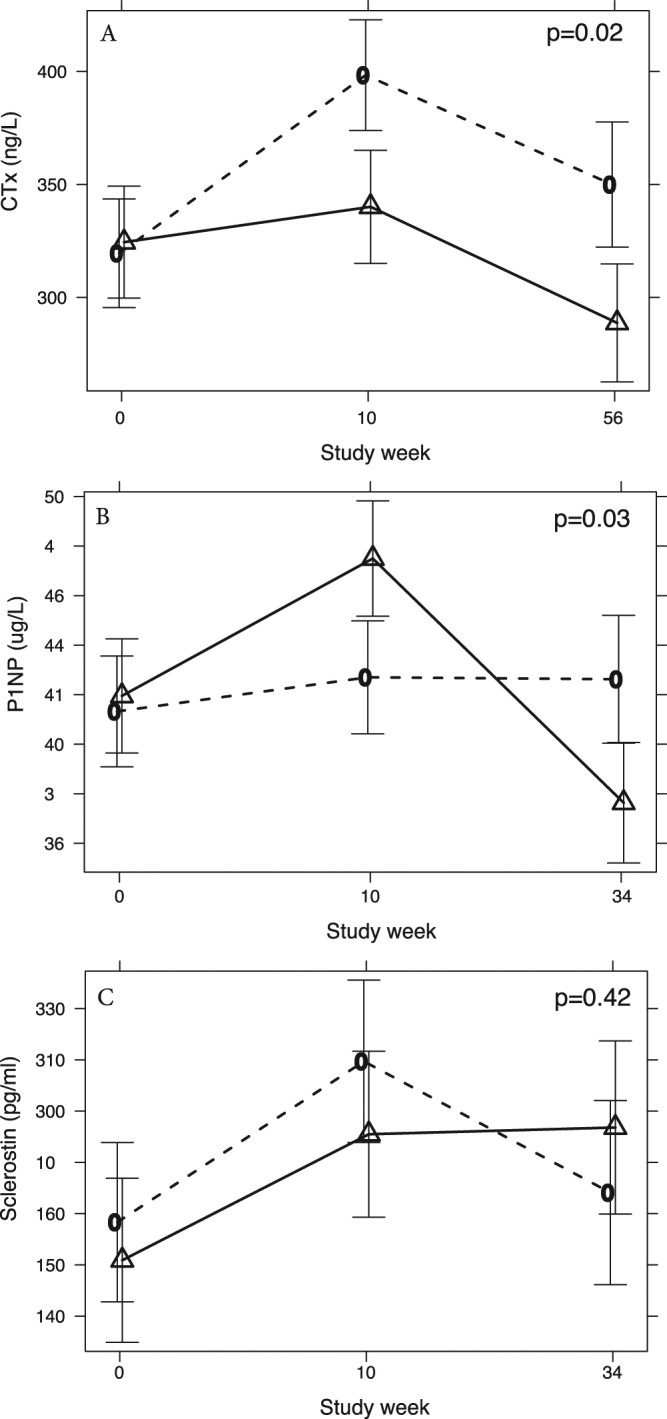
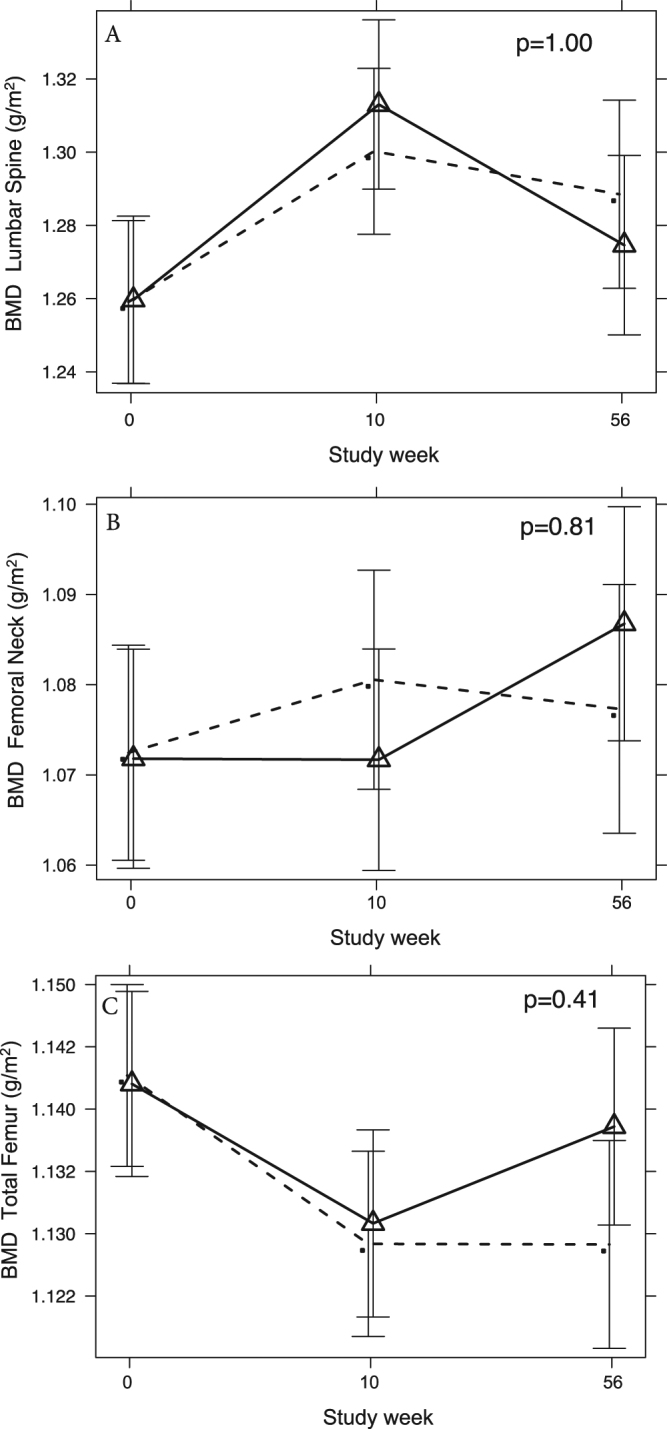
To assess the effect of testosterone treatment on bone remodelling and density in dieting obese men, 100 obese men aged 53 years (interquartile range 47-60) with a total testosterone level <12 nmol/L receiving 10 weeks of a very low energy diet (VLED) followed by 46 weeks of weight maintenance were randomly assigned at baseline to 56 weeks of intramuscular testosterone undecanoate (n = 49, cases) or matching placebo (n = 51, controls). Pre-specified outcomes were between-group differences (mean adjusted difference, MAD) in serum c-telopeptide (CTx), N-terminal propeptide of type 1 procollagen (P1NP) and bone mineral density (BMD). At trial end, CTx was significantly reduced in men receiving testosterone compared to placebo, MAD -66 ng/L (95% CI -113, -18), p = 0.018, and this was apparent already after the 10 week VLED phase, MAD -63 ng/L (95% CI -108, -18), p = 0.018. P1NP was marginally increased after VLED, MAD +4.2 ug/L (95% CI -0.01, +8.4), p = 0.05 but lower at study end, MAD -5.6 ug/L (95% CI -10.1, -1.1), p = 0.03. No significant changes in sclerostin, lumbar spine BMD or femoral BMD were seen. We conclude that in obese men with low testosterone levels undergoing weight loss, bone remodelling markers are modulated in a way that may have favourable effects on bone mass.
为了评估睾酮治疗对节食肥胖男性骨重塑和密度的影响,100 名年龄为 53 岁(四分位距 47-60)、总睾酮水平<12nmol/L 的肥胖男性接受了 10 周极低能量饮食(VLED),随后进行 46 周的体重维持,在基线时随机分为 56 周肌内十一酸睾酮(n=49,病例组)或匹配安慰剂(n=51,对照组)。预先指定的结局是血清 c 端肽(CTX)、I 型前胶原 N 端前肽(P1NP)和骨密度(BMD)的组间差异(平均调整差异,MAD)。在试验结束时,与安慰剂相比,接受睾酮治疗的男性 CTx 明显降低,MAD-66ng/L(95%CI-113,-18),p=0.018,这在 10 周 VLED 阶段已经明显,MAD-63ng/L(95%CI-108,-18),p=0.018。VLED 后 P1NP 略有增加,MAD+4.2μg/L(95%CI0.01,+8.4),p=0.05,但在研究结束时更低,MAD-5.6μg/L(95%CI-10.1,-1.1),p=0.03。骨硬化素、腰椎 BMD 或股骨 BMD 无明显变化。我们的结论是,在接受减肥治疗的低睾酮水平肥胖男性中,骨重塑标志物的变化可能对骨量产生有利影响。