Shigehara Kazuyoshi, Izumi Kouji, Kadono Yoshifumi, Mizokami Atsushi
Department of Integrative Cancer Therapy and Urology, Kanazawa University Graduate School of Medical Science, 13-1, Kanazawa, Ishikawa 920-8641, Japan.
J Clin Med. 2021 Feb 2;10(3):530. doi: 10.3390/jcm10030530.
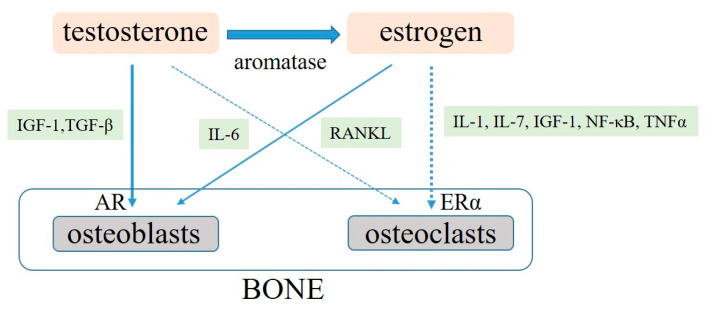
Bone fracture due to osteoporosis is an important issue in decreasing the quality of life for elderly men in the current aging society. Thus, osteoporosis and bone fracture prevention is a clinical concern for many clinicians. Moreover, testosterone has an important role in maintaining bone mineral density (BMD) among men. Some testosterone molecular mechanisms on bone metabolism have been currently established by many experimental data. Concurrent with a decrease in testosterone with age, various clinical symptoms and signs associated with testosterone decline, including decreased BMD, are known to occur in elderly men. However, the relationship between testosterone levels and osteoporosis development has been conflicting in human epidemiological studies. Thus, testosterone replacement therapy (TRT) is a useful tool for managing clinical symptoms caused by hypogonadism. Many recent studies support the benefit of TRT on BMD, especially in hypogonadal men with osteopenia and osteoporosis, although a few studies failed to demonstrate its effects. However, no evidence supporting the hypothesis that TRT can prevent the incidence of bone fracture exists. Currently, TRT should be considered as one of the treatment options to improve hypogonadal symptoms and BMD simultaneously in symptomatic hypogonadal men with osteopenia.
在当前老龄化社会中,骨质疏松导致的骨折是降低老年男性生活质量的一个重要问题。因此,骨质疏松和骨折预防是许多临床医生关注的临床问题。此外,睾酮在维持男性骨矿物质密度(BMD)方面发挥着重要作用。目前,许多实验数据已经确立了一些睾酮对骨代谢的分子机制。随着年龄增长睾酮水平下降,老年男性会出现各种与睾酮水平降低相关的临床症状和体征,包括骨密度降低。然而,在人类流行病学研究中,睾酮水平与骨质疏松发展之间的关系一直存在争议。因此,睾酮替代疗法(TRT)是治疗性腺功能减退引起的临床症状的有效手段。许多近期研究支持TRT对骨密度的益处,特别是对于患有骨质减少和骨质疏松的性腺功能减退男性,尽管有少数研究未能证明其效果。然而,没有证据支持TRT可以预防骨折发生率这一假设。目前,对于有症状的性腺功能减退且伴有骨质减少的男性,TRT应被视为同时改善性腺功能减退症状和骨密度的治疗选择之一。