Manzo Ernesto, O'Conner Abigail G, Barrows Jordan M, Shreiner Dakotah D, Birchak Gabriel J, Zarnescu Daniela C
Department of Molecular and Cellular Biology, University of Arizona, Tucson, AZ, United States.
Department of Neuroscience, University of Arizona, Tucson, AZ, United States.
Front Mol Neurosci. 2018 May 31;11:182. doi: 10.3389/fnmol.2018.00182. eCollection 2018.
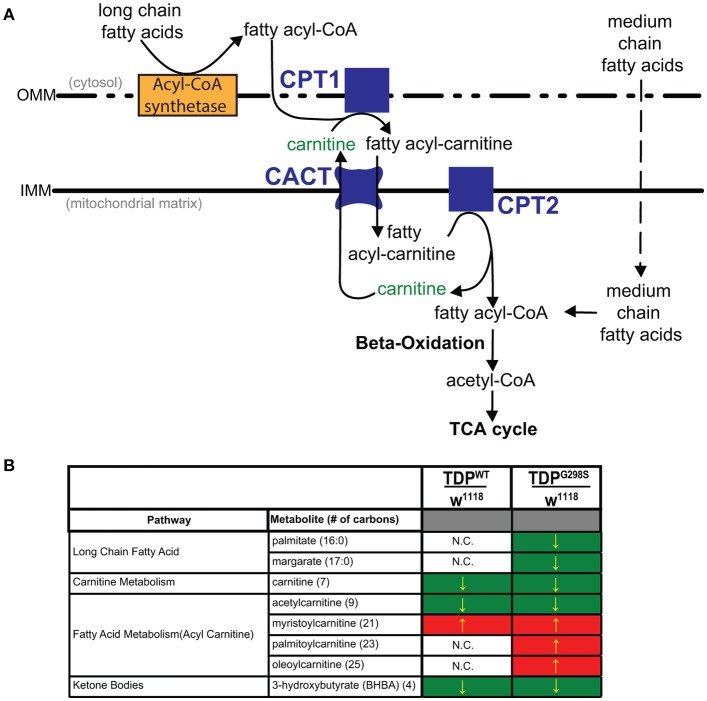
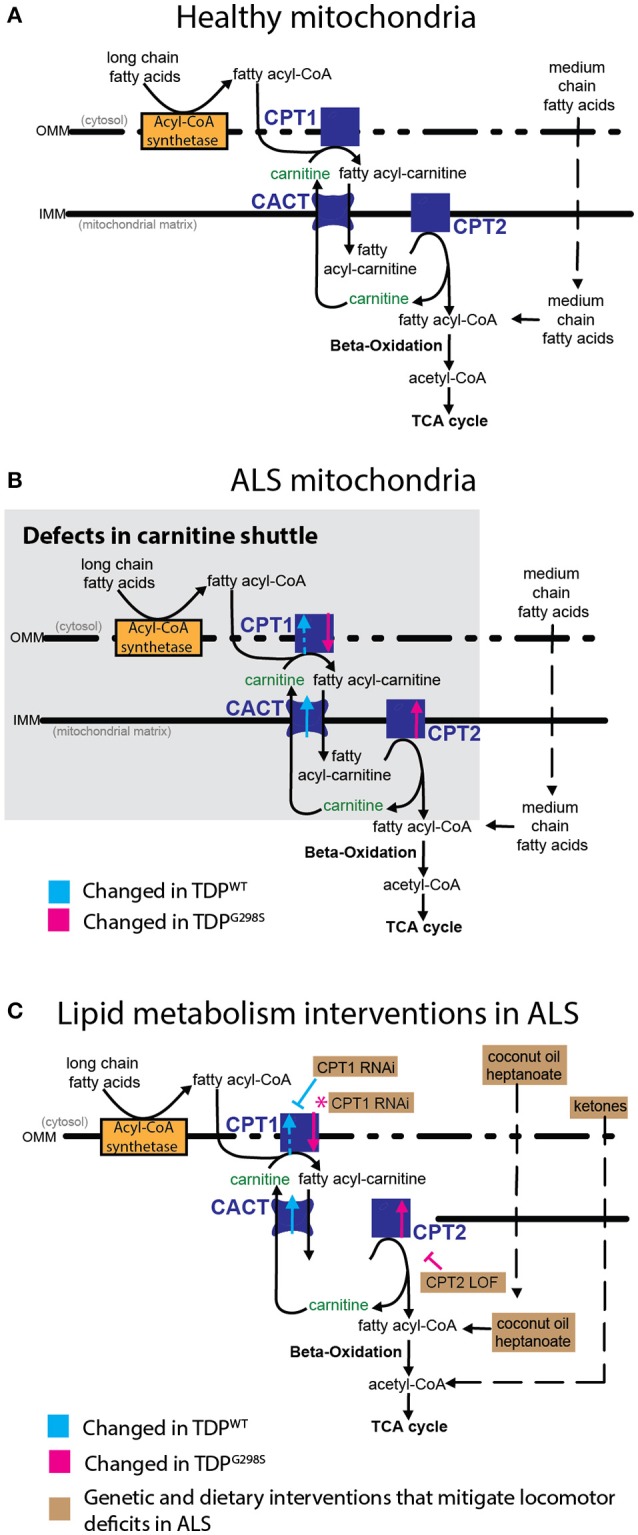
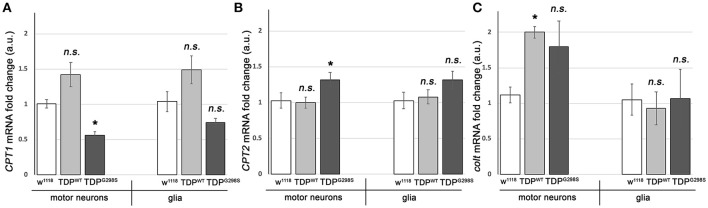
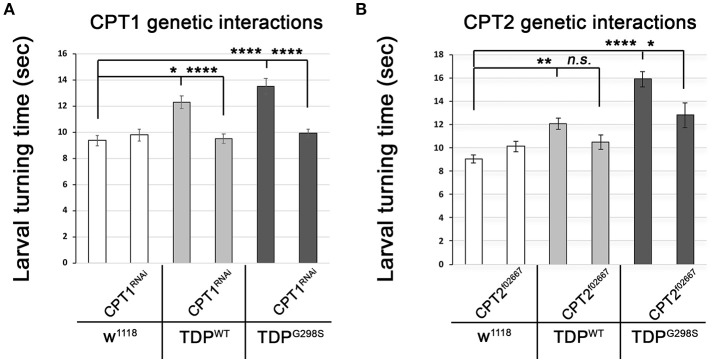
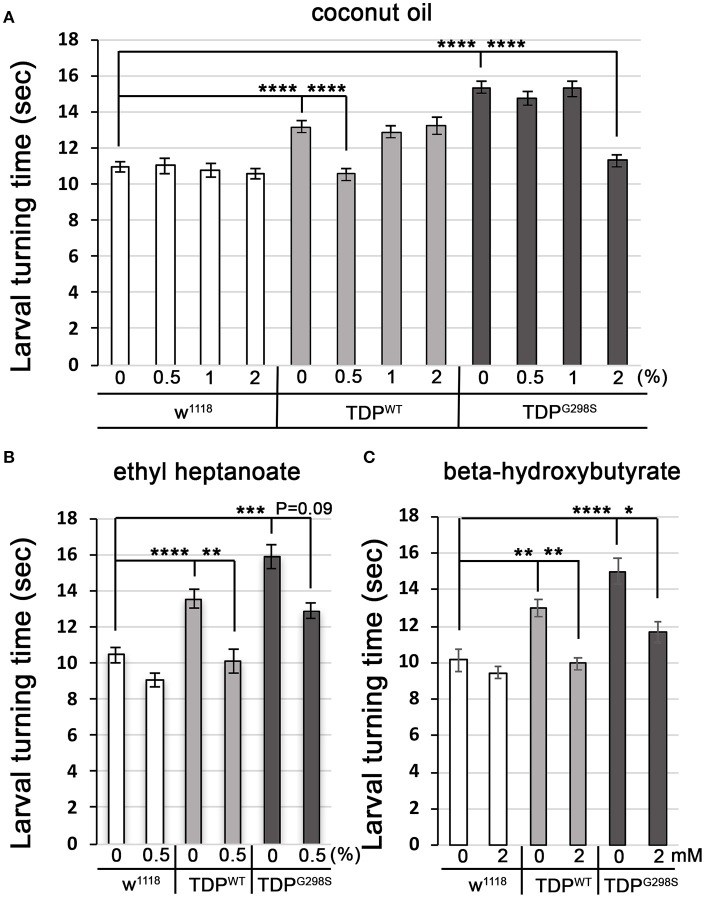
ALS patients exhibit dyslipidemia, hypermetabolism and weight loss; in addition, cellular energetics deficits have been detected prior to denervation. Although evidence that metabolism is altered in ALS is compelling, the mechanisms underlying metabolic dysregulation and the contribution of altered metabolic pathways to disease remain poorly understood. Here we use a model of ALS based on TDP-43 that recapitulates hallmark features of the disease including locomotor dysfunction and reduced lifespan. We performed a global, unbiased metabolomic profiling of larvae expressing TDP-43 (wild-type, TDP or disease-associated mutant, TDP) and identified several lipid metabolism associated alterations. Among these, we found a significant increase in carnitine conjugated long-chain fatty acids and a significant decrease in carnitine, acetyl-carnitine and beta-hydroxybutyrate, a ketone precursor. Taken together these data suggest a deficit in the function of the carnitine shuttle and reduced lipid beta oxidation. To test this possibility we used a combined genetic and dietary approach in . Our findings indicate that components of the carnitine shuttle are misexpressed in the context of TDP-43 proteinopathy and that genetic modulation of CPT1 or CPT2 expression, two core components of the carnitine shuttle, mitigates TDP-43 dependent locomotor dysfunction, in a variant dependent manner. In addition, feeding medium-chain fatty acids or beta-hydroxybutyrate improves locomotor function, consistent with the notion that bypassing the carnitine shuttle deficit is neuroprotective. Taken together, our findings highlight the potential contribution of the carnitine shuttle and lipid beta oxidation in ALS and suggest strategies for therapeutic intervention based on restoring lipid metabolism in motor neurons.
肌萎缩侧索硬化症(ALS)患者表现出血脂异常、代谢亢进和体重减轻;此外,在去神经支配之前就已检测到细胞能量代谢缺陷。尽管有令人信服的证据表明ALS患者的代谢发生了改变,但代谢失调的潜在机制以及代谢途径改变对疾病的影响仍知之甚少。在这里,我们使用基于TDP-43的ALS模型,该模型概括了该疾病的标志性特征,包括运动功能障碍和寿命缩短。我们对表达TDP-43(野生型、TDP或疾病相关突变体TDP)的幼虫进行了全面、无偏倚的代谢组学分析,并确定了几种与脂质代谢相关的改变。其中,我们发现肉碱共轭长链脂肪酸显著增加,而肉碱、乙酰肉碱和酮体前体β-羟基丁酸显著减少。综合这些数据表明肉碱穿梭功能存在缺陷,脂质β氧化减少。为了验证这种可能性,我们在……中采用了基因和饮食相结合的方法。我们的研究结果表明,在TDP-43蛋白病的背景下,肉碱穿梭的成分表达错误,并且肉碱穿梭的两个核心成分CPT1或CPT2表达的基因调节以变体依赖的方式减轻了TDP-43依赖性运动功能障碍。此外,喂食中链脂肪酸或β-羟基丁酸可改善运动功能,这与绕过肉碱穿梭缺陷具有神经保护作用的观点一致。综上所述,我们的研究结果突出了肉碱穿梭和脂质β氧化在ALS中的潜在作用,并提出了基于恢复运动神经元脂质代谢的治疗干预策略。