Rusińska Agnieszka, Płudowski Paweł, Walczak Mieczysław, Borszewska-Kornacka Maria K, Bossowski Artur, Chlebna-Sokół Danuta, Czech-Kowalska Justyna, Dobrzańska Anna, Franek Edward, Helwich Ewa, Jackowska Teresa, Kalina Maria A, Konstantynowicz Jerzy, Książyk Janusz, Lewiński Andrzej, Łukaszkiewicz Jacek, Marcinowska-Suchowierska Ewa, Mazur Artur, Michałus Izabela, Peregud-Pogorzelski Jarosław, Romanowska Hanna, Ruchała Marek, Socha Piotr, Szalecki Mieczysław, Wielgoś Mirosław, Zwolińska Danuta, Zygmunt Arkadiusz
Department of Paediatric Propedeutics and Bone Metabolic Diseases, Medical University of Lodz, Lodz, Poland.
Department of Biochemistry, Radioimmunology and Experimental Medicine, The Children's Memorial Health Institute, Warsaw, Poland.
Front Endocrinol (Lausanne). 2018 May 31;9:246. doi: 10.3389/fendo.2018.00246. eCollection 2018.
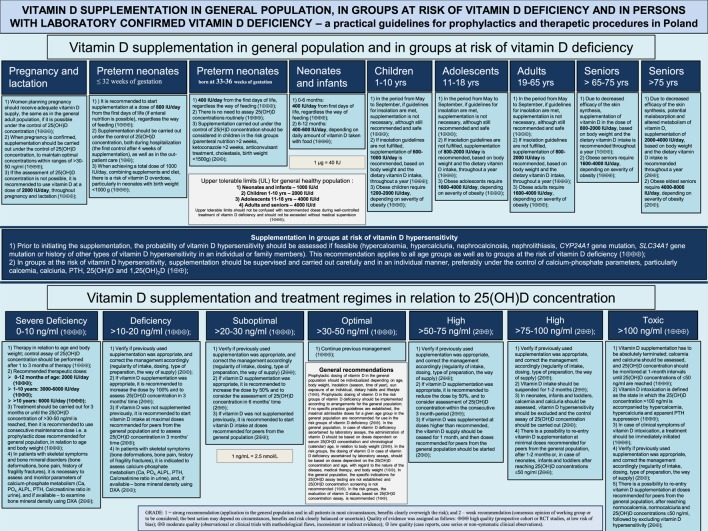
Vitamin D deficiency is an important public health problem worldwide. Vitamin D deficiency confers a significant risk for both skeletal and non-skeletal disorders and a number of lifelong negative health outcomes. The objectives of this evidence-based guidelines document are to provide health care professionals in Poland, an updated recommendation for the prevention, diagnosis and treatment of vitamin D deficiency.
A systematic literature search examining the prevention and treatment strategies for vitamin D deficiency was conducted. Updated recommendations were developed using the Grading of Recommendations, Assessment, Development and Evaluation system describing the strength of the recommendation and the quality of supporting evidence. Twenty-seven contributors representing different areas of expertise and medical specialties, including pediatricians, geriatricians, endocrinologists, epidemiologists, nephrologists, gynecologists and obstetricians evaluated the available published evidence related to vitamin D, formulated the goals of this document and developed a common consolidated position. The consensus group, representing six national specialist consultants and eight Polish and international scientific organizations/societies, participated in the process of grading evidence and drawing up the general and specific recommendations.
The updated recommendations define the diagnostic criteria for the evaluation of vitamin D status and describe the prevention and treatment strategies of vitamin D deficiency in the general population and in groups at increased risk of the deficiency. Age- and weight-specific recommendations for prevention, supplementation and treatment of vitamin D deficiency are presented, and detailed practice guidance is discussed regarding the management in primary and specialized health care.
Vitamin D deficiency remains still highly prevalent in Poland, in all age groups. Currently, there is a great necessity to implement a regular supplementation with recommended doses and to develop an effective strategy to alleviate vitamin D deficiency in the population. These updated recommendations are addressed to health professionals and the authorities pursuing comprehensive health policies and should also be included in public health programs aimed at preventing a broad spectrum of chronic diseases.
维生素D缺乏是全球重要的公共卫生问题。维生素D缺乏会给骨骼和非骨骼疾病带来重大风险,并导致许多终身不良健康后果。本循证指南文件的目的是为波兰的医疗保健专业人员提供关于维生素D缺乏预防、诊断和治疗的最新建议。
对维生素D缺乏的预防和治疗策略进行了系统的文献检索。使用推荐分级、评估、制定和评价系统制定了最新建议,该系统描述了建议的强度和支持证据的质量。27名代表不同专业领域和医学专科的贡献者,包括儿科医生、老年病医生、内分泌学家、流行病学家、肾病学家、妇科医生和产科医生,评估了与维生素D相关的现有已发表证据,制定了本文件的目标并形成了共同的综合立场。代表6名国家专家顾问以及8个波兰和国际科学组织/协会的共识小组参与了证据分级和制定一般及具体建议的过程。
最新建议定义了评估维生素D状态的诊断标准,并描述了普通人群以及维生素D缺乏风险增加人群中维生素D缺乏的预防和治疗策略。给出了针对维生素D缺乏预防、补充和治疗的年龄及体重特异性建议,并讨论了初级和专科医疗保健管理方面的详细实践指南。
在波兰,所有年龄组的维生素D缺乏仍然非常普遍。目前,非常有必要实施推荐剂量的定期补充,并制定一项有效策略来缓解人群中的维生素D缺乏。这些最新建议是针对卫生专业人员以及推行全面卫生政策的当局,也应纳入旨在预防广泛慢性病的公共卫生项目中。