Tacchella Andrea, Romano Silvia, Ferraldeschi Michela, Salvetti Marco, Zaccaria Andrea, Crisanti Andrea, Grassi Francesca
Institute for Complex Systems, National Research Council - UOS Sapienza, Rome, 00185, Italy.
Center for Experimental Neurological Therapies (CENTERS), Dept. of Neurosciences, Mental Health and Sensory Organs, Sapienza University of Rome, Rome, 00189, Italy.
F1000Res. 2017 Dec 22;6:2172. doi: 10.12688/f1000research.13114.2. eCollection 2017.
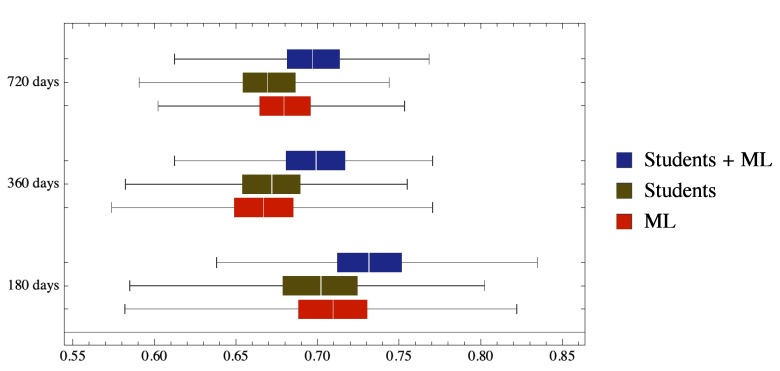
Multiple sclerosis has an extremely variable natural course. In most patients, disease starts with a relapsing-remitting (RR) phase, which proceeds to a secondary progressive (SP) form. The duration of the RR phase is hard to predict, and to date predictions on the rate of disease progression remain suboptimal. This limits the opportunity to tailor therapy on an individual patient's prognosis, in spite of the choice of several therapeutic options. Approaches to improve clinical decisions, such as collective intelligence of human groups and machine learning algorithms are widely investigated. Medical students and a machine learning algorithm predicted the course of disease on the basis of randomly chosen clinical records of patients that attended at the Multiple Sclerosis service of Sant'Andrea hospital in Rome. A significant improvement of predictive ability was obtained when predictions were combined with a weight that depends on the consistence of human (or algorithm) forecasts on a given clinical record. In this work we present proof-of-principle that human-machine hybrid predictions yield better prognoses than machine learning algorithms or groups of humans alone. To strengthen and generalize this preliminary result, we propose a crowdsourcing initiative to collect prognoses by physicians on an expanded set of patients.
多发性硬化症的自然病程极具变异性。在大多数患者中,疾病始于复发缓解(RR)期,随后进展为继发进展(SP)型。RR期的持续时间难以预测,迄今为止,关于疾病进展速度的预测仍不尽人意。尽管有多种治疗选择,但这限制了根据个体患者预后量身定制治疗方案的机会。人们广泛研究了改善临床决策的方法,如人类群体的集体智慧和机器学习算法。医学生和一种机器学习算法基于随机选择的罗马圣安德烈亚医院多发性硬化症科室就诊患者的临床记录来预测疾病进程。当预测结果与一个取决于人类(或算法)对给定临床记录预测一致性的权重相结合时,预测能力有了显著提高。在这项工作中,我们提供了原理证明,即人机混合预测比单独的机器学习算法或人类群体能产生更好的预后。为了强化并推广这一初步结果,我们提出了一项众包倡议,以收集医生对更多患者的预后预测。