Kozar Nejc, Kruusmaa Kristi, Bitenc Marko, Argamasilla Rosa, Adsuar Antonio, Goswami Nandu, Arko Darja, Takač Iztok
Clinic of Gynaecology and Perinatology, University Medical Centre Maribor, Ljubljanska 5, 2000 Maribor, Slovenia.
Faculty of Medicine, University of Maribor, Taborska ulica 8, 2000 Maribor, Slovenia.
Data Brief. 2018 Apr 30;18:1825-1831. doi: 10.1016/j.dib.2018.04.081. eCollection 2018 Jun.
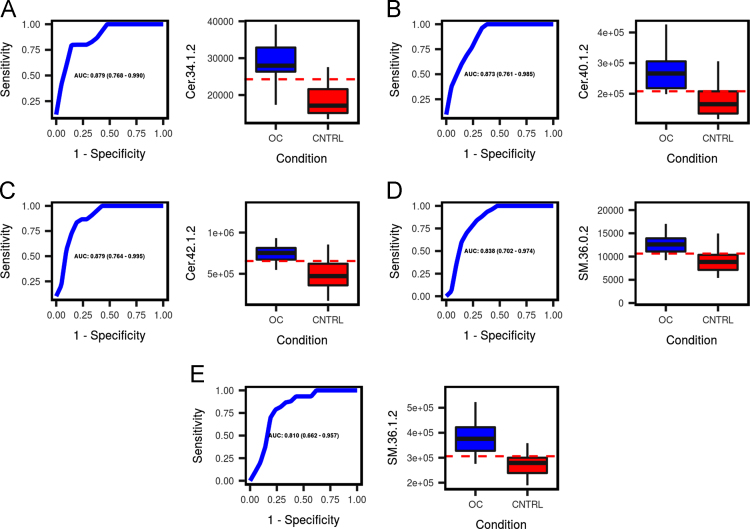
The data presented here are related to the research paper entitled "Metabolomic profiling suggests long chain ceramides and sphingomyelins as a possible diagnostic biomarker of epithelial ovarian cancer." (Kozar et al., 2018) [1]. Metabolomic profiling was performed on 15 patients with ovarian cancer, 21 healthy controls and 21 patients with benign gynecological conditions. HPLC-TQ/MS was performed on all samples. PLS-DA was used for the first line classification of epithelial ovarian cancer and healthy control group based on metabolomic profiles. Random forest algorithm was used for building a prediction model based over most significant markers. Univariate analysis was performed on individual markers to determine their distinctive roles. Furthermore, markers were also evaluated for their biological significance in cancer progression.
此处呈现的数据与题为《代谢组学分析表明长链神经酰胺和鞘磷脂可能是上皮性卵巢癌的诊断生物标志物》的研究论文相关(科扎尔等人,2018年)[1]。对15例卵巢癌患者、21例健康对照者和21例患有良性妇科疾病的患者进行了代谢组学分析。对所有样本进行了高效液相色谱-串联质谱分析(HPLC-TQ/MS)。基于代谢组学谱,采用偏最小二乘判别分析(PLS-DA)对上皮性卵巢癌和健康对照组进行一线分类。使用随机森林算法基于最显著的标志物构建预测模型。对单个标志物进行单变量分析以确定其独特作用。此外,还评估了标志物在癌症进展中的生物学意义。