Heidari Reza, Jamshidzadeh Akram, Ghanbarinejad Vahid, Ommati Mohammad Mehdi, Niknahad Hossein
Pharmaceutical Sciences Research Center, Shiraz University of Medical Sciences, Shiraz, Iran.
Department of Animal Sciences, School of Agriculture, Shiraz University, Shiraz, Iran.
Clin Exp Hepatol. 2018 Jun;4(2):72-82. doi: 10.5114/ceh.2018.75956. Epub 2018 May 25.
Hepatic encephalopathy and hyperammonemia is a clinical complication associated with liver cirrhosis. The brain is the target organ for ammonia toxicity. Ammonia-induced brain injury is related to oxidative stress, locomotor activity dysfunction, and cognitive deficit, which could lead to permanent brain injury, coma and death if not appropriately managed. There is no promising pharmacological intervention against cirrhosis-associated brain injury. Taurine (TAU) is one of the most abundant amino acids in the human body. Several physiological and pharmacological roles have been attributed to TAU. TAU may act as an antioxidant and is an excellent neuroprotective agent. This study aimed to evaluate the effect of TAU supplementation on cirrhosis-associated locomotor activity disturbances and oxidative stress in the brain.
Rats underwent bile duct ligation (BDL) surgery, and plasma and brain ammonia level, plasma biochemical parameters, and rats' locomotor function were monitored. Furthermore, brain tissue markers of oxidative stress were assessed.
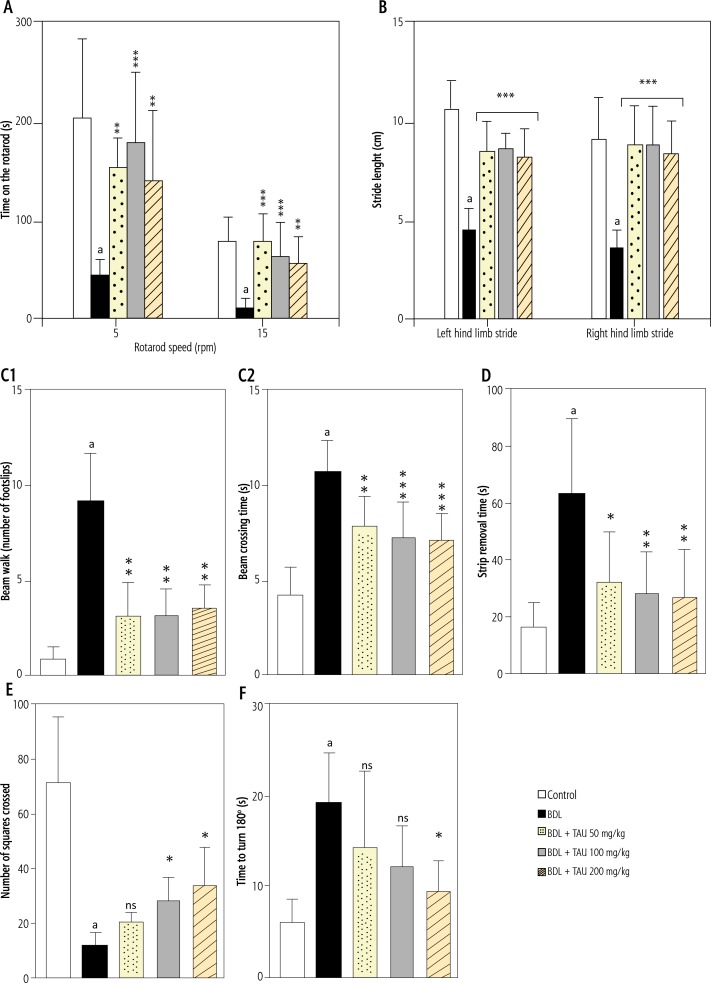
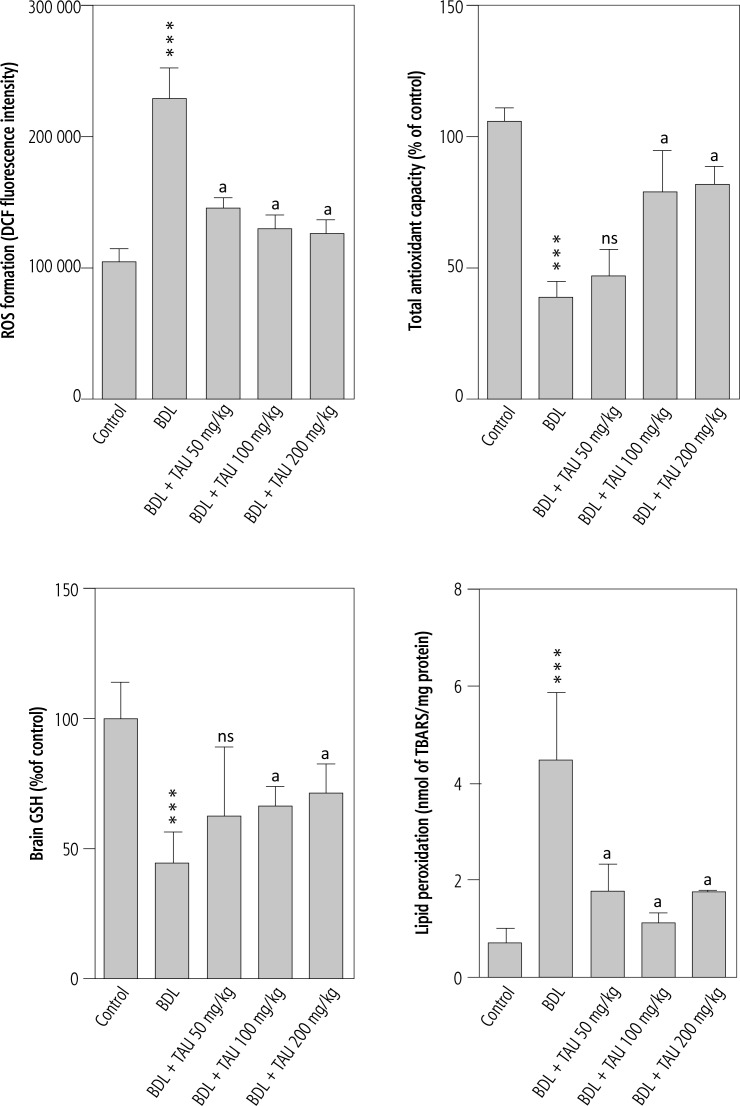
It was found that plasma and brain ammonia was increased, and markers of liver injury were significantly elevated in the cirrhotic group. Impaired locomotor activity was also evident in BDL rats. Moreover, an increase in brain tissue markers of oxidative stress was detected in the brain of cirrhotic animals. It was found that TAU supplementation (50, 100, and 200 mg/kg, gavage) alleviated brain tissue markers of oxidative stress and improved animals' locomotor activity.
These data suggest that TAU is a potential protective agent against cirrhosis-associated brain injury.
肝性脑病和高氨血症是肝硬化相关的临床并发症。脑是氨毒性的靶器官。氨诱导的脑损伤与氧化应激、运动功能障碍和认知缺陷有关,如果处理不当,可能导致永久性脑损伤、昏迷和死亡。目前尚无针对肝硬化相关脑损伤的有效药物干预措施。牛磺酸(TAU)是人体中含量最丰富的氨基酸之一。TAU具有多种生理和药理作用。TAU可能作为一种抗氧化剂,是一种出色的神经保护剂。本研究旨在评估补充TAU对肝硬化相关的运动活动障碍和脑内氧化应激的影响。
对大鼠进行胆管结扎(BDL)手术,并监测血浆和脑内氨水平、血浆生化参数以及大鼠的运动功能。此外,还评估了脑组织的氧化应激标志物。
发现肝硬化组血浆和脑内氨水平升高,肝损伤标志物显著升高。BDL大鼠的运动活动也明显受损。此外,在肝硬化动物的脑中检测到氧化应激的脑组织标志物增加。发现补充TAU(50、100和200mg/kg,灌胃)可减轻脑组织的氧化应激标志物,并改善动物的运动活动。
这些数据表明,TAU是一种潜在的预防肝硬化相关脑损伤的保护剂。