Department of Radiation Oncology, University of North Carolina School of Medicine, Chapel Hill, North Carolina; Medical Physics Graduate Program, Duke University, Durham, North Carolina.
Department of Biomedical Engineering, Duke University, Durham, North Carolina.
Int J Radiat Oncol Biol Phys. 2018 Aug 1;101(5):1113-1122. doi: 10.1016/j.ijrobp.2018.04.017. Epub 2018 Apr 14.
To investigate the degree to which lung ventilation and gas exchange are regionally correlated, using the emerging technology of hyperpolarized (HP)-Xe magnetic resonance imaging (MRI).
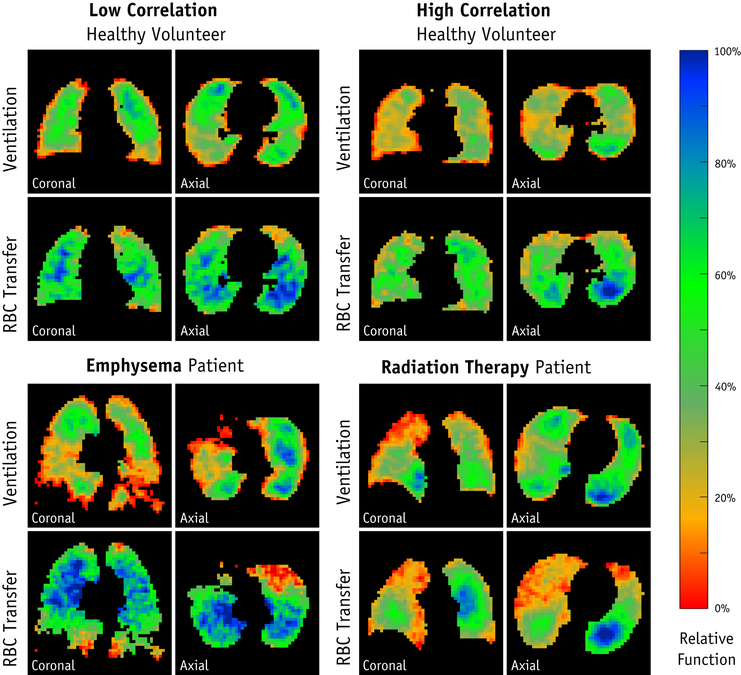
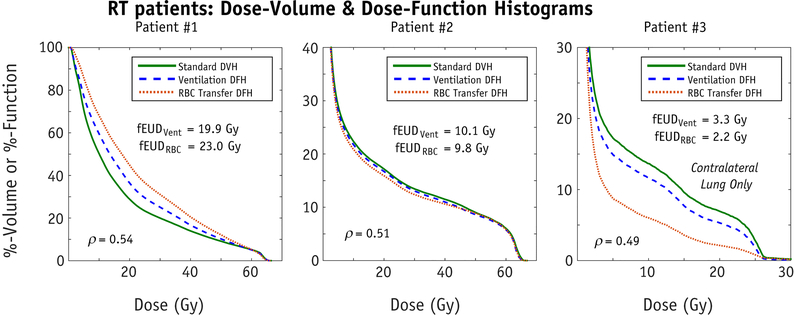
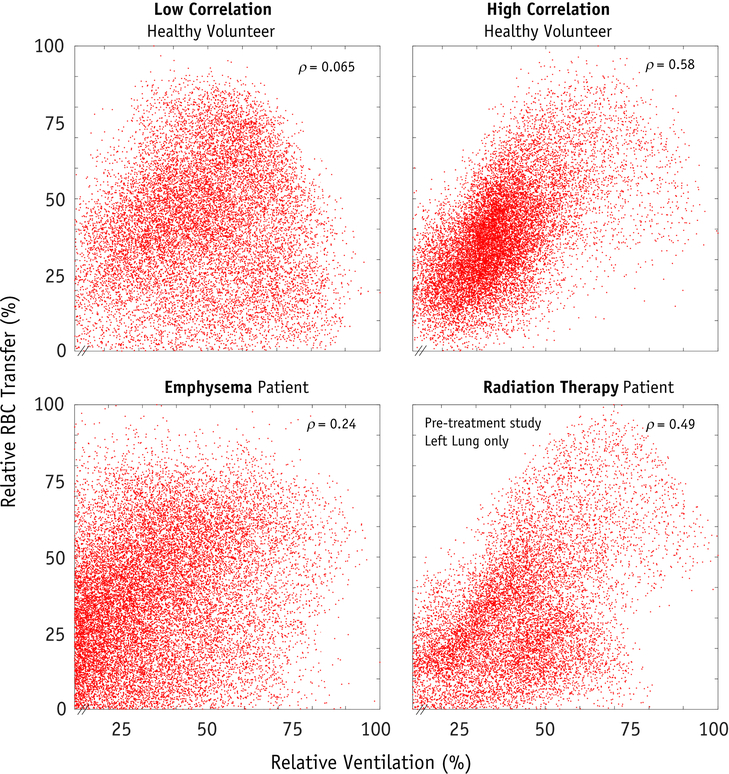
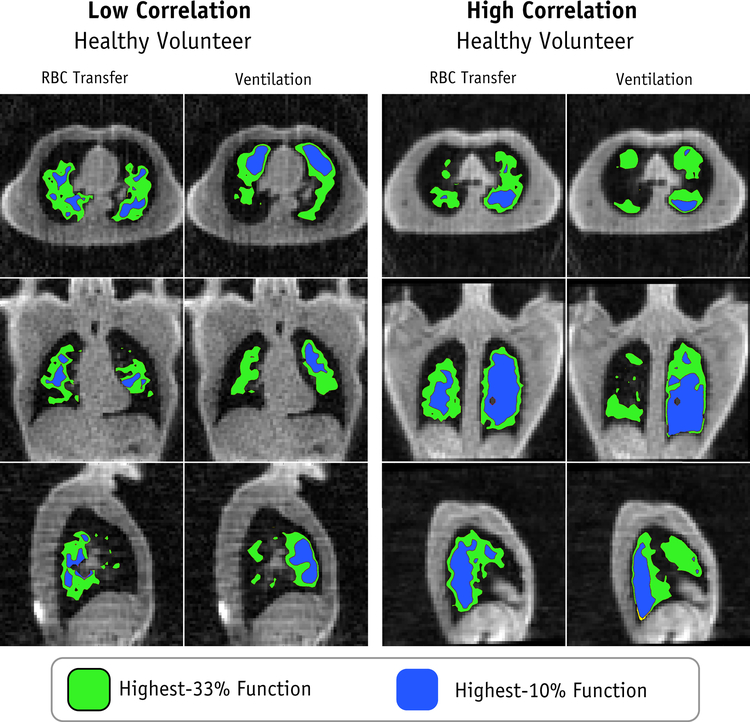
Hyperpolarized-Xe MRI studies were performed on 17 institutional review board-approved human subjects, including 13 healthy volunteers, 1 emphysema patient, and 3 non-small cell lung cancer patients imaged before and approximately 11 weeks after radiation therapy (RT). Subjects inhaled 1 L of HP-Xe mixture, followed by the acquisition of interleaved ventilation and gas exchange images, from which maps were obtained of the relative HP-Xe distribution in three states: (1) gaseous, in lung airspaces; (2) dissolved interstitially, in alveolar barrier tissue; and (3) transferred to red blood cells (RBCs), in the capillary vasculature. The relative spatial distributions of HP-Xe in airspaces (regional ventilation) and RBCs (regional gas transfer) were compared. Further, we investigated the degree to which ventilation and RBC transfer images identified similar functional regions of interest (ROIs) suitable for functionally guided RT. For the RT patients, both ventilation and RBC functional images were used to calculate differences in the lung dose-function histogram and functional effective uniform dose.
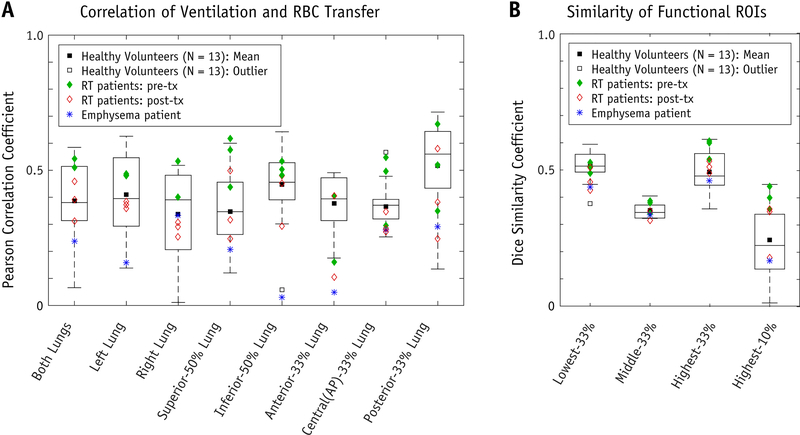
The correlation of ventilation and RBC transfer was ρ = 0.39 ± 0.15 in healthy volunteers. For the RT patients, this correlation was ρ = 0.53 ± 0.02 before treatment and ρ = 0.39 ± 0.07 after treatment; for the emphysema patient it was ρ = 0.24. Comparing functional ROIs, ventilation and RBC transfer demonstrated poor spatial agreement: Dice similarity coefficient = 0.50 ± 0.07 and 0.26 ± 0.12 for the highest-33%- and highest-10%-function ROIs in healthy volunteers, and in RT patients (before treatment) these were 0.58 ± 0.04 and 0.40 ± 0.04. The average magnitude of the differences between RBC- and ventilation-derived functional effective uniform dose, fV20Gy, fV10Gy, and fV5Gy were 1.5 ± 1.4 Gy, 4.1% ± 3.8%, 5.0% ± 3.8%, and 5.3% ± 3.9%, respectively.
Ventilation may not be an effective surrogate for true regional lung function for all patients.
利用新兴的超极化(HP)-氙磁共振成像(MRI)技术,研究肺通气和气体交换在多大程度上具有区域性相关性。
对 17 名经过机构审查委员会批准的人体受试者进行了超极化-Xe MRI 研究,包括 13 名健康志愿者、1 名肺气肿患者和 3 名非小细胞肺癌患者,分别在放疗(RT)前和大约 11 周后进行成像。受试者吸入 1 L 的 HP-Xe 混合物,然后采集通气和气体交换的交错图像,从这些图像中获得三种状态下的相对 HP-Xe 分布图谱:(1)气态,位于肺气道中;(2)弥散于肺泡屏障组织中的溶解状态;(3)转移到毛细血管中的红细胞(RBC)中。比较气道(区域通气)和 RBC(区域气体转移)中 HP-Xe 的相对空间分布。此外,我们还研究了通气和 RBC 转移图像在识别适用于功能指导 RT 的相似功能感兴趣区域(ROI)方面的程度。对于 RT 患者,通气和 RBC 功能图像均用于计算肺剂量-功能直方图和功能有效均匀剂量的差异。
在健康志愿者中,通气和 RBC 转移的相关性为 ρ=0.39±0.15。对于 RT 患者,治疗前为 ρ=0.53±0.02,治疗后为 ρ=0.39±0.07;对于肺气肿患者,相关性为 ρ=0.24。比较功能 ROI,通气和 RBC 转移显示出较差的空间一致性:在健康志愿者中,最高 33%和最高 10%功能 ROI 的 Dice 相似系数分别为 0.50±0.07 和 0.26±0.12,在 RT 患者(治疗前)中,这些分别为 0.58±0.04 和 0.40±0.04。RBC 和通气衍生的功能有效均匀剂量 fV20Gy、fV10Gy 和 fV5Gy 之间差异的平均幅度分别为 1.5±1.4 Gy、4.1%±3.8%、5.0%±3.8%和 5.3%±3.9%。
对于所有患者,通气可能不是真正的区域性肺功能的有效替代指标。