• 文献检索
  • 文档翻译
  • 深度研究
  • 学术资讯
  • Suppr Zotero 插件Zotero 插件
  • 邀请有礼
  • 套餐&价格
  • 历史记录
应用&插件
Suppr Zotero 插件Zotero 插件浏览器插件Mac 客户端Windows 客户端微信小程序
定价
高级版会员购买积分包购买API积分包
服务
文献检索文档翻译深度研究API 文档MCP 服务
关于我们
关于 Suppr公司介绍联系我们用户协议隐私条款
关注我们

Suppr 超能文献

核心技术专利:CN118964589B侵权必究
粤ICP备2023148730 号-1Suppr @ 2026

文献检索

告别复杂PubMed语法,用中文像聊天一样搜索,搜遍4000万医学文献。AI智能推荐,让科研检索更轻松。

立即免费搜索

文件翻译

保留排版,准确专业,支持PDF/Word/PPT等文件格式,支持 12+语言互译。

免费翻译文档

深度研究

AI帮你快速写综述,25分钟生成高质量综述,智能提取关键信息,辅助科研写作。

立即免费体验

深度学习方法将 3DCT 转化为 SPECT 通气成像:与 Kr 气体 SPECT 通气成像的首次比较。

A deep learning method for translating 3DCT to SPECT ventilation imaging: First comparison with Kr-gas SPECT ventilation imaging.

机构信息

Department of Radiology, Graduate School of Medical Science, Kyoto Prefectural University of Medicine, Kyoto, Japan.

Department of Radiation Oncology, Tohoku University Graduate School of Medicine, Sendai, Japan.

出版信息

Med Phys. 2022 Jul;49(7):4353-4364. doi: 10.1002/mp.15697. Epub 2022 May 17.

DOI:10.1002/mp.15697
PMID:35510535
原文链接:https://pmc.ncbi.nlm.nih.gov/articles/PMC9545310/
Abstract

PURPOSE

This study aimed to evaluate the accuracy of deep learning (DL)-based computed tomography (CT) ventilation imaging (CTVI).

METHODS

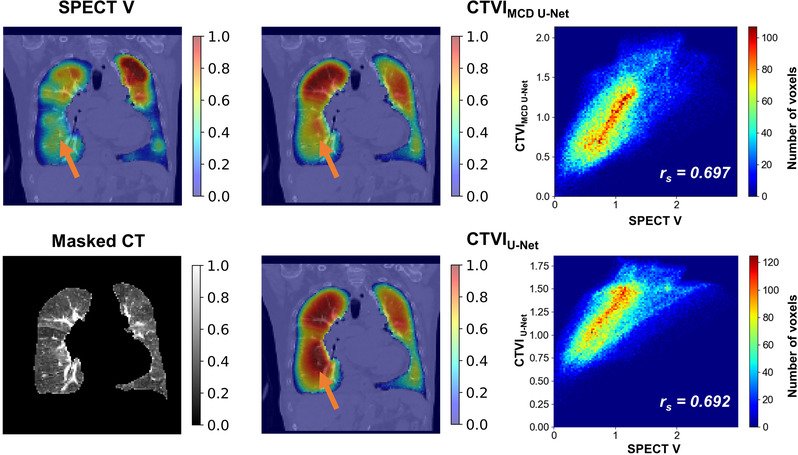
A total of 71 cases that underwent single-photon emission CT Kr-gas ventilation (SPECT V) and CT imaging were included. Sixty cases were assigned to the training and validation sets, and the remaining 11 cases were assigned to the test set. To directly transform three-dimensional (3D) CT (free-breathing CT) images to SPECT V images, a DL-based model was implemented based on the U-Net architecture. The input and output data were 3DCT- and SPECT V-masked, respectively, except for whole-lung volumes. These data were rearranged in voxel size, registered rigidly, cropped, and normalized in preprocessing. In addition to a standard estimation method (i.e., without dropout during the estimation process), a Monte Carlo dropout (MCD) method (i.e., with dropout during the estimation process) was used to calculate prediction uncertainty. To evaluate the two models' (CTVI , CTVI ) performance, we used fivefold cross-validation for the training and validation sets. To test the final model performances for both approaches, we applied the test set to each trained model and averaged the test prediction results from the five trained models to acquire the mean test result (bagging) for each approach. For the MCD method, the models were predicted repeatedly (sample size = 200), and the average and standard deviation (SD) maps were calculated in each voxel from the predicted results: The average maps were defined as test prediction results in each fold. As an evaluation index, the voxel-wise Spearman rank correlation coefficient (Spearman r ) and Dice similarity coefficient (DSC) were calculated. The DSC was calculated for three functional regions (high, moderate, and low) separated by an almost equal volume. The coefficient of variation was defined as prediction uncertainty, and these average values were calculated within three functional regions. The Wilcoxon signed-rank test was used to test for a significant difference between the two DL-based approaches.

RESULTS

The average indexes with one SD (1SD) between CTVI and SPECT V were 0.76 ± 0.06, 0.69 ± 0.07, 0.51 ± 0.06, and 0.75 ± 0.04 for Spearman r , DSC , DSC , and DSC , respectively. The average indexes with 1SD between CTVI and SPECT V were 0.72 ± 0.05, 0.66 ± 0.04, 0.48 ± 0.04, and 0.74 ± 0.06 for Spearman r , DSC , DSC , and DSC , respectively. These indexes between CTVI and CTVI showed no significance difference (Spearman r , p = 0.175; DSC , p = 0.123; DSC , p = 0.278; DSC , p = 0.520). The average coefficient of variations with 1SD were 0.27 ± 0.00, 0.27 ± 0.01, and 0.36 ± 0.03 for the high-, moderate-, and low-functional regions, respectively, and the low-functional region showed a tendency to exhibit larger uncertainties than the others.

CONCLUSION

We evaluated DL-based framework for estimating lung-functional ventilation images only from CT images. The results indicated that the DL-based approach could potentially be used for lung-ventilation estimation.

摘要

目的

本研究旨在评估基于深度学习(DL)的计算机断层扫描(CT)通气成像(CTVI)的准确性。

方法

共纳入 71 例接受单光子发射 CT Kr-气体通气(SPECT V)和 CT 成像的患者。其中 60 例被分配到训练集和验证集,其余 11 例被分配到测试集。为了直接将三维(3D)CT(自由呼吸 CT)图像转换为 SPECT V 图像,我们基于 U-Net 架构实施了基于 DL 的模型。输入和输出数据分别为 3DCT 和 SPECT V 掩模,除了全肺体积外。这些数据以体素大小进行重新排列,刚性注册,裁剪和标准化预处理。除了标准估计方法(即在估计过程中不使用随机失活)之外,还使用蒙特卡罗随机失活(MCD)方法(即在估计过程中使用随机失活)来计算预测不确定性。为了评估两种模型(CTVI,CTVI)的性能,我们使用五折交叉验证对训练集和验证集进行评估。为了测试两种方法的最终模型性能,我们将测试集应用于每个训练模型,并对五个训练模型的测试预测结果进行平均,以获得每个方法的平均测试结果(袋装)。对于 MCD 方法,模型会重复进行预测(样本量=200),并从预测结果中计算每个体素的平均和标准偏差(SD)图:平均图被定义为每个折叠的测试预测结果。作为评估指标,计算了体素水平的斯皮尔曼等级相关系数(Spearman r)和 Dice 相似系数(DSC)。根据几乎相等的体积将三个功能区域(高、中、低)分开,并计算 DSC。变异系数被定义为预测不确定性,并在三个功能区域内计算这些平均值。使用 Wilcoxon 符号秩检验检验两种基于 DL 的方法之间是否存在显著差异。

结果

CTVI 与 SPECT V 之间的 1SD 平均指标分别为 0.76 ± 0.06、0.69 ± 0.07、0.51 ± 0.06 和 0.75 ± 0.04 的 Spearman r、DSC、DSC 和 DSC。CTVI 与 SPECT V 之间的 1SD 平均指标分别为 0.72 ± 0.05、0.66 ± 0.04、0.48 ± 0.04 和 0.74 ± 0.06 的 Spearman r、DSC、DSC 和 DSC。CTVI 与 CTVI 之间的这些指标没有显著差异(Spearman r,p=0.175;DSC,p=0.123;DSC,p=0.278;DSC,p=0.520)。1SD 的平均变异系数分别为 0.27 ± 0.00、0.27 ± 0.01 和 0.36 ± 0.03,分别用于高、中和低功能区域,并且低功能区域表现出比其他区域更大的不确定性的趋势。

结论

我们评估了基于 DL 的框架,仅从 CT 图像估计肺功能通气图像。结果表明,基于 DL 的方法可能可用于肺通气估计。

https://cdn.ncbi.nlm.nih.gov/pmc/blobs/9297/9545310/581e25c99588/MP-49-4353-g004.jpg
https://cdn.ncbi.nlm.nih.gov/pmc/blobs/9297/9545310/aaee0d1b6c1e/MP-49-4353-g001.jpg
https://cdn.ncbi.nlm.nih.gov/pmc/blobs/9297/9545310/4c035f1f7cf4/MP-49-4353-g002.jpg
https://cdn.ncbi.nlm.nih.gov/pmc/blobs/9297/9545310/99a547eab7b6/MP-49-4353-g003.jpg
https://cdn.ncbi.nlm.nih.gov/pmc/blobs/9297/9545310/ad9b69d5fcf9/MP-49-4353-g005.jpg
https://cdn.ncbi.nlm.nih.gov/pmc/blobs/9297/9545310/581e25c99588/MP-49-4353-g004.jpg
https://cdn.ncbi.nlm.nih.gov/pmc/blobs/9297/9545310/aaee0d1b6c1e/MP-49-4353-g001.jpg
https://cdn.ncbi.nlm.nih.gov/pmc/blobs/9297/9545310/4c035f1f7cf4/MP-49-4353-g002.jpg
https://cdn.ncbi.nlm.nih.gov/pmc/blobs/9297/9545310/99a547eab7b6/MP-49-4353-g003.jpg
https://cdn.ncbi.nlm.nih.gov/pmc/blobs/9297/9545310/ad9b69d5fcf9/MP-49-4353-g005.jpg
https://cdn.ncbi.nlm.nih.gov/pmc/blobs/9297/9545310/581e25c99588/MP-49-4353-g004.jpg

相似文献

1
A deep learning method for translating 3DCT to SPECT ventilation imaging: First comparison with Kr-gas SPECT ventilation imaging.深度学习方法将 3DCT 转化为 SPECT 通气成像:与 Kr 气体 SPECT 通气成像的首次比较。
Med Phys. 2022 Jul;49(7):4353-4364. doi: 10.1002/mp.15697. Epub 2022 May 17.
2
A deep learning method for producing ventilation images from 4DCT: First comparison with technegas SPECT ventilation.一种从 4DCT 生成通气图像的深度学习方法:首次与 technegas SPECT 通气比较。
Med Phys. 2020 Mar;47(3):1249-1257. doi: 10.1002/mp.14004. Epub 2020 Jan 28.
3
A deep learning model for translating CT to ventilation imaging: analysis of accuracy and impact on functional avoidance radiotherapy planning.用于将 CT 转换为通气成像的深度学习模型:准确性分析及其对功能回避放疗计划的影响。
Jpn J Radiol. 2024 Jul;42(7):765-776. doi: 10.1007/s11604-024-01550-2. Epub 2024 Mar 27.
4
Evaluating the accuracy of 4D-CT ventilation imaging: First comparison with Technegas SPECT ventilation.评估 4D-CT 通气成像的准确性:首次与 Technegas SPECT 通气比较。
Med Phys. 2017 Aug;44(8):4045-4055. doi: 10.1002/mp.12317. Epub 2017 Jun 16.
5
The VAMPIRE challenge: A multi-institutional validation study of CT ventilation imaging.VAMPIRE 挑战赛:CT 通气成像的多机构验证研究。
Med Phys. 2019 Mar;46(3):1198-1217. doi: 10.1002/mp.13346. Epub 2019 Feb 1.
6
Deep learning-based combination of [18F]-FDG PET and CT images for producing pulmonary perfusion image.基于深度学习的 [18F]-FDG PET 和 CT 图像融合生成肺灌注图像。
Med Phys. 2023 Dec;50(12):7779-7790. doi: 10.1002/mp.16566. Epub 2023 Jun 30.
7
Deep Learning-Based Computed Tomography Perfusion Mapping (DL-CTPM) for Pulmonary CT-to-Perfusion Translation.基于深度学习的计算机断层扫描灌注成像(DL-CTPM)在 CT 至灌注转换中的应用。
Int J Radiat Oncol Biol Phys. 2021 Aug 1;110(5):1508-1518. doi: 10.1016/j.ijrobp.2021.02.032. Epub 2021 Mar 6.
8
4D CT lung ventilation images are affected by the 4D CT sorting method.4D CT 肺部通气图像受 4D CT 分类方法的影响。
Med Phys. 2013 Oct;40(10):101907. doi: 10.1118/1.4820538.
9
Enhancing voxel-based dosimetry accuracy with an unsupervised deep learning approach for hybrid medical image registration.利用无监督深度学习方法提高混合医学图像配准的体素剂量学精度。
Med Phys. 2024 Sep;51(9):6432-6444. doi: 10.1002/mp.17129. Epub 2024 May 21.
10
Investigating the use of machine learning to generate ventilation images from CT scans.研究使用机器学习从 CT 扫描中生成通气图像。
Med Phys. 2022 Aug;49(8):5258-5267. doi: 10.1002/mp.15688. Epub 2022 May 15.

引用本文的文献

1
Perfusion estimation from dynamic non-contrast computed tomography using self-supervised learning and a physics-inspired U-net transformer architecture.使用自监督学习和物理启发式U-net变压器架构从动态非对比计算机断层扫描中进行灌注估计。
Int J Comput Assist Radiol Surg. 2025 May;20(5):959-970. doi: 10.1007/s11548-025-03323-2. Epub 2025 Jan 20.
2
Motion and anatomy dual aware lung ventilation imaging by integrating Jacobian map and average CT image using dual path fusion network.基于双路径融合网络整合雅可比映射和平均CT图像的运动与解剖双感知肺通气成像
Med Phys. 2025 Jan;52(1):246-256. doi: 10.1002/mp.17466. Epub 2024 Oct 21.
3

本文引用的文献

1
Error detection model developed using a multi-task convolutional neural network in patient-specific quality assurance for volumetric-modulated arc therapy.使用多任务卷积神经网络在容积调强弧形治疗的个体化质量保证中开发的误差检测模型。
Med Phys. 2021 Sep;48(9):4769-4783. doi: 10.1002/mp.15031. Epub 2021 Jul 29.
2
Investigation of a Novel Deep Learning-Based Computed Tomography Perfusion Mapping Framework for Functional Lung Avoidance Radiotherapy.基于深度学习的新型计算机断层扫描灌注成像框架用于功能性肺避让放疗的研究
Front Oncol. 2021 Mar 24;11:644703. doi: 10.3389/fonc.2021.644703. eCollection 2021.
3
Deep Learning-Based Computed Tomography Perfusion Mapping (DL-CTPM) for Pulmonary CT-to-Perfusion Translation.
Artificial intelligence uncertainty quantification in radiotherapy applications - A scoping review.
人工智能在放射治疗应用中的不确定性量化 - 范围综述。
Radiother Oncol. 2024 Dec;201:110542. doi: 10.1016/j.radonc.2024.110542. Epub 2024 Sep 17.
4
Artificial Intelligence Uncertainty Quantification in Radiotherapy Applications - A Scoping Review.放射治疗应用中的人工智能不确定性量化——一项范围综述。
medRxiv. 2024 May 13:2024.05.13.24307226. doi: 10.1101/2024.05.13.24307226.
基于深度学习的计算机断层扫描灌注成像(DL-CTPM)在 CT 至灌注转换中的应用。
Int J Radiat Oncol Biol Phys. 2021 Aug 1;110(5):1508-1518. doi: 10.1016/j.ijrobp.2021.02.032. Epub 2021 Mar 6.
4
A comparison of Monte Carlo dropout and bootstrap aggregation on the performance and uncertainty estimation in radiation therapy dose prediction with deep learning neural networks.深度学习神经网络在放射治疗剂量预测中蒙特卡罗随机失活和自助聚合法在性能及不确定性估计方面的比较
Phys Med Biol. 2021 Feb 24;66(5):054002. doi: 10.1088/1361-6560/abe04f.
5
Error detection using a convolutional neural network with dose difference maps in patient-specific quality assurance for volumetric modulated arc therapy.基于剂量差图的卷积神经网络在容积调强弧形治疗个体化质量保证中的误差检测。
Phys Med. 2020 May;73:57-64. doi: 10.1016/j.ejmp.2020.03.022. Epub 2020 Apr 21.
6
DeepDose: Towards a fast dose calculation engine for radiation therapy using deep learning.深剂量:利用深度学习开发辐射治疗快速剂量计算引擎。
Phys Med Biol. 2020 Apr 8;65(7):075013. doi: 10.1088/1361-6560/ab7630.
7
A deep learning method for producing ventilation images from 4DCT: First comparison with technegas SPECT ventilation.一种从 4DCT 生成通气图像的深度学习方法:首次与 technegas SPECT 通气比较。
Med Phys. 2020 Mar;47(3):1249-1257. doi: 10.1002/mp.14004. Epub 2020 Jan 28.
8
Uncertainty and interpretability in convolutional neural networks for semantic segmentation of colorectal polyps.卷积神经网络在结直肠息肉语义分割中的不确定性和可解释性。
Med Image Anal. 2020 Feb;60:101619. doi: 10.1016/j.media.2019.101619. Epub 2019 Nov 20.
9
A convolutional neural network approach for IMRT dose distribution prediction in prostate cancer patients.一种用于前列腺癌患者调强放疗剂量分布预测的卷积神经网络方法。
J Radiat Res. 2019 Oct 23;60(5):685-693. doi: 10.1093/jrr/rrz051.
10
Technical Note: Deriving ventilation imaging from 4DCT by deep convolutional neural network.技术说明:通过深度卷积神经网络从 4DCT 中获取通气成像。
Med Phys. 2019 May;46(5):2323-2329. doi: 10.1002/mp.13421. Epub 2019 Mar 12.