Australian Research Council Centre of Excellence in Plant Energy Biology, School of Molecular Sciences, The University of Western Australia, Crawley, Western Australia 6009, Australia.
Harry Perkins Institute of Medical Research, Nedlands, Western Australia 6009, Australia.
Genome Res. 2018 Aug;28(8):1193-1206. doi: 10.1101/gr.233049.117. Epub 2018 Jun 15.
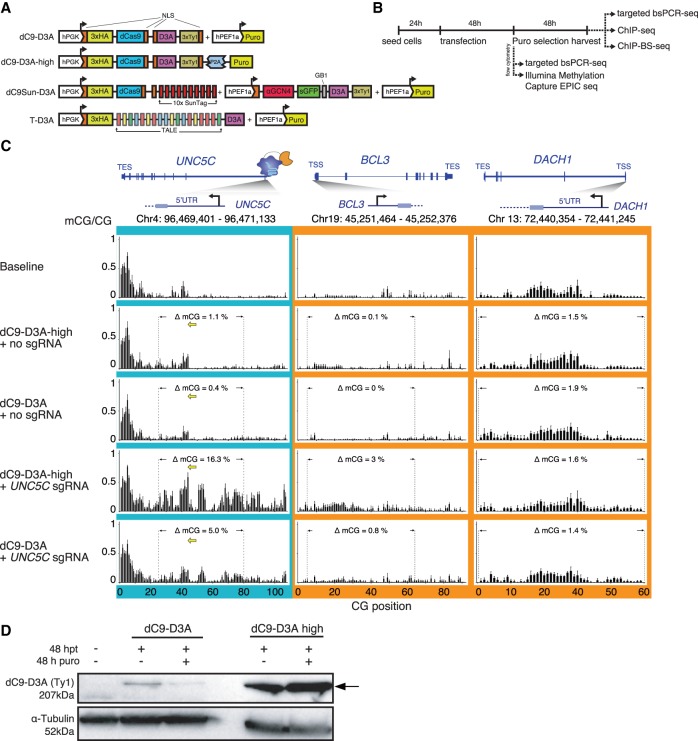
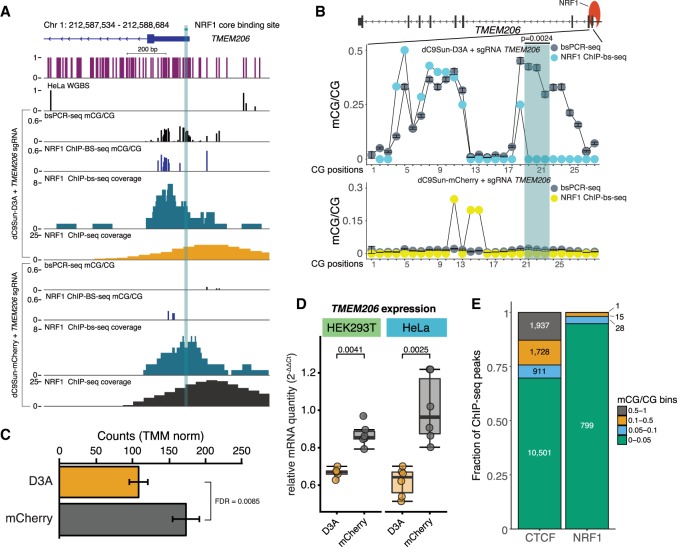
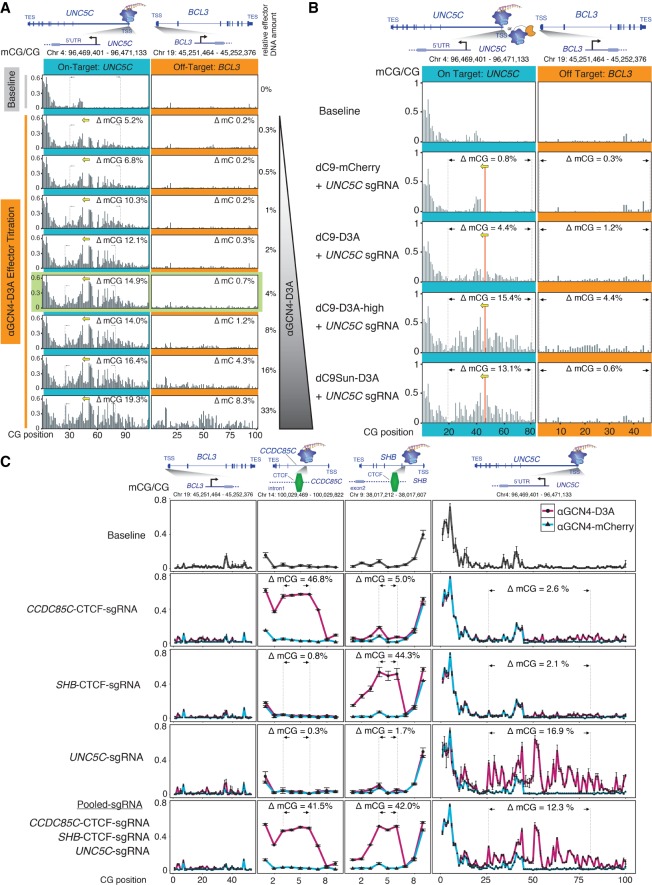
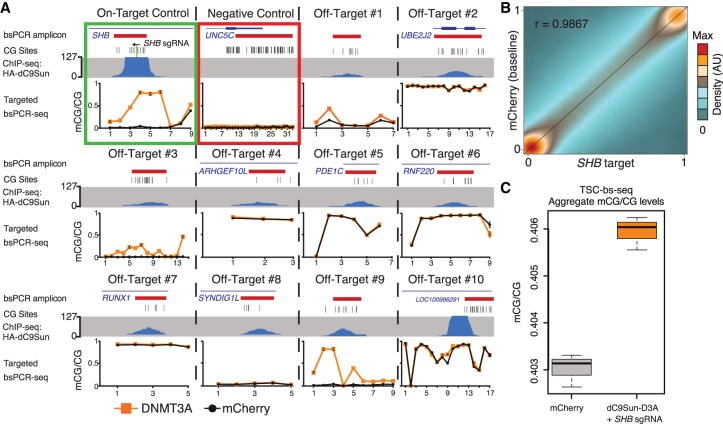
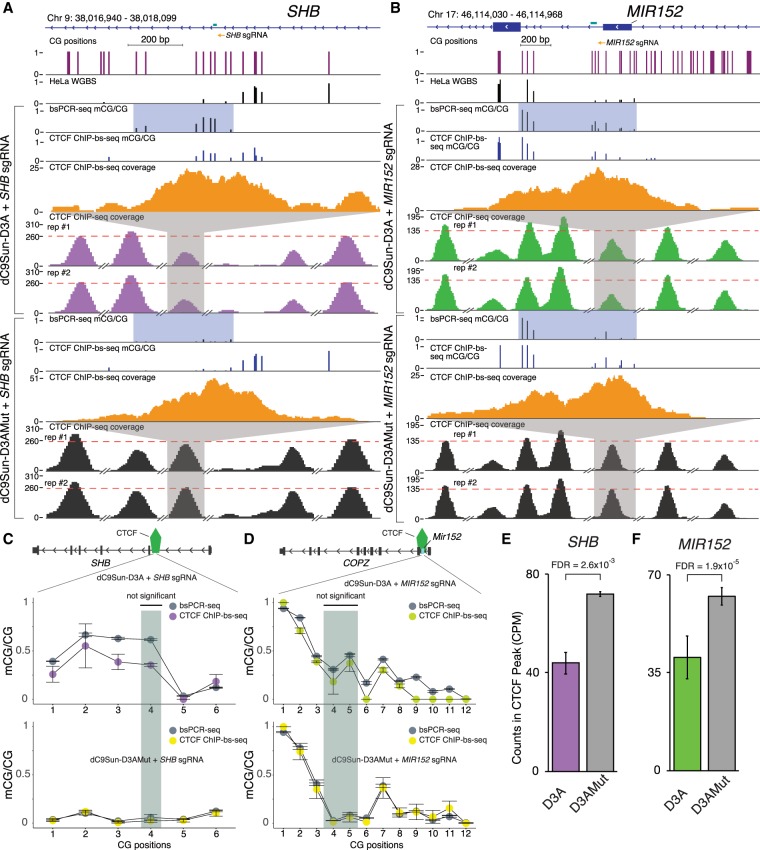
Detection of DNA methylation in the genome has been possible for decades; however, the ability to deliberately and specifically manipulate local DNA methylation states in the genome has been extremely limited. Consequently, this has impeded our understanding of the direct effect of DNA methylation on transcriptional regulation and transcription factor binding in the native chromatin context. Thus, highly specific targeted epigenome editing tools are needed to address this. Recent adaptations of genome editing technologies, including fusion of the DNMT3A DNA methyltransferase catalytic domain to catalytically inactive Cas9 (dC9-D3A), have aimed to alter DNA methylation at desired loci. Here, we show that these tools exhibit consistent off-target DNA methylation deposition in the genome, limiting their capabilities to unambiguously assess the functional consequences of DNA methylation. To address this, we developed a modular dCas9-SunTag (dC9Sun-D3A) system that can recruit multiple DNMT3A catalytic domains to a target site for editing DNA methylation. dC9Sun-D3A is tunable, specific, and exhibits much higher induction of DNA methylation at target sites than the dC9-D3A direct fusion protein. Importantly, genome-wide characterization of dC9Sun-D3A binding sites and DNA methylation revealed minimal off-target protein binding and induction of DNA methylation with dC9Sun-D3A, compared to pervasive off-target methylation by dC9-D3A. Furthermore, we used dC9Sun-D3A to demonstrate the binding sensitivity to DNA methylation for CTCF and NRF1 in situ. Overall, this modular dC9Sun-D3A system enables precise DNA methylation deposition with the lowest off-target DNA methylation levels reported to date, allowing accurate functional determination of the role of DNA methylation at single loci.
几十年来,人们已经能够检测基因组中的 DNA 甲基化;然而,在基因组中故意且特异性地操作局部 DNA 甲基化状态的能力极其有限。因此,这阻碍了我们对 DNA 甲基化对转录调控和转录因子在天然染色质环境中结合的直接影响的理解。因此,需要高度特异性的靶向表观基因组编辑工具来解决这个问题。最近对基因组编辑技术的改编,包括将 DNMT3A DNA 甲基转移酶催化结构域融合到无催化活性的 Cas9(dC9-D3A)中,旨在改变所需基因座的 DNA 甲基化。在这里,我们表明这些工具在基因组中表现出一致的脱靶 DNA 甲基化沉积,限制了它们明确评估 DNA 甲基化功能后果的能力。为了解决这个问题,我们开发了一种模块化的 dCas9-SunTag(dC9Sun-D3A)系统,可以将多个 DNMT3A 催化结构域募集到靶位点进行 DNA 甲基化编辑。dC9Sun-D3A 是可调的、特异性的,并且在靶位点诱导 DNA 甲基化的能力比直接融合蛋白 dC9-D3A 高得多。重要的是,与 dC9-D3A 广泛的脱靶甲基化相比,dC9Sun-D3A 的全基因组特征分析表明,dC9Sun-D3A 结合位点和 DNA 甲基化的脱靶蛋白结合和诱导 DNA 甲基化最小。此外,我们使用 dC9Sun-D3A 来证明 CTCF 和 NRF1 在体内对 DNA 甲基化的结合敏感性。总体而言,这种模块化的 dC9Sun-D3A 系统能够以迄今为止报道的最低脱靶 DNA 甲基化水平进行精确的 DNA 甲基化沉积,从而可以准确确定单个基因座上 DNA 甲基化的功能作用。