Center for Molecular Spectroscopy and Dynamics, Institute for Basic Science, Seoul, 02841, Korea.
Department of Physics, Korea University, Seoul, 02841, Korea.
Sci Rep. 2018 Jun 15;8(1):9165. doi: 10.1038/s41598-018-27289-1.
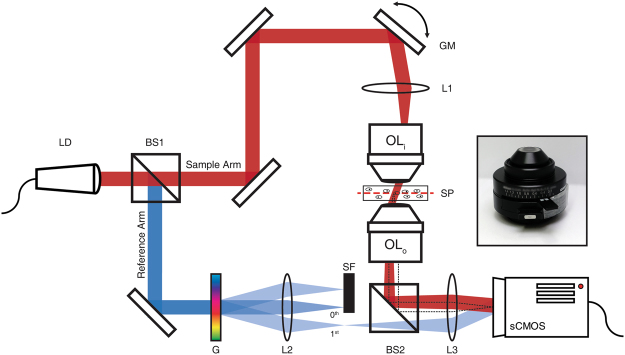
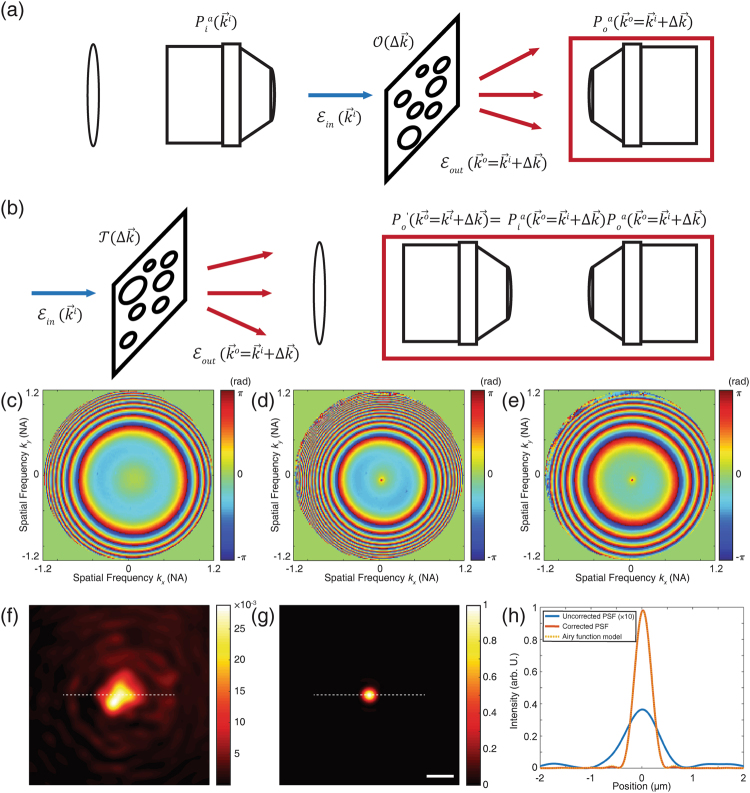
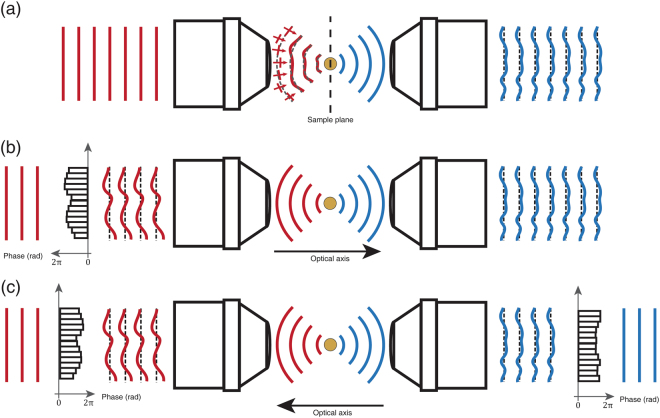
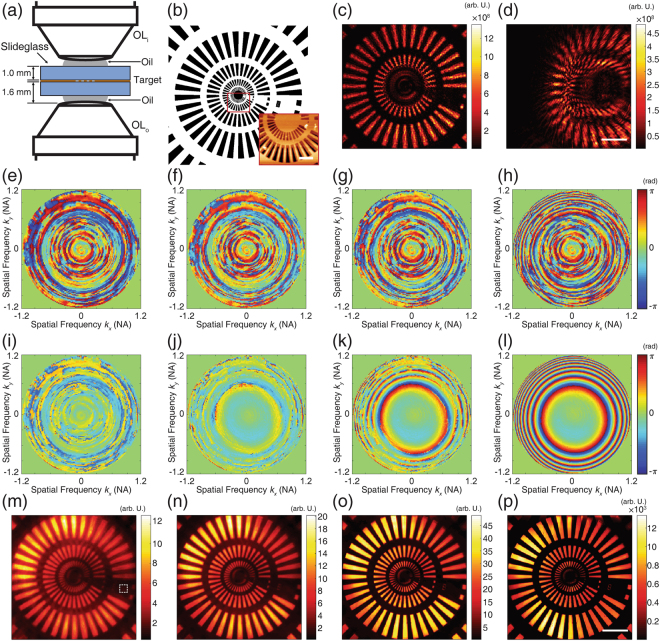
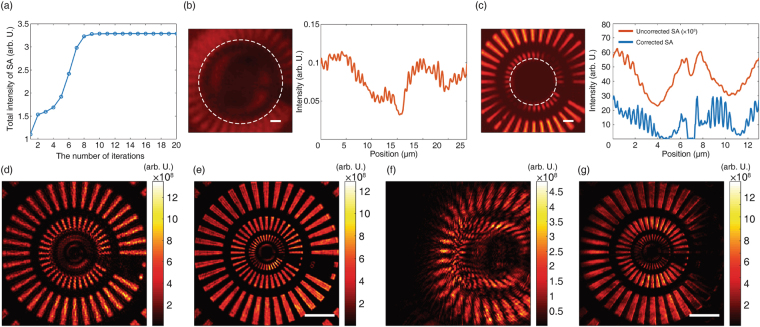
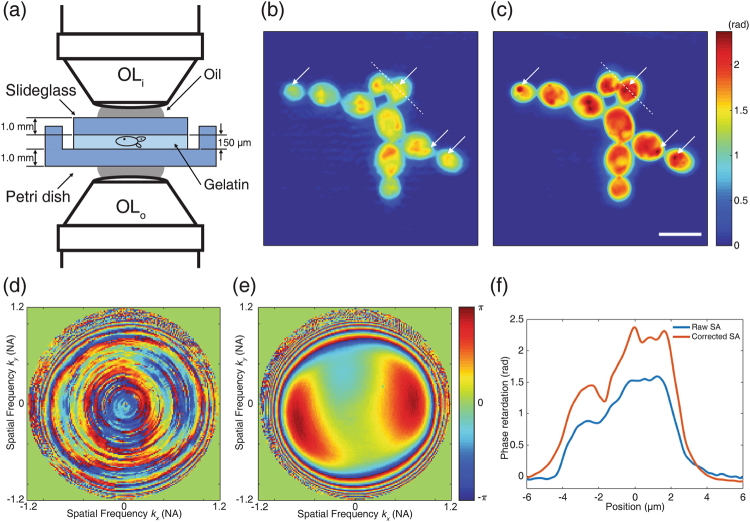
High-resolution optical imaging within thick objects has been a challenging task due to the short working distance of conventional high numerical aperture (NA) objective lenses. Lenses with a large physical diameter and thus a large aperture, such as microscope condenser lenses, can feature both a large NA and a long working distance. However, such lenses suffer from strong aberrations. To overcome this problem, we present a method to correct the aberrations of a transmission-mode imaging system that is composed of two condensers. The proposed method separately identifies and corrects aberrations of illumination and collection lenses of up to 1.2 NA by iteratively optimizing the total intensity of the synthetic aperture images in the forward and phase-conjugation processes. At a source wavelength of 785 nm, we demonstrated a spatial resolution of 372 nm at extremely long working distances of up to 1.6 mm, an order of magnitude improvement in comparison to conventional objective lenses. Our method of converting microscope condensers to high-quality objectives may facilitate increases in the imaging depths of super-resolution and expansion microscopes.
在厚物体内部进行高分辨率光学成像是一项具有挑战性的任务,这是因为传统高数值孔径(NA)物镜的工作距离较短。具有大物理直径和大孔径的透镜,例如显微镜聚光镜,可以具有大的 NA 和长的工作距离。然而,此类透镜会受到强烈像差的影响。为了解决这个问题,我们提出了一种方法,可以校正由两个聚光镜组成的透射模式成像系统的像差。该方法通过在正向和相位共轭过程中迭代优化合成孔径图像的总强度,分别识别和校正照明和收集透镜的高达 1.2 NA 的像差。在 785nm 的光源波长下,我们在长达 1.6mm 的极长工作距离下实现了 372nm 的空间分辨率,与传统物镜相比提高了一个数量级。我们将显微镜聚光镜转换为高质量物镜的方法可能会促进超分辨率和扩展显微镜的成像深度的增加。