Department of Obstetrics and Gynecology, University of Pennsylvania, Philadelphia, Pennsylvania.
Department of Psychiatry, University of Pennsylvania, Philadelphia, Pennsylvania.
Fertil Steril. 2018 Jul 1;110(1):161-171.e1. doi: 10.1016/j.fertnstert.2018.03.028. Epub 2018 Jun 13.
To compare the effects of cognitive-behavioral therapy (CBT) and lifestyle modification (LS) versus LS alone on weight, depressive and anxiety symptoms, and stress response in women with polycystic ovary syndrome (PCOS), overweight/obesity, and depressive symptoms.
A 16-week pilot randomized clinical trial.
Tertiary-care PCOS center.
PATIENT(S): Overweight/obese women with PCOS and depressive symptoms.
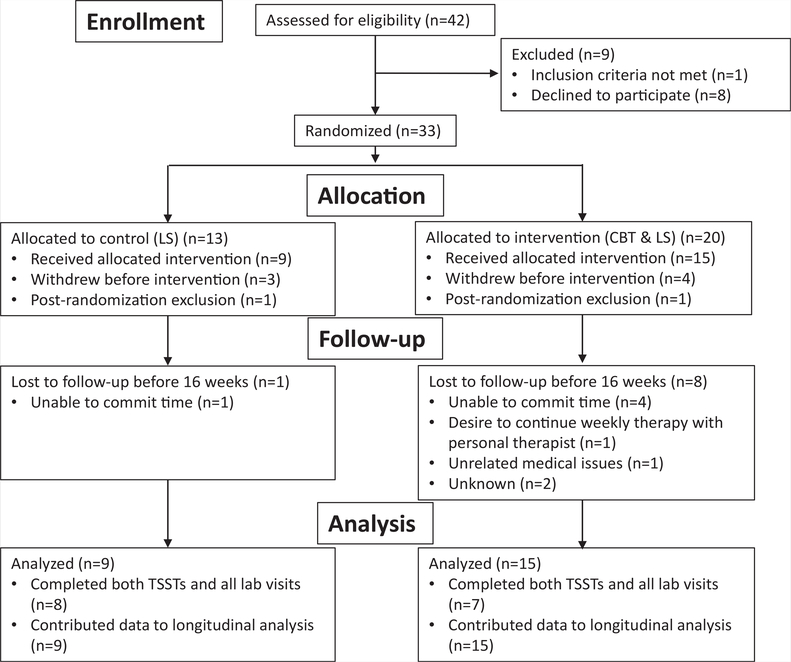
INTERVENTION(S): Weekly CBT (n = 7) or contact only/no therapy (n = 8) for 8 weeks. Both groups received weekly LS for 16 weeks.
MAIN OUTCOME MEASURE(S): Changes in weight, depression (Center for Epidemiologic Studies Depression Scale [CES-D]), anxiety (State-Trait Anxiety Inventory [STAI]), quality of life (Polycystic Ovary Syndrome Health-Related Quality of Life Questionnaire [PCOSQ]), laboratory tests, and response to a Trier Social Stress Test (TSST).
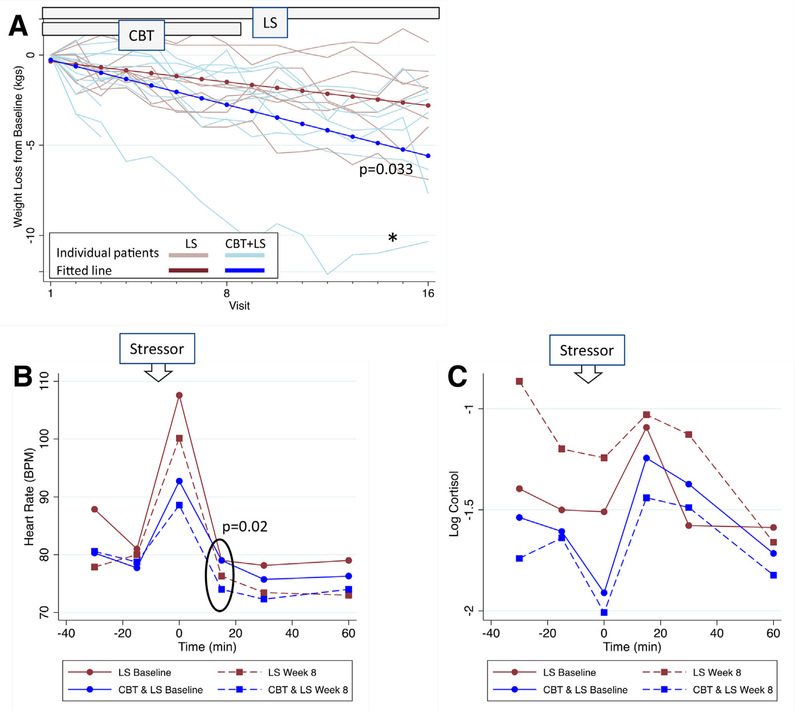
RESULT(S): The CBT+LS group lost more weekly weight (-0.35 kg/wk vs. -0.16 kg/wk) compared with the LS group. Overall, the CBT+LS group lost 3.2 kg versus 1.8 kg for the LS group. The CBT+LS group had greater improvement in PCOSQ at 8 weeks (+3.7 vs. +1.2 points). In the overall cohort, STAI and CES-D decreased by -0.27 points per week and -0.31 points/wk, respectfully, and total and free T decreased at week 8. Heart rate response to TSST was lower at 15 minutes after stressor in the CBT+LS group.
CONCLUSION(S): Weekly CBT+LS for 8 weeks compared with LS alone resulted in significant weight loss and improved quality of life in overweight/obese women with PCOS and depressive symptoms. These interventions were associated with a decreased autonomic response to a laboratory stressor, suggesting a potential link between CBT, weight loss, and modulation of the stress response.
NCT01899001.
比较认知行为疗法(CBT)和生活方式改变(LS)与单独 LS 对多囊卵巢综合征(PCOS)、超重/肥胖和抑郁症状女性的体重、抑郁和焦虑症状以及应激反应的影响。
一项 16 周的试点随机临床试验。
三级 PCOS 中心。
超重/肥胖且伴有抑郁症状的 PCOS 女性。
每周 CBT(n = 7)或仅接触/无治疗(n = 8)8 周。两组均接受 16 周的每周 LS。
体重变化、抑郁(流行病学研究中心抑郁量表 [CES-D])、焦虑(状态特质焦虑量表 [STAI])、生活质量(多囊卵巢综合征健康相关生活质量问卷 [PCOSQ])、实验室检查和特里尔社会应激测试(TSST)的反应。
与 LS 组相比,CBT+LS 组每周体重减轻更多(-0.35kg/wk 比 -0.16kg/wk)。总体而言,CBT+LS 组体重减轻 3.2kg,而 LS 组体重减轻 1.8kg。8 周时,CBT+LS 组 PCOSQ 改善更大(+3.7 分比+1.2 分)。在整个队列中,STAI 和 CES-D 每周分别下降 0.27 点和 0.31 点,总 T 和游离 T 在第 8 周下降。应激源后 15 分钟时,CBT+LS 组的心率对 TSST 的反应较低。
与单独 LS 相比,8 周的每周 CBT+LS 治疗可显著减轻超重/肥胖且伴有抑郁症状的 PCOS 女性的体重,并改善生活质量。这些干预措施与实验室应激源下自主神经系统反应的降低有关,提示 CBT、体重减轻和应激反应调节之间可能存在联系。
NCT01899001。