Schmidt J A, Beug H, Hayman M J
EMBO J. 1985 Jan;4(1):105-12. doi: 10.1002/j.1460-2075.1985.tb02323.x.
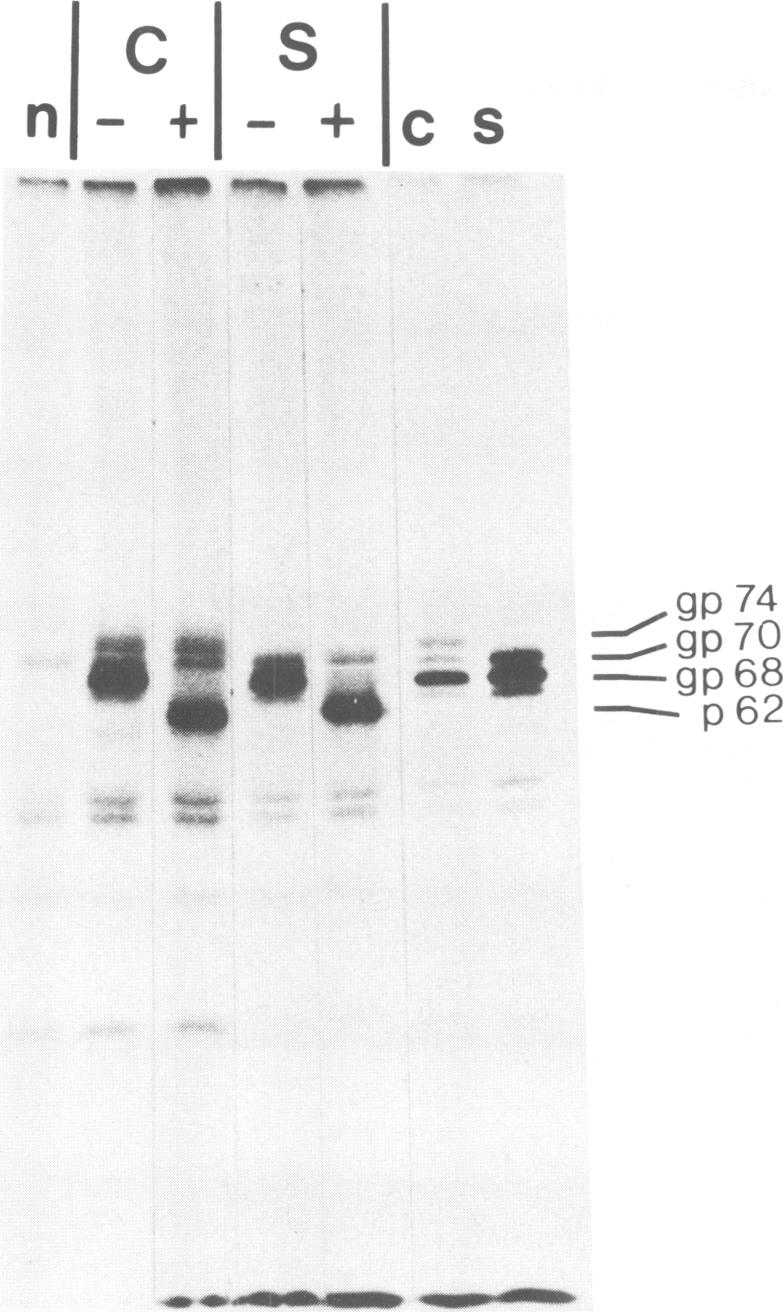
Three glycoprotein-processing inhibitors were used to resolve whether correct glycosylation was required for the oncogenic activity of erb B. The two glucosidase-I inhibitors, 1-deoxynojirimycin and 2,5-dihydroxymethyl 3,4-dihydroxypyrrolidine, arrested processing of v-erb B at the immature 68-kd form whereas, in the presence of the alpha-mannosidase-II inhibitor (swainsonine), cells synthesised an abnormally processed 70-kd form of v-erb B. Transport of incorrectly processed v-erb B to the cell surface was, however, unaffected, suggesting that correct processing is not a prerequisite for intracellular routing of v-erb B. Two systems were used to assess whether incorrectly processed erb B could maintain the transformed state. The first asked whether inhibitor treatment would release temperature-sensitive avian erythroblastosis virus (AEV) transformed erythroblasts kept at the viral permissive temperature from the erb B-induced block in differentiation, as seen when cells are normally shifted to the non-permissive temperature. The second tested the ability of AEV-transformed fibroblasts to grow in soft agar. In both systems, all three processing inhibitors did not alter the transformed phenotype suggesting that correct carbohydrate processing is not required for the transforming activity of erb B. In addition, none of the three processing inhibitors were found to have any effect on the normal maturation of bone marrow CFU-E or induced differentiation of temperature-sensitive AEV-transformed erythroblasts.
使用了三种糖蛋白加工抑制剂来确定erb B的致癌活性是否需要正确的糖基化。两种葡萄糖苷酶I抑制剂,1-脱氧野尻霉素和2,5-二羟甲基3,4-二羟基吡咯烷,使v-erb B的加工停滞在未成熟的68-kd形式,而在α-甘露糖苷酶II抑制剂(苦马豆素)存在的情况下,细胞合成了一种加工异常的70-kd形式的v-erb B。然而,加工错误的v-erb B向细胞表面的转运未受影响,这表明正确的加工不是v-erb B细胞内转运的先决条件。使用了两种系统来评估加工错误的erb B是否能维持转化状态。第一个系统是询问抑制剂处理是否会使在病毒允许温度下保持的温度敏感型禽成红细胞增多症病毒(AEV)转化的成红细胞从erb B诱导的分化阻滞中释放出来,就像正常情况下细胞转移到非允许温度时那样。第二个系统测试了AEV转化的成纤维细胞在软琼脂中生长的能力。在这两个系统中,所有三种加工抑制剂都没有改变转化表型,这表明erb B的转化活性不需要正确的碳水化合物加工。此外,未发现这三种加工抑制剂中的任何一种对骨髓CFU-E的正常成熟或温度敏感型AEV转化的成红细胞的诱导分化有任何影响。