Department of Acupuncture, Guang'anmen Hospital, China Academy of Chinese Medical Sciences, Beijing, China.
Beijing University of Chinese Medicine, Beijing, China.
Acupunct Med. 2018 Aug;36(4):261-266. doi: 10.1136/acupmed-2016-011225. Epub 2018 Jun 16.
To preliminarily explore the effect of electroacupuncture (EA) on bladder and bowel dysfunction in patients with transverse myelitis.
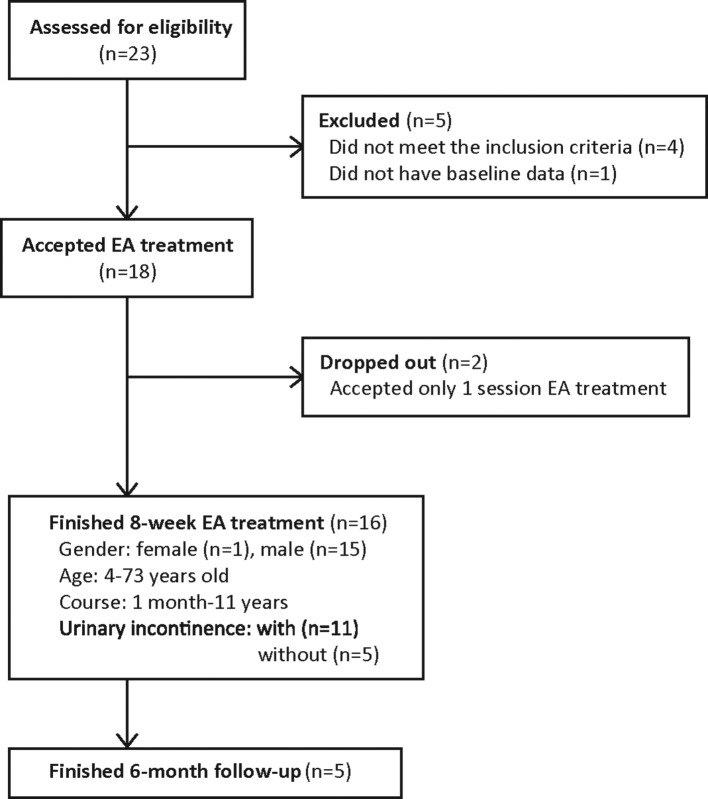
Sixteen participants were treated with EA at bilateral BL32, BL33, and BL35 once a day, five times a week for the first 4 weeks, and once every other day, three times a week for the following 4 weeks. Patients were then followed up for 6 months. Bladder and bowel function, and the safety of EA, were assessed.
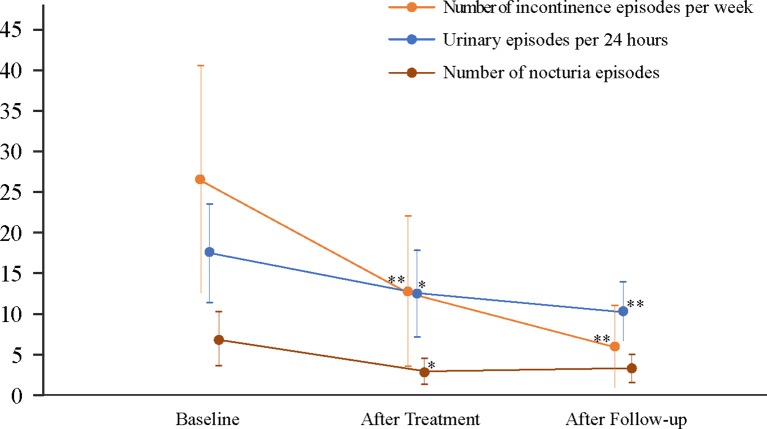
After 8 weeks of treatment, five (5/16, 31%) patients resumed normal voiding, three (6/16, 38%) regained partially normal voiding, and five (5/16, 31%) had no change. After treatment, the residual urine volume decreased by 100 mL (IQR 53-393 mL; P<0.05) in nine patients with bladder voiding dysfunction; in 11 patients with urinary incontinence, the number of weekly urinary incontinence episodes, 24-hour urinary episodes, and nocturia episodes per night diminished by 14 (95% CI 5 to 22), 5 (95% CI 1 to 9), and 4 (95% CI 0 to 7) episodes, respectively (all P<0.05). After 8 weeks of treatment in eight patients with faecal retention, four (4/8, 50%) resumed normal bowel movements, three (3/8, 38%) regained partially normal bowel movements, and one (1/8, 13%) had no change.
EA might be a promising alternative for the management of bladder and bowel dysfunction in patients with transverse myelitis. Randomised controlled trials are needed to confirm the effectiveness and safety of EA for this condition.
初步探讨电针对横断性脊髓炎患者膀胱和肠道功能障碍的影响。
16 名参与者接受双侧 BL32、BL33 和 BL35 的电针治疗,每周 5 次,第 1 至 4 周每天 1 次,第 5 至 8 周每周 3 次,第 9 至 12 周每周 2 次,第 13 至 16 周每周 1 次,共治疗 8 周。然后对患者进行 6 个月的随访,评估膀胱和肠道功能以及电针的安全性。
治疗 8 周后,5 名(5/16,31%)患者恢复正常排尿,3 名(6/16,38%)部分恢复正常排尿,5 名(5/16,31%)无变化。治疗后,9 名膀胱排尿功能障碍患者的残余尿量减少了 100 mL(IQR 53-393 mL;P<0.05);11 名尿失禁患者每周尿失禁次数、24 小时尿失禁次数和夜间每夜夜尿次数分别减少了 14 次(95%CI 5 至 22)、5 次(95%CI 1 至 9)和 4 次(95%CI 0 至 7)(均 P<0.05)。在 8 名有粪便潴留的患者中,治疗 8 周后,4 名(4/8,50%)恢复正常排便,3 名(3/8,38%)部分恢复正常排便,1 名(1/8,13%)无变化。
电针可能是横断性脊髓炎患者膀胱和肠道功能障碍的一种有前途的治疗选择。需要进行随机对照试验来确认电针对这种疾病的有效性和安全性。