Hackett Daniel A, Amirthalingam Theban, Mitchell Lachlan, Mavros Yorgi, Wilson Guy C, Halaki Mark
Discipline of Exercise and Sport Science, The University of Sydney, Sydney, NSW 2141, Australia.
Sports (Basel). 2018 Jan 29;6(1):7. doi: 10.3390/sports6010007.
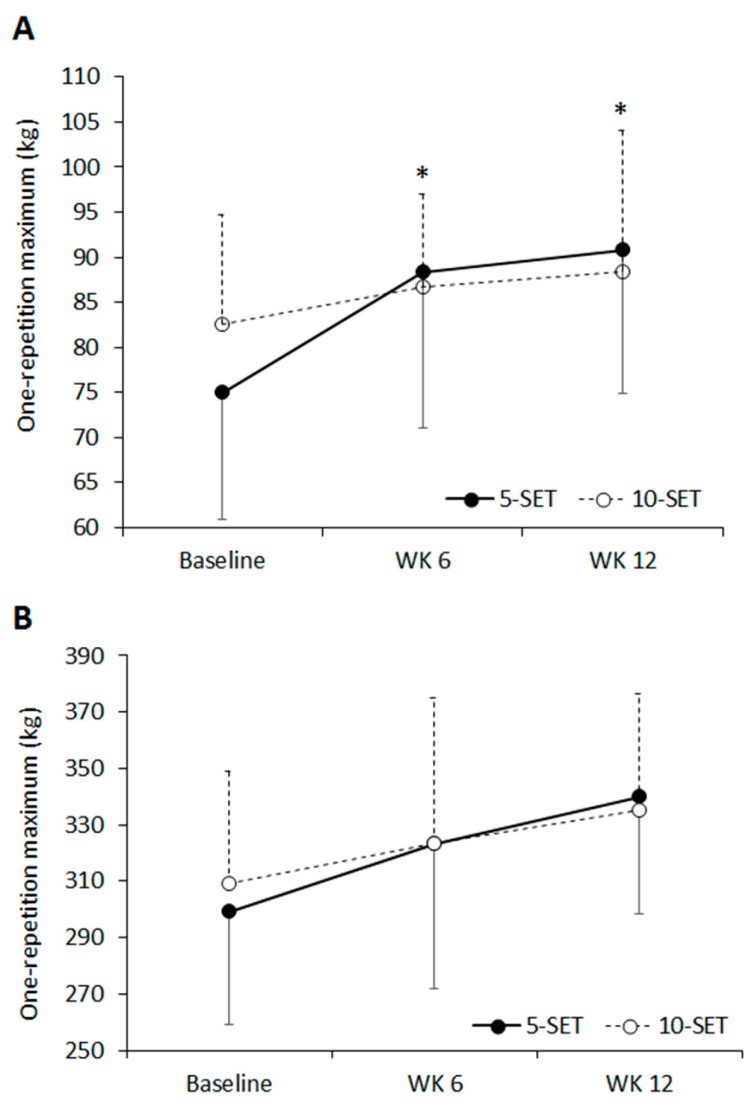
This study investigated the effect of a 12-week modified German Volume Training intervention, or the 10 sets method, on muscle strength and hypertrophy. Twelve healthy males were randomly assigned to either a 5-SET or 10-SET group and performed 5 or 10 sets, respectively, of 10 repetitions at 60⁻80% one-repetition maximum (1RM). Muscle strength and body composition measures were taken at baseline, six weeks, and after 12 weeks of training. No significant changes in total, trunk, and arm lean mass were found within and between groups at any time point. There was no significant difference between groups for lean leg mass. However, a decrease in lean leg mass was observed within the 10-SET group between six and 12 weeks ( = 0.02). An increase in 1RM bench press was found within the 5-SET group at week 6 ( = 0.001) and 12 ( = 0.001) when compared to baseline, while no increases in 1RM leg press were observed at any time point within any group. No significant differences were found for 1RM bench press and leg press between groups. For 1RM bench press moderate effect sizes (ES) favored 5-SET and for 1RM leg press small ESs favored 10-SET. Findings suggest performing >5 sets per exercise does not promote greater gains in muscle strength and hypertrophy. Future research should aim to substantiate these preliminary findings in a larger cohort.
本研究调查了为期12周的改良德国容量训练干预(即10组训练法)对肌肉力量和肥大的影响。12名健康男性被随机分为5组或10组,分别以60⁻80%的一次重复最大值(1RM)进行5组或10组,每组10次重复训练。在基线、6周和训练12周后测量肌肉力量和身体成分指标。在任何时间点,组内和组间的总体、躯干和手臂瘦体重均无显著变化。两组间的腿部瘦体重无显著差异。然而,在10组训练组中,6至12周期间观察到腿部瘦体重有所下降(P = 0.02)。与基线相比,5组训练组在第6周(P = 0.001)和第12周(P = 0.001)时1RM卧推有所增加,而在任何组的任何时间点均未观察到1RM腿举增加。两组间的1RM卧推和腿举无显著差异。对于1RM卧推,中等效应量(ES)有利于5组训练,对于1RM腿举,小效应量有利于10组训练。研究结果表明,每次练习进行超过5组训练并不能促进肌肉力量和肥大的更大增长。未来的研究应旨在以更大的队列证实这些初步发现。