Ozkaya Ozgur, Balci Gorkem Aybars, As Hakan, Vardarli Emre
Coaching Education Department, Faculty of Sport Sciences, Ege University, Izmir 35050, Turkey.
Health Sciences Institution, Ege University, Izmir 35050, Turkey.
Sports (Basel). 2018 Apr 7;6(2):31. doi: 10.3390/sports6020031.
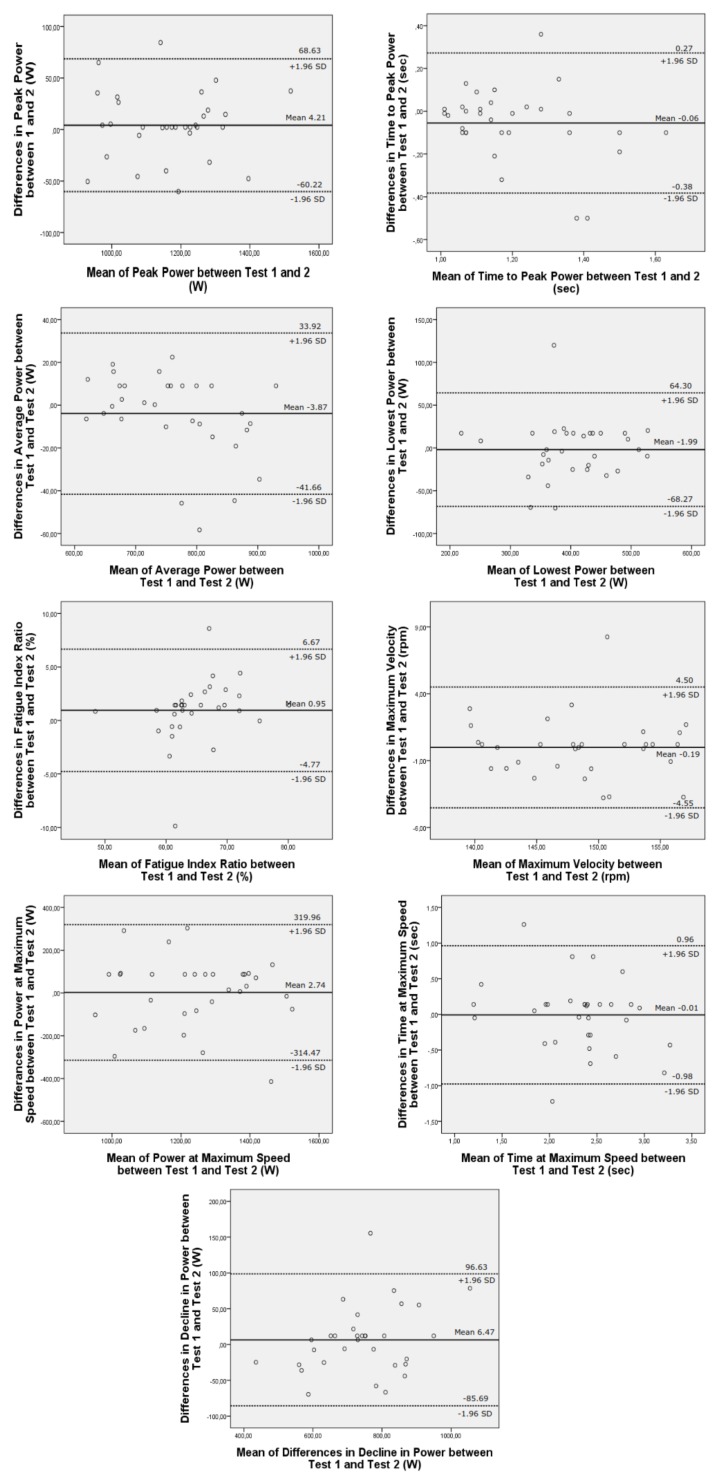
Although reliability correlations of traditional power indices of the Wingate test have been well documented, no study has analyzed new generation power indices based on milliseconds obtained from a Peak Bike. The purpose of this study was to investigate the retest reliability of new generation power indices. Thirty-two well-trained male athletes who were specialized in basketball, football, tennis, or track and field volunteered to take part in the study (age: 24.3 ± 2.2 years; body mass: 77 ± 8.3 kg; height: 180.3 ± 6.3 cm). Participants performed two Wingate all-out sessions on two separate days. Intra-class correlation coefficient (ICC), standard error measurement (SEM), smallest real differences (SRD) and coefficient of variation (CV) scores were analyzed based on the test and retest data. Reliability results of traditional power indices calculated based on 5-s means such as peak power, average power, power drop, and fatigue index ratio were similar with the previous findings in literature (ICC ≥ 0.94; CV ≤ 2.8%; SEM ≤ 12.28; SRD% ≤ 7.7%). New generation power indices such as peak power, average power, lowest power, power drop, fatigue index, power decline, maximum speed as rpm, and amount of total energy expenditure demonstrated high reliability (ICC ≥ 0.94; CV ≤ 4.3%; SEM ≤ 10.36; SRD% ≤ 8.8%). Time to peak power, time at maximum speed, and power at maximum speed showed a moderate level of reliability (ICC ≥ 0.73; CV ≤ 8.9%; SEM ≤ 63.01; SRD% ≤ 22.4%). The results of this study indicate that reliability correlations and SRD% of new generation power and fatigue-related indices are similar with traditional 5-s means. However, new time-related indices are very sensitive and moderately reliable.
尽管温盖特测试传统功率指标的可靠性相关性已有充分记录,但尚无研究分析基于峰值自行车获取的毫秒数的新一代功率指标。本研究的目的是调查新一代功率指标的重测可靠性。32名分别擅长篮球、足球、网球或田径的训练有素的男性运动员自愿参与本研究(年龄:24.3±2.2岁;体重:77±8.3千克;身高:180.3±6.3厘米)。参与者在两个不同日期进行了两次温盖特全力测试。基于测试和重测数据,分析了组内相关系数(ICC)、测量标准误差(SEM)、最小真实差异(SRD)和变异系数(CV)得分。基于5秒均值计算的传统功率指标(如峰值功率、平均功率、功率下降和疲劳指数比)的可靠性结果与文献中先前的研究结果相似(ICC≥0.94;CV≤2.8%;SEM≤12.28;SRD%≤7.7%)。新一代功率指标,如峰值功率、平均功率、最低功率、功率下降、疲劳指数、功率下降率、以每分钟转速计的最大速度和总能量消耗总量,显示出高可靠性(ICC≥0.94;CV≤4.3%;SEM≤10.36;SRD%≤8.8%)。达到峰值功率的时间、最大速度时的时间以及最大速度时的功率显示出中等水平的可靠性(ICC≥0.73;CV≤8.9%;SEM≤63.01;SRD%≤22.4%)。本研究结果表明,新一代功率和疲劳相关指标的可靠性相关性和SRD%与传统的5秒均值相似。然而,新的时间相关指标非常敏感且可靠性中等。