Cavanellas Naasson Trindade, Cossich Victor Rodrigues Amaral, Nicoliche Eduardo Becker, Martins Marilena Bezerra, Sousa Eduardo Branco de, Salles José Inácio
Instituto Nacional de Traumatologia e Ortopedia, Laboratório de Pesquisa Neuromuscular, Rio de Janeiro, RJ, Brazil.
Rev Bras Ortop. 2018 Feb 23;53(2):158-164. doi: 10.1016/j.rboe.2018.02.009. eCollection 2018 Mar-Apr.
Compare the maximal isokinetic muscle strength of knee extensor and flexor muscles between patients with knee osteoarthritis and patients submitted to total knee arthroplasty.
Volunteers were divided into five groups ( = 20): Control; Ahlbäck I and II; Ahlbäck IV; six months after total knee arthroplasty; 12 months after total knee arthroplasty. An isokinetic knee strength evaluation was conducted for the quadriceps and hamstrings at 60°/s.
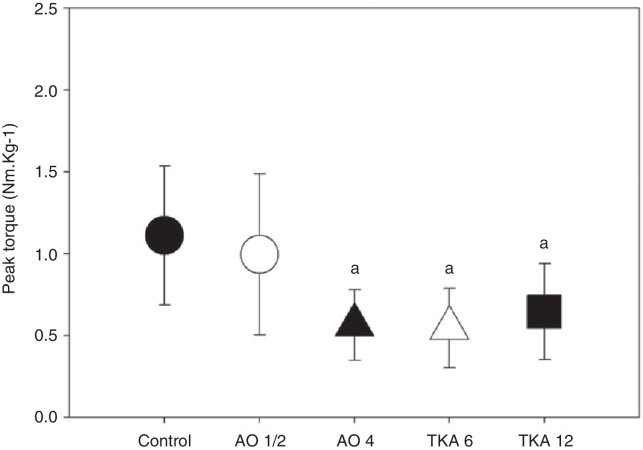
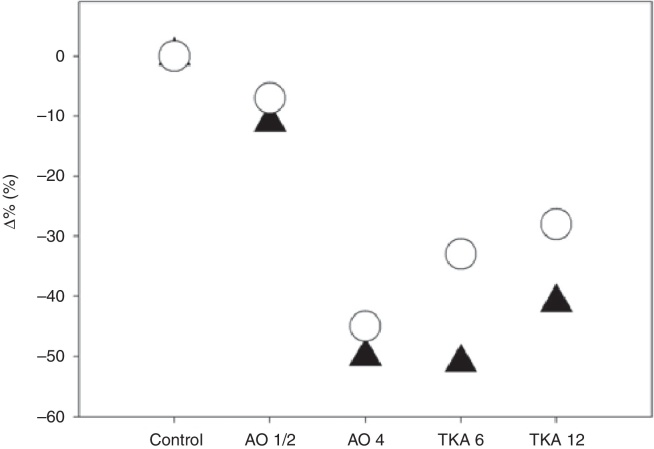
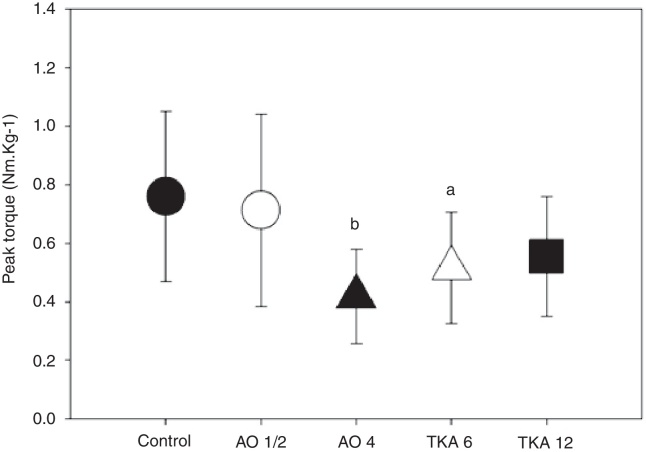
Significant differences in the peak torque of the quadriceps and hamstrings were found among the groups ( < 0.001). The Ahlbäck IV, six-month, and 12-month postoperative groups demonstrated lower values when compared to the Control and Ahlbäck I and II groups. When percentage values were compared to the Control group, mean differences ranged from 7% to 41%.
Patients with healthy knees or early stage osteoarthritis have higher quadriceps and hamstrings strengths than those with a more advanced stage of the disease, even after knee replacement. These findings suggest that the traditional rehabilitation programs do not recover strength to levels observed in individuals without knee osteoarthritis.
比较膝关节骨关节炎患者与接受全膝关节置换术患者的膝关节伸肌和屈肌的最大等速肌力。
志愿者被分为五组(每组 = 20 人):对照组;阿尔贝克 I 型和 II 型;阿尔贝克 IV 型;全膝关节置换术后六个月;全膝关节置换术后 12 个月。以 60°/秒的速度对股四头肌和腘绳肌进行等速膝关节力量评估。
各组之间股四头肌和腘绳肌的峰值扭矩存在显著差异(P < 0.001)。与对照组和阿尔贝克 I 型和 II 型组相比,阿尔贝克 IV 型、术后六个月和术后 12 个月组的值较低。与对照组相比,百分比值的平均差异范围为 7%至 41%。
即使在膝关节置换术后,健康膝关节或早期骨关节炎患者的股四头肌和腘绳肌力量也高于疾病更晚期患者。这些发现表明,传统的康复计划无法将力量恢复到无膝关节骨关节炎个体所观察到的水平。