Gouttebarge Vincent, Aoki Haruhito, Kerkhoffs Gino M M J
World Players' Union (FIFPro), Scorpius 161, 2132 LR, Hoofddorp, The Netherlands.
Department of Orthopaedic Surgery, Academic Medical Center, University of Amsterdam, Amsterdam Movement Sciences, Amsterdam, The Netherlands.
Inj Epidemiol. 2018 Jun 18;5(1):26. doi: 10.1186/s40621-018-0157-8.
As a consequence of severe knee injuries, knee osteoarthritis (OA) seems prevalent in retired professional footballers. However, some epidemiological data remain missing, for instance whether knee OA is also prevalent in current professional footballers, whether knee OA is associated with knee injuries and surgeries, and whether knee OA leads to a lower level of functioning. Therefore, three research questions were answered: (i) what is the prevalence of knee osteoarthritis (OA) among current and retired professional footballers? (ii) is severe knee injury or knee surgery associated with knee OA among current and retired professional footballers? (iii) what are the consequences of knee OA on physical knee function among current and retired professional footballers?
An observational study based on a cross-sectional design by means of questionnaires was conducted. Participants were current and retired professional footballers recruited by the World Players' Union (FIFPro). Information about severe knee injury and knee OA was gathered (medical record or team doctor), while physical knee function was assessed through a validated scale.
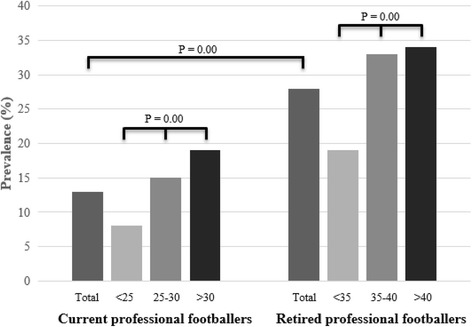
A total of 1360 participants (964 current and 396 retired professional footballers) were enrolled in the study (response rate of 54%). Prevalence of knee OA was 13% among current players and 28% among retired players (p < 0.01), being higher among older players. Current and retired professional footballers were nearly twice as likely to suffer from knee OA by every additional severe knee injury and by every additional knee surgery (risk ratio: 1.72-1.96; p < 0.01). Current and retired professional footballers with knee OA reported a lower level of physical knee function than current and retired players without OA (p < 0.01), their physical knee function being also lower than reference values (adult population, young athletic population and amateur footballers).
The prevalence of knee OA was higher among retired than among current professional footballers and reached up to 40%, leading to negative consequences for their physical knee function. Current and retired professional footballers were nearly twice as likely to suffer from knee OA by every additional severe knee injury and by every additional knee surgery incurred during their career. Management of knee OA should be prioritized among professional footballers, especially to prevent the worsening of the condition during their retirement years.
由于严重的膝关节损伤,膝关节骨关节炎(OA)在退役职业足球运动员中似乎很普遍。然而,一些流行病学数据仍然缺失,例如膝关节OA在现役职业足球运动员中是否也很普遍,膝关节OA是否与膝关节损伤和手术有关,以及膝关节OA是否会导致功能水平降低。因此,回答了三个研究问题:(i)现役和退役职业足球运动员中膝关节骨关节炎(OA)的患病率是多少?(ii)现役和退役职业足球运动员中严重膝关节损伤或膝关节手术与膝关节OA有关吗?(iii)现役和退役职业足球运动员中膝关节OA对膝关节身体功能有什么影响?
通过问卷调查进行了一项基于横断面设计的观察性研究。参与者是由世界球员联盟(国际职业足球运动员联合会)招募的现役和退役职业足球运动员。收集了有关严重膝关节损伤和膝关节OA的信息(病历或队医),同时通过经过验证的量表评估膝关节身体功能。
共有1360名参与者(964名现役和396名退役职业足球运动员)纳入研究(应答率为54%)。现役球员中膝关节OA的患病率为13%,退役球员中为28%(p<0.01),年龄较大的球员中患病率更高。现役和退役职业足球运动员每增加一次严重膝关节损伤和每增加一次膝关节手术,患膝关节OA的可能性几乎是原来的两倍(风险比:1.72 - 1.96;p<0.01)。患有膝关节OA的现役和退役职业足球运动员报告的膝关节身体功能水平低于没有OA的现役和退役球员(p<0.01),他们的膝关节身体功能也低于参考值(成年人群、年轻运动员人群和业余足球运动员)。
退役职业足球运动员中膝关节OA的患病率高于现役职业足球运动员,高达40%,这对他们的膝关节身体功能产生了负面影响。现役和退役职业足球运动员每增加一次严重膝关节损伤和职业生涯中每增加一次膝关节手术,患膝关节OA的可能性几乎是原来的两倍。职业足球运动员中应优先管理膝关节OA,特别是为了防止在他们退役期间病情恶化。