Villalobos García Jesús, Dow Noel, Milne Nicholas, Zhang Jianhua, Naidoo Leslie, Gray Stephen, Duke Mikel
Institute for Sustainable Industries & Liveable Cities, Victoria University, P.O. Box 14428, Melbourne, VIC 8001, Australia.
Australian Textile Mills Pty Ltd., Wangaratta, VIC 3677, Australia.
Membranes (Basel). 2018 Jun 15;8(2):31. doi: 10.3390/membranes8020031.
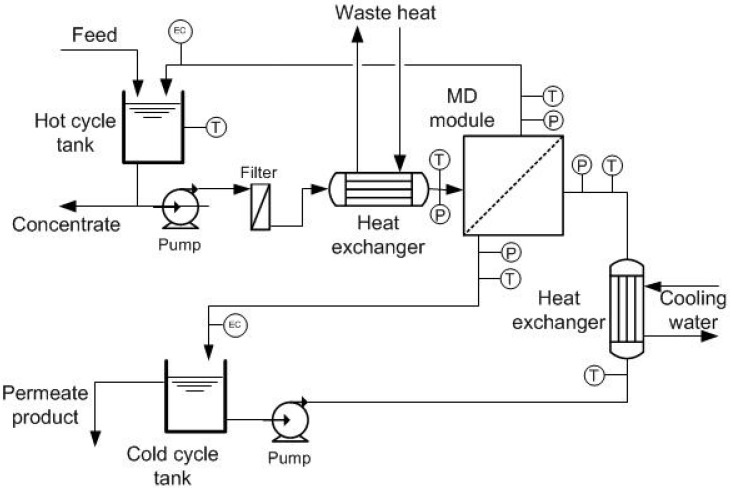
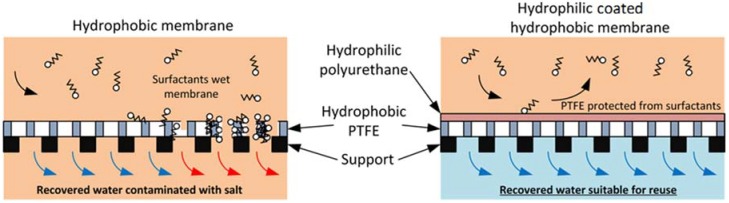
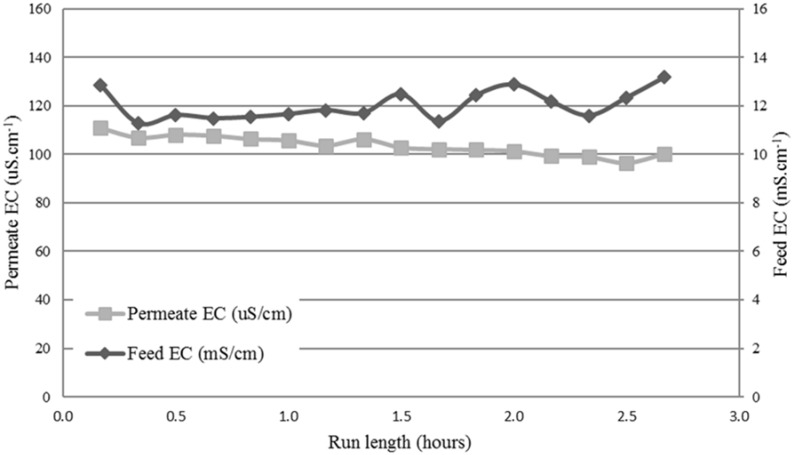
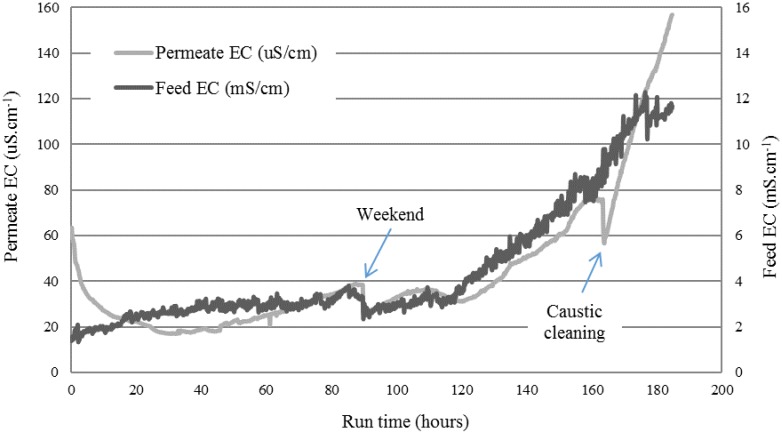
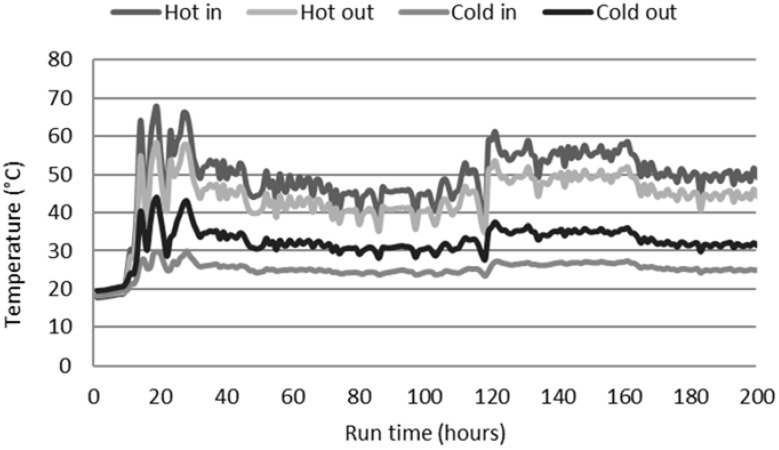
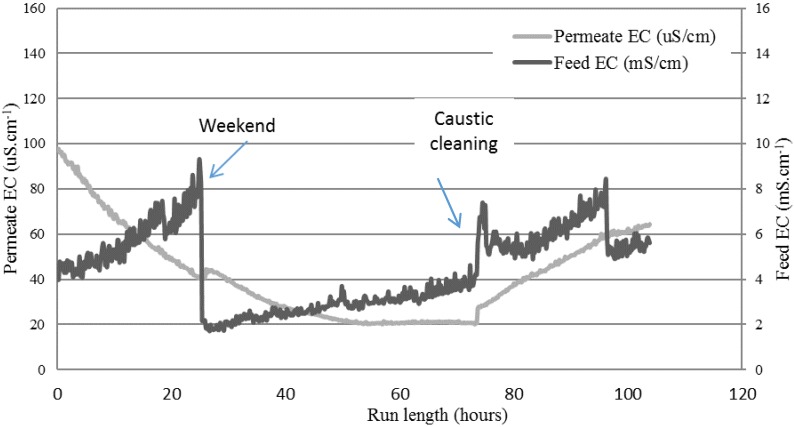
Treating wastewater from textile plants using membrane distillation (MD) has great potential due to the high-salinity wastes and availability of waste heat. However, textile wastewaters also contain surfactants, which compromise the essential hydrophobic feature of the membrane, causing membrane wetting. To address this wetting issue, a custom-made membrane consisting of a hydrophilic layer coated on hydrophobic polytetrafluoroethylene (PTFE) was tested on textile wastewater in a pilot MD setup, and compared with a conventional hydrophobic PTFE membrane. The test was carried out with a feed temperature of 60 °C, and a permeate temperature of 45 °C. The overall salt rejection of both membranes was very high, at 99%. However, the hydrophobic membrane showed rising permeate electrical conductivity, which was attributed to wetting of the membrane. Meanwhile, the hydrophilic-coated membrane showed continually declining electrical conductivity demonstrating an intact membrane that resisted wetting from the surfactants. Despite this positive result, the coated membrane did not survive a simple sodium hydroxide clean, which would be typically applied to a membrane process. This brief study showed the viability of membrane distillation membranes on real textile wastewaters containing surfactants using hydrophilic-coated hydrophobic PTFE, but the cleaning process required for membranes needs optimization.
由于纺织厂废水盐度高且有废热可用,采用膜蒸馏(MD)处理纺织厂废水具有巨大潜力。然而,纺织废水还含有表面活性剂,这会损害膜的基本疏水特性,导致膜湿润。为解决这一湿润问题,在中试MD装置中,对一种由涂覆在疏水性聚四氟乙烯(PTFE)上的亲水层组成的定制膜进行了纺织废水测试,并与传统的疏水性PTFE膜进行了比较。测试在进料温度为60℃、渗透液温度为45℃的条件下进行。两种膜的总脱盐率都非常高,达到99%。然而,疏水膜的渗透液电导率不断上升,这归因于膜的湿润。同时,亲水涂层膜的电导率持续下降这表明膜完好无损,能够抵抗表面活性剂的湿润。尽管取得了这一积极成果,但涂覆膜在通常用于膜工艺的简单氢氧化钠清洗中未能幸存下来。这项简短的研究表明,使用亲水涂层疏水性PTFE的膜蒸馏膜处理含表面活性剂的实际纺织废水是可行的,但膜所需的清洗过程需要优化。